Mariners 2026 Instant Redraft

By Jared Stanger

The deadline for MLB teams to sign their 2026 draftpicks passed yesterday, and it has become a bit of an annual tradition for me to create an instant re-draft of Mariners’ picks that takes into account the factual draft positions and signing bonuses of all players that signed their pro contracts. The rules are pretty simple: 1) I can draft any player at the Mariner pick that was, in fact, still on the board when said pick occurred in the realtime draft, 2) my overall draftboard must fall in line with draft bonus rules.

Reminder of the draft bonus rules for this Mariners’ class: the slot bonus allotment for Seattle rounds 1-10 was $8,218,200. Picks in rounds 11-20 have no slotting rule, but any bonus amount over $150,000 per pick counts towards the $8,218,200 total.

The third thing I kind of try to factor is that I will mostly mirror the Mariners’ draft in terms of positions. If Seattle found their needs ventured more towards bats than pitchers; I would do more bats than pitchers. If Seattle sought to draft a bunch of third basemen; I would draft a bunch of third basemen. I don’t force myself to draft position for position in identical rounds as what Seattle did, but a lot of the time it’s not a crazy stretch to match them up.

I did, however, feel more preference to draft high school players than the Mariners did. The Mariners drafted one high school bat, who they knew was unsignable, and so their completed draft class ends with zero prep players.

#1.24 – 3B, Magnolia Heights HS, Cole Prosek (Bonus $3,247,500)

The M’s first pick went to a college lefthanded-hitting third basemen, and my first pick goes to a prep lefthanded-hitting third basemen. Prosek was actually picked #41 overall by the White Sox, and his signed bonus of $3.25mill would have been a savings of $252k over Ace Reese. Prosek, to this point in his development, seems to have better plate discipline than Reese, while maintaining some of the best in-game power documented in the entire national high school baseball season. To me, this is a no-brainer swap for more upside with less bonus required.

Prosek also has experience as a catcher, and Seattle appeared to have a preference for a catcher that hits lefthanded, as they drafted one and signed a second LH catcher in undrafted free agency.

#2.65 – OF, North Carolina, Owen Hull (Bonus $1,200,000)

The Mariners drafted lefty-hitting outfielder Jake Brown with pick #65 and signed him for $1,382,600. The Red Sox drafted lefty-hitting outfielder Hull two picks later and signed him for $182,600 less than Brown cost. Hull, again, showed a better hit tool with more discipline than Brown. Hull hit .393 with 48 BB and 49 SO in 324 PA, while Brown hit .309 with 23 BB, 32 SO in 194 PA. Brown easily had the bigger power with 16 HR to Hull’s 9. Brown tested at the Combine as having very good running speed, but Hull was easily the better basestealer amongst the two.

#3.101 – SS, Mamaroneck HS, Will Plunkett (Bonus $675,000)

I think the Mariners tragically misread this draftclass, and potentially ignored warning signs about the future of the draft in general, when it came to the prep players. I think there were far better values to be found in the high school ranks than Scott Hunter suggested in his post-draft comments. I think, maybe, Seattle is thinking they have a more abbreviated window to win, and therefore were looking for shortcuts to major league reinforcements by targeting college players. I lowkey wonder if the Seattle scouting department even did their due diligence on this high school class, or if they allocated an extreme majority of their scouting personnel and time resources to focus on college players.

Anyways…Plunkett was on my shortlist before the draft, and seeing him sign with the Orioles for this low of a bonus was too good to pass up. The Orioles drafted him at pick #230 in the 8th round, but gave him closer to 3rd round money, which is where I’m taking him.

#4.129 – RHP, Georgia, Dylan Vigue (Bonus $622,500)

The Mariners drafted college RHP Nathan Taylor in the 3rd round and signed him for $778,200. I’m getting college RHP Vigue in the 4th round for about $156k savings. The Mariners seemed to have a preference for SEC players throughout this draft, so it’s odd to me they went for the more expensive Taylor out of a Big12 school instead of Vigue from Georgia on a pretty big savings.

Vigue looked so much like a Mariner kind of arm to me pre-draft, and for him to fall to the 7th round was kind of shocking. The one thing I see from Taylor that might have pulled Seattle more towards him than Vigue was the control. Taylor averaged 2.7 BB/9 whereas Vigue averaged 5.1. But that isn’t unusual. Bryce Miller averaged 5.9 BB/9 coming out of college. That has never been a deal-breaker for Seattle’s pitching lab.

#5.162 – 3B, Tennessee, Henry Ford (Bonus $335,900)

Whenever I saw that the Mariners’ actual draftpick felt like the best fit for round and bonus; I was open to matching their pick. I liked Ford’s righthanded power, and he signed for exactly slot money. The way this draft played out; I was able to draft Ford a round earlier than Seattle actually took him while still achieving the rest of my desired picks.

#6.191 – 2B, Iowa, Gable Mitchell (Bonus $5,000)

I’m really not a big fan of drafting guys and underslotting them this severely. Minor league pay is barely a living wage, so a lot of these guys will be surviving off of their signing bonus for their minor league careers. In the case of Mitchell; I had flagged him as a guy I was targeting to draft anyways, and then his signing bonus he received from the Blue Jays made it possible for me to target other, more expensive players elsewhere. The Jays drafted him at pick #193, so we snipe him two picks early.

#7.220 – OF, Marist HS, Martin Shelar (Bonus $1,500,000)

Pre-draft I really wanted to get Shelar, and I was willing to spend my second round pick and pay him overslot money in order to secure him. It turns out it wouldn’t have taken much more than the second round money of $1,382,600, and we could have drafted him as late as the M’s pick in the 8th round. The Red Sox eventually took him with pick #274.

#8.250 – C, Cal Poly, Ryan Tayman (Bonus $204,700)

The Mariners drafted their lone catcher, Mason Eckelman, in this exact spot, but they paid him $220,900. Tayman saves us $16k, but arguably brings a better defensive catcher profile.

#9.280 – RHP, Oregon State, Wyatt Queen (Bonus $275,000)

I had Queen in some of my earlier mock drafts, so after Seattle actually drafted this local product; I figured I should keep him. The M’s drafted him at pick #340 and paid him $275k. That means $125k of that bonus counts towards Seattle’s bonus pool. I’m sort of cutting out the middle man and putting him in the 9th round.

#10.310 – OF, Pittsburgh, Lorenzo Carrier (Bonus $70,000)

In addition to the Mariners focusing exclusively on college players, they also seemed to only target college players that were 21 years old (give or take a few months). They really didn’t draft any “senior-sign” players. So they didn’t want 18 year olds, but they also didn’t want 23 year olds. Carrier is the latter, so it seems pretty likely they overlooked him for what will inevitably be an arbitrary reason. Carrier rakes, and he’s a steal at $70k.

#11.340 – RHP, St Joseph’s, Christian Coppola (Bonus $150,000)

It’s not totally clear at first blush which pitchers the Mariners actually drafted will begin their pro careers as starters and which will immediately be placed in relief roles. My revisionist draft has some similar lack of clarity. I think Queen and Coppola (and maybe others later) might be given the chance to start initially.

Coppola was actually drafted at pick #369, which is the pick immediately preceding their pick at #370, so it serves to wonder if they might have taken him there if he lasted one more pick.

#12.370 – RHP, UNCW, Connor Marshburn (Bonus $200,000)

Marshburn was another late round pick that Seattle dipped into their bonus pool to sign. He has been exclusively a starter in the last two seasons at UNCW. I liked the pick so I kept it the same for this exercise.

#13.400 – RHP, Coastal Carolina, Darin Horn (Bonus $100,000)

Horn is another guy that might have been wholesale excluded from the Mariners’ board as a 23 y/o. He’s an interesting profile in that he’s a college bullpen long reliever. He pitched 67.1 innings this year in 31 appearances, which averages out to over two innings per game. He also struck out over 12 per nine innings while never operating with premium velocity. The guy just knows how to spin it. If you can add some velocity in a pro system; this would be a great value.

#14.430 – 3B, Oregon, Drew Smith (Bonus $25,000)

This is probably the most forced pick I’ve made in this draft. The Mariners drafted four third basemen (one of which did not sign), and I only managed two through my first 13 picks. Smith hit .342/.425/1.047 with 16 homers this year for the Ducks. He really wasn’t on my radar much before the draft, but seemed a decent value play this late in the draft.

#15.460 – OF, Minnesota, Charlie Sutherland (Bonus $150,000)

Sutherland was the rare case of a player that was nowhere near my radar before the draft, but the selection by Seattle brough him to my attention and I quite liked the pick. The Mariners did this weird thing where they sacrificed plate discipline for power early in the draft, but then in later rounds they flipped it and went after hitterish traits while foregoing power. Sutherland only hit 11 homeruns, but he got on-base at a .434 clip and walked 29 times to 31 strikeouts. Plus, when I studied him, he comes across with strong leadership. My kind of guy.

#16.490 – RHP, Vanderbilt, Alex Kranzler (Bonus $150,000)

These next two picks came to my attention after the college regular season, and during the MLB Draft League, where pitch metrics were more readily accessible to the public. Kranzler made four starts to go along with fifteen relief appearances this year for Vanderbilt. He followed that up with five starts in the MLBDL where he posted a 2.35 ERA, 23 SO, 10 BB, 10 H across 23 innings. This is a guy I would love to see the Seattle pitching lab get their hands on.

#17.520 – LHP, Bowling Green, Ethan Stade (Bonus $50,000)

Stade was the other MLBDL pitcher I liked. He made ten starts for Bowling Green, and then another four in the the Draft League where he was striking out 17.2 batters per nine innings. There is just so much potential upside here from a late-round starting lefthanded pitcher. I far prefer this upside to that of the lone LHP Seattle drafted, Chris Torres.

#18.550 – 1B, Baylor, Tyce Armstrong (Bonus $100,000)

Armstrong had some of the best righthanded power still left on the board this late. He hit .338/.453/1.211 with 24 homeruns this year for Baylor. He gives you roughly the same strikeout rate as Ace Reese, but seventeen rounds later.

The Mariners didn’t draft a first baseman anywhere in this class, but with two un-signed draftpicks, I took the liberty of replacing one of them with a 1B.

#19.580 – SS, Nebraska, Dylan Carey (Bonus NA)

Seattle only drafted one shortstop this class, which (again) is a little unusual, but I replace one of their unsigned picks with Carey who plays a very strong defensive SS, while also hitting 15 homers. He’s just a little old. Carey was an undrafted signee by the Mets, so I don’t have a reported signing bonus, but most UDFA sign for very little money.

#20.610 – RHP, East Texas Baptist, Isaac Thornton (Bonus NA)

A pick this late in the draft is basically forced to be transposed from the list of signed, undrafted players. In this case, I place one of Seattle’s own UDFA signings into the ranks of their drafted players. Thornton has a big frame at 6’5″ that could, potentially, add some velocity as he strengthens his 185lb body. He seems to control the zone well at 110 strikeouts to 29 walks in 102 innings this year.

After all of these picks and their bonuses, I calculate Seattle would have had $32,600 of bonus still remaining. I’m going to give all of that money to Gable Mitchell after the fact to bring his bonus up to $37,600.
Mariner penultimate mock

By Jared Stanger

The MLB Draft begins five days from today, and we actually have some new intel to use when attempting to predict what the Mariners will do. Mariner Director of Amateur Scouting, Scott Hunter, held his annual media huddle a few days ago and gave some surprisingly candid answers about how Seattle is evaluating this draft class.

“Because we do have a lot of pitching…I don’t think we’re in any area that we say we ‘need’ but maybe, if anything, maybe some college outfielders or high school outfielders that fit the next wave.”

JFC…not only did he go as far as to say hitters, but he kind of led with college hitters, and then went even further to specify college outfield hitters. That’s crazy to be that transparent. This could be a few things:

  1. Hunter could be trying to misdirect people away from their true interest(s). I kinda don’t think this is it, because when you look at the Mariner major league roster combined with their top prospects on the farm…they have literally six starters in their MLB rotation, plus an injured Logan Evans who has big league innings, plus Kade Anderson who is MLB-ready now, plus Ryan Sloan who may be ready by September-ish. Then, Seattle has two young middle infielders on the MLB starting lineup with promising early returns and tons of club control, plus Michael Arroyo recently promoted to AAA, plus Felnin Celesten tearing up high-A. The thing Seattle really needs is a bat or two that can eventually join Julio Rodriguez in the major league outfield as Randy Arozerana heads to free agency immediately, and Luke Raley and Victor Robles expire soon thereafter. The outfielders on the farm basically start and end with Lazaro Montes (also just promoted to AAA), and Jonny Farmelo whose multiple injuries have slowed his development.
  2. Hunter could know that picking as late as #1.24, subterfuge really won’t make much of a difference to what the league and the Mariners will do.
  3. Hunter could see that there are enough players of a similar scouting grade that they won’t lose a particular player before pick because they don’t have a particular player they are targeting.
  4. The Mariners may have in mind to overdraft a player from farther down the consensus board in order to sign him for underslot money, which can then be redirected to other players in later rounds.
  5. Some combination of multiple ideas on this list.

It’s probably #5.

Regardless of reasoning; I thought it might be worthwhile to at least indulge this idea and see what a mock draft might look like with the Mariners looking to draft for need in the first round.

I’ve seen at least two mocks released in the last 48 hours that have the Mariners drafting a college outfielder, including Keith Law who has them drafting Virginia outfielder AJ Gracia. I typically don’t see Gracia available at #24, so I kinda doubt it. I’d like the pick, but I just don’t think he lasts. The other draft I saw had them picking Texas outfielder Aiden Robbins. Not a terrible pick. I like that Robbins is righthanded, and the Mariner farm seems to go heavily lefty-hitting. Righthanded hitting is certainly what the Mariner big league roster needs. Or at least someone that can hit lefthanded pitching well. I think I have some righthanded bats coming up later on that allow me to go with my preferred OF name at #24.

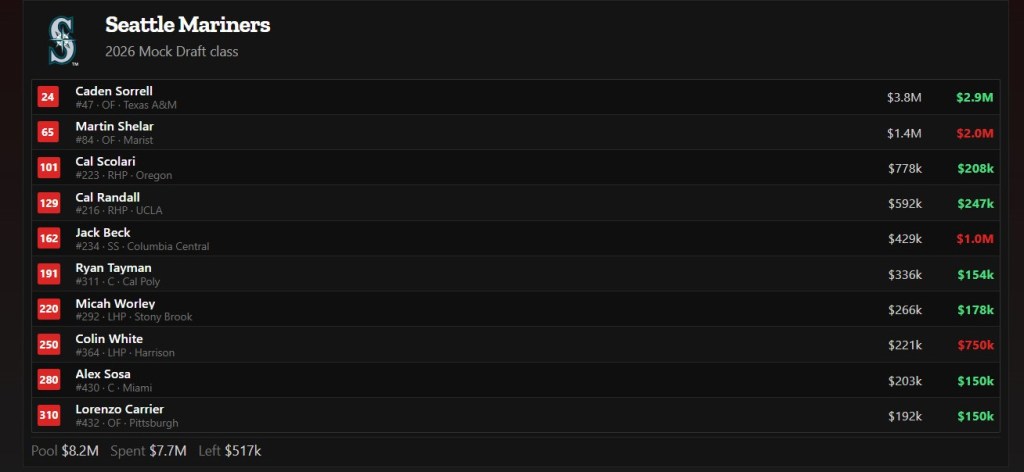
#1.24 – OF, Texas A&M, Caden Sorrell ($2.9mill bonus)

I’m going with Sorrell over Robbins because I tend to prefer his intangibles, and maybe a slight edge to him in terms of his defense. Sorrell has played some CF, but he probably settles in to a corner outfield spot. Sorrell is 6’3″/210lbs, and has hit at least .275 in all three of his college seasons, with him improving each year to his .341/.434/1.177 slash this year with 23 HR, 76 RBI, 20 doubles, 11 SB, 33 BB, 61 SO.

Sorrell was ranked much higher in big boards earlier in the season, but he has fallen over time, but I’m not totally sure why. He has had a totally respectable season. He is in the top 15-20 in the country in a number of offensive categories. If you eliminate underclassmen, Sorrell is arguably a top-10 college bat. The fact that he has dropped on the big board may help Seattle out by making him more likely to sign for underslot money.

#2.65 – OF, Marist HS, Martin Shelar ($2.0mill bonus)

It doesn’t take long to get a righthanded power-hitting outfielder after passing on one in the first. Since doing a deep-dive on Shelar after his performance at the MLB Draft Combine; I’ve really fallen in love with his potential. I like Blake Bowen, too, but in the mock draft simulator; Shelar is a more bonus-friendly signing than Bowen while sacrificing none of the upside. So that’s an easy call for me.

#3.101 – RHP, Oregon, Cal Scolari ($208k bonus)

When I mock-draft; it’s tough for me to go dominant on either hitting or pitching. I tend to land closer to a balanced draft than not. So it’s tough for me to not get a starting pitcher somewhere here in my top four picks before the board really falls away of potential MLB caliber arms. I would really like to draft Ben Blair or Jacob Dudan if either, for some reason, falls to this pick, but in the simulator they never do. Dylan Vigue is generally available here, and I like him for Seattle, but his signing bonus “demand” in the simulator was preventive for me doing other things I plan on doing later in this mock.

Scolari is a 6’4″/220lb starter that posted a 3.32 ERA, 1.386 WHIP, 13.4 SO/9, 5.5 BB/9. The fastball is up to 96mph, and there’s a very strong present curveball, with a promising slider as his third offering. It’s not the sexiest pick…he’s struggled more with control than I typically like, and his velocity is a tick or two below where it starts to get pretty sexy…but this is a very solid pick for the third round. Mariner pitching lab do your thing.

#4.129 – RHP, UCLA, Cal Randall ($247k bonus)

Similar to how the farm needs to be restocked with outfield talent; we might need to add 1-2 high profile, fast-rising relief arms. We don’t currently have many arms that look like a future closer. Randall is a big kid at 6’4″/235lbs and he’s already throwing 100mph. That velo helped him strikeout 16.5 hitters per nine. The control needs a bit of work at 5.5 BB/9, but guys couldn’t hit him…he only allowed 4.4 H/9. We’ve seen Seattle take on guys like that and make adjustments that led to better control. Andres Munoz was at 5.4 BB/9 as a minor leaguer in the Padre system, Bryce Miller actually averaged 5.9 BB/9 in his final college season before Seattle drafted him, farmhand Brock Moore was drafted with a 5.8 BB/9 rate for Oregon and that is currently down to 4.1 in 2026 in the minors…there is improvement they could make here with Randal.

#5.162 – SS/3B, Columbia Central HS, Jack Beck ($1.0mill bonus)

Beck was another guy that flashed at the Combine and I started to dig into his profile. Listed at 6’3″/210lbs; Beck was absolutely crushing balls at the combine with premium exit velocities for all players let alone the high school ranks. He may currently be a shortstop, but his projection (and the Mariners’ needs) could push him to third base, which would lowkey be perfect for the M’s. They need to get more righthanded in the infield, but it currently looks like lefties Colt Emerson and Cole Young will be manning SS and 2B for years to come. A righty at third would be ideal.

As with all of my prep picks in this mock draft; part of the interest here with Beck is the signing bonus. I am hunting value more than I would in a year the Mariners have more bonus slot flexibility. Every dollar counts more this year.

#6.191 – C, Cal Poly, Ryan Tayman ($154k bonus)

There are a handful of catchers that I really like in this draft class. I am landing on Tayman for his combination of skillsets with the bat and the glove. Plus, there is a good chance I can get a second of my guys later on. Tayman hit .357/.447/1.119 with 18 HR this year, and he’s young for the class as a guy that won’t turn 21 until this August.

#7.220 – LHP, Stony Brook, Micah Worley ($178k bonus)

Worley was on my shortlist of interesting midround college LHP, and then he touched 98mph at the Combine. Let’s go. He’s 6’5″/230lbs and pitched to a 3.12 ERA, 1.255 WHIP, 12.1 SO/9 for the season.

#8.250 – LHP, Harrison HS, Colin White ($750k bonus)

I found White when it started to appear that I couldn’t/shouldn’t take prep LHP Carson Bolemon with our first round pick. I made a targeted search of the bulk of prep lefties. White stood out as a 6’3″/205lb southpaw with a 95mph fastball and pretty advanced feel for his slider. He’s a bit overaged already being 19 y/o, and he has a college commitment to Florida, which may be pricey to buy out of.

In terms of baseball mock draft strategies; it’s not the worst idea to draft a tough-sign prep player in rounds 8-10 where the bonus is only slotted for $221-$192k, then if he doesn’t sign you can move the surplus over to a prep player you draft in round 11.

#9.280 – 1B/C, Miami, Alex Sosa ($150k bonus)

This mock became a little TOO righthand-heavy from the bats, so I had to lock in Sosa. I’ve had him in some of my previous mocks, and this is the latest I’ve mocked him. It may be too late, but the simulator allows it for now. He has experience as a catcher, and a lefthanded catcher is a great bonus, but I’m totally fine moving him permanently to first base, which is where he played most of his games for Miami this year.

#10.310 – OF, Pittsburgh, Lorenzo Carrier ($150k bonus)

Carrier is a tremendous hitter, but falls late in the draft as a 23 y/o senior sign player. He’s a nice counterbalance to the lefthanded OF Sorrell and the youth of Shelar. If Seattle gets two of the three to the majors; this will be an excellent draft class as viewed from the future.

#11.340 – RHP, Olathe West HS, Max Hamilton ($667k bonus)

As you can see from my screencap of this simulation of this mock; after my top ten rounds I had a bonus surplus of $517k. And that doesn’t include a potential bump of an additional $529k if they don’t sign Colin White. If you add the non-penalty max bonus for players drafted in rounds 11-20 of $150k; we can pay Hamilton $667k if we sign White, and we can pay him $1.196mill if we don’t sign White.

Hamilton is a prep player that got some innings throwing in the MLB Draft League to primarily college hitters. And he looked great. He struck out 11 to only 2 walks across 5.2 innings in two appearances.

#12.370 – LHP, Bowling Green, Ethan Stade

Stade was a guy I had flagged, like Worley, from the regular season as a LHP that I had interest in. He has pushed himself over the top with his performance in the Draft League where his SO/9 has jumped from 14.5 in college season to a staggering 17.2 across 14.2 innings in the MLBDL. Another guy with prototypical pitcher size at 6’4″/220lbs. His fastball is only topping out at 91.2mph, but he makes 7′ of extension down the mound, and the pitch moves 12.9″ IVB and another -15.6″ HB. And his armslot works great with his primary secondary: slider. If we can add some velocity, maybe with a move to the bullpen, this could be Brandyn Garcia 2.0. They drafted Garcia in the 11th round in 2023 and he powered through the minors in under two years.

#13.400 – SS, Nebraska, Dylan Carey

Unlike basically every other year; I don’t think of shortstop as a huge need for Seattle this draft. I took Beck earlier as a SS, but already thinking he might be a future 3B. Carey is a college shortstop who I think sticks at SS. If we can get a future utility infielder out of him; I think that’s great value for this round of the draft.

In 2026, Carey hit .353/.428/1.050 with 15 HR and played some great defense at SS.

#14.430 – C, VMI, Cole Raile

Raile kind of reminds me of Daulton Varsho a few years ago. He’s a catcher but he has such impressive athleticism that he might end up in the outfield. He hit .347/.435/1.099 with 16 HR and 24 SB. He also has one of the better catcher arms I’ve seen.

#15.460 – RHP, Oregon State, Wyatt Queen

Queen was a reliable setup man out of the Beavers’ bullpen where he pitched a 2.49 ERA, 1.128 WHIP, and 14.9 SO/9 using an elite curveball and a solid slider. Originally out of Lake Stevens, WA, this would be a homecoming for Queen.

#16.490 – 1B, Baylor, Tyce Armstrong

In 2023, the Mariners signed Hunter Fitz-Gerald as an undrafted free agent after he hit .316/.403/1.061 with 22 HR for Old Dominion. Fitz has turned into a decent player in the Mariner system, currently hitting .271 with 19 HR in 77 games in a notoriously pitcher-friendly ballpark in the M’s double-A Arkansas affiliate. I think Tyce Armstrong could be that kind of player. He hit .338/.453/1.211 this year for Baylor while adding 24 HR. He just turned 23 y/o on Friday, so he likely signs for a lower bonus amount.

#17.520 – RHP, Coastal Carolina, Darin Horn

Horn is a 6’4″/200lb, lanky long-reliever for the Chanticleers who pitched 67.1 innings across 31 relief appearances (avg appearance: over 2.0 innings). He’s not big on velo, but the guy can spin the ball like crazy. I’m thinking future Cooper Criswell vibes. He kind of has reverse splits on his sinker which gets 20-21″ of horizontal break to only 5-10″ of induced vertical break. He currently only sits at 87mph, so we’ll need to get him in the weight room and in to gas camp ASAP.

#18.550 – 2B, Iowa, Gable Mitchell

This draft is so heavy towards the righthanded hitting side that I’m trying to force some lefties in where I can. At second base I like Kyle Morrison for Southern Mississippi, and Mitchell from Iowa. I’m taking Mitchell, who has the lesser power, but the better plate discipline and the better defense. He played 47 games at shortstop for the Hawkeyes in 2025, but projects primarily as a 2B down the road. He only struck out 18 times (31 BB) in 270 plate appearances this year.

#19.580 – RHP, Clemson, Hayden Simmerson

Simmerson is another pure reliever I found across my study of the class that piqued my interest. Listed 6’2″/205lbs, he finished the year with a 3.62 ERA, 0.897 WHIP, 12.8 SO/9 in 32.1 innings out of the bullpen. Fastball profile has a nice floor.

#20.610 – 3B, Toledo, Troy Sudbrook

Just to round out my draft, I looked to add a college third baseman to fill out a minor league roster. Sudbrook hit .373/.467/1.132 with 11 HR, but an impressive 32 doubles for the year. If he can add some strength; this could be a sneaky pick.

Ultimately, it will be interesting to see if an outfielder falls to Seattle at pick #24, if they strategically force one as an underslot pick, or if they actually draft for best player available, which may put them back in position of drafting another high-end pitcher.