The Seahawks will be playing their final preseason game in a matter of hours, and tomorrow marks week zero of the college football season, so I’ve done some tape grinding for the last week to get us a mock draft for the upcoming 2027 Draft.
The Seahawks have stacked themselves one hell of a draft board for this year after scoring compensatory picks for the loss of Nolan Teasley to Minnesota GM as a minority candidate, plus projected comp picks for the loss of Boye Mafe, Ken Walker, Riq Woolen, and Coby Bryant. They lost their native 4th round pick for trading into the 2026 Draft to get Beau Stephens, but they may earn an additional 7th rounder for the trade of Mike Jerrell two years ago. The current capital adds up to twelve picks. I’ve done some research (with the help of OTC), and this work has yielded an overall Seahawk draft board that will look something like this:
I used a mock draft simulator parallel to my theoretical mock, but the simulator is not accurate to the number and placement of the Seahawks’ picks. But I don’t mind it as I expect Seattle to use some of that capital for player trades now, before the regular season starts, and/or during the trade deadline. Coming out of the draft with ten total picks seems reasonable.
The next piece of information to consider going into the scouting season, for me, is the impending free agents Seattle will potentially be losing. This list currently includes: Uchenna Nwosu, Dante Fowler, Mike Morris, Zach Charbonnet, Emmanuel Wilson, Drew Lock, Anthony Bradford, Olu Oluwatimi, Noah Igbinoghene, Trevon Diggs. After extending Leonard Williams this week; there are really only 1-3 starters the team might need to replace. Which is wild.
The combination of huge draft capital and hardly any dire needs is why I think the Seahawks will win Super Bowl #3 in 2028 and not 2027 after this season.
I like Seattle to start the draft by trading down their first pick and moving up their second. I like drafting twice in the #35-55 range.
I tend to think the Seahawks’ first pick this year will be an Edge Rusher. I suspect the scouting department had taken a peek at the 2026 Edge class, and then looked ahead to the 2027 class, and decided they could get their long-term replacement for Boye Mafe in 2027 (and after signing Fowler as a stop-gap).
#2.43 – Edge, Louisville, Clev Lubin
As I alluded to earlier…this is essentially the replacement for Boye Mafe who was temporarily replaced by Dante Fowler. This needs to be a speed rusher for quick wins. Lubin is being listed by Louisville at 6’3″/260lbs currently, which is perfect size for the role Seattle needs to fill. In 2025 Lubin posted 13.5 TFL and 8.5 sacks after transferring from Coastal Carolina where he had 12.0 TFL and 9.5 sacks. He also had 11.5 sacks and 23.5 TFL in 2023 at JUCO Iowa Western. So he’s had success every year, every time he has leveled-up.
2026 Top ACC Returners to Watch: 𝐂𝐥𝐞𝐯 𝐋𝐮𝐛𝐢𝐧‼️@ClevLubin is back at Louisville after earning 3rd Team All-ACC honors in 2025. He was T4th in the ACC with 8.5 SK & 7th with 13.5 TFL. He led the P4 with a 24% pass-rush win rate@LouisvilleFB | @GoCards | #GoCardspic.twitter.com/8vEYOgdNKC
Arguably, the biggest need for the Seahawks will be to replace their starter at right guard, Anthony Bradford. Maybe somebody currently on the roster will earn promotion to the starting role, but I haven’t really seen enough from anyone to think that. Plus, I think there are some strong options in the draft. This could be a tackle they move inside to guard, but I like Tengesdahl quite a bit and he will simply need to move from left guard to right.
Tengesdahl is listed 6’3″/325lbs, which marks a nice middle point between the 335lbs of Bradford, and the 307lbs of Mason Richman or 308lbs of Bryce Cabeldue. I think he’s got the perfect temperament for replacing Bradford, as well. He’s got some of that “warrior in the garden” that Mike Macdonald has said he is looking for. Plus, he’s outstanding in zone scheme.
Not only is Drew Lock about to be a free agent, but I suspect we’re about to see Jalen Milroe get a full preseason game to showcase how little he has developed. I look at the 2027 QB class, and I think there’s a ton of depth, so locating a backup QB should be relatively easy. I think we could be looking for a backup with upside.
I loved Mensah before the 2025 season after he transferred from Tulane to Duke. Now, after transferring from Duke to Miami; Mensah could, honestly, be in the pole position for the Heisman after following in the portal footsteps of Carson Beck last year and Cam Ward in 2024. I think he might be closer to the Cam Ward tract. But for now; Mensah is available in the middle of the 3rd round, so I’m taking him there. Not far off from the Russell Wilson pick in 2012.
Mensah is listed at 6’3″/218lbs. He was the #21 passer in the country last year, and he will be joining a stacked roster with better OL and better weapons on the Hurricanes. I like him to climb from his already respectable draft projection.
The (kinda) only negative on the fit for Mensah and the Seahawks is that Darian isn’t much of a runner, and I think Macdonald wants a QB that can run. At least he hasn’t been asked to do that to this point. He kinda looks more like Sam Darnold in that regard.
Similar to QB; I’m already a little skeptical about the type of runner I’m projecting for Macdonald. I think he might want a bit of a bigger back that will be more complimentary to Jadarian Price, who is only 209lbs. Haynes is listed 5’11″/210lbs by the Yellowjackets. Zach Charbonnet is more the profile I think we may need, and he is listed 6’1″/220lbs. That may not seem like a huge difference, but I tend to think it is. At 220lbs, you’re bigger than most modern safeties, and with proper momentum; you can put a hurting on many modern linebackers. But I just really like Haynes’ overall profile.
Last year, at Michigan, Haynes had one of the better explosive-run rates in the country.
The wide receiver room is actually in pretty good shape going into next off-season in terms of club control. But they could, potentially, look to get out ahead of cutting some of their less-healthy, less-productive receivers at the bottom of the depth chart. Jake Bobo will be coming back from major knee surgery. Tory Horton has had multiple injuries. Ricky White has only played in two games and has yet to see a target as a pro. Emmanuel Henderson might be more of a return specialist so that Rashid Shaheed can focus on offense. I just think any of these guys can be upgraded.
Barkate actually made the same transfer that Mensah made, as both were playing for Duke last year. Barkate, however, transferred to Duke from Harvard the year prior. So, yeah, this is a very smart player. And I love his tape. Listed 6’1″/195lbs, Barkate had 72 catches for 1106 yards last year.
I think Corner is a pretty high want/need for the Seahawks right now. I think they wanted a corner at the trade deadline while Riq Woolen was under contract, I think they wanted a corner in free agency, I think they wanted a corner early on draft weekend, I think they wanted a corner before agreeing to deal(s) with Terrion Arnold and Trevon Diggs, and I think they want a corner after agreeing with Arnold and Diggs. The only reason I’m waiting until the fourth round to draft one is because I happen to really like Zeke Berry, who is insanely under-ranked to start the year. He probably won’t get out of the 2nd round by the time the draft actually rolls around.
Listed 5’11″/196lbs, Berry had 1 INT, 10 PBU last year, but more importantly…he’s got some of the best pure coverage skill I’ve seen this early in the cycle.
Zeke Berry is the stickiest '27 CB I've watched (aside from Leonard Moore) and the most composed/precise at the catch point. Top-40 player/CB5 on my board heading into the year pic.twitter.com/6bqsp14V4o
The Seahawks need, at minimum, a replacement for backup Center next offseason. Listed 6’2″/315lbs; Evans will slide into the opening vacated by Oluwatimi hitting free agency.
Nebraska OC, Justin Evans, is one of my favorite prospects in the entire class
A player who has good athleticism, great with his hands in pass protection, anchors well, and has awesome finishing ability
Safety may not be a need for Seattle at all, but when you have 12 picks; you can draft pretty much every position group. I wasn’t even, technically, looking for safeties when I found Bryant. I was actually looking at a teammate of his, but then Ty popped on the tape.
Listed 6’0″/198lbs, Bryant had 4 INT, 1 PBU, 76 tackles, and 2 TFL last year.
#5.176 – Defensive line, Notre Dame, Francis Brewu
I’ll be curious if the Seahawks look to address more positions along the defensive line. They could double down on Edge with both Nwosu and Fowler becoming free agents. They could target a bigger hybrid DT/DE profile with Mike Morris becoming a free agent. They could look to finally address nose-tackle in a more substantive way. I’ve got Seattle taking Brewu who is listed 6’1″/285lbs as more of the Mike Morris profile. Better yet…let’s dare to dream on Brewu being the Mike Bennett profile.
There is NO way that Fletcher is available this late, but for now I’m psyched to get a second RB that could actually start this late. Fletcher is listed 6’2″/225lbs and would immediately slot in as a replacement for Emanuel Wilson, who is a similar size.
In 2025, Fletcher ran for 1192 yards and 12 TD’s. He has some of the best contact balance in the country.
The Seahawks could be looking to add two QB’s this offseason. It’s unlikely they would add two that were rookies, but if you’re drafting one in the 7th round, you probably can sneak him to the practice squad. Then, you sign a vet QB on a one-year deal to be the actual 2027 backup.
Brown is a unicorn in this QB class. Listed 6’3″/235lbs…Brown is an absolute tank of a man at QB. In 2025, he passed for 3158 yards, 28 TD, 7 INT, and he RAN for an additional 1008 yards and 14 TD on the ground. That is the real lede of the story. Macdonald wants this profile. But it’s gotta work.
The deadline for MLB teams to sign their 2026 draftpicks passed yesterday, and it has become a bit of an annual tradition for me to create an instant re-draft of Mariners’ picks that takes into account the factual draft positions and signing bonuses of all players that signed their pro contracts. The rules are pretty simple: 1) I can draft any player at the Mariner pick that was, in fact, still on the board when said pick occurred in the realtime draft, 2) my overall draftboard must fall in line with draft bonus rules.
Reminder of the draft bonus rules for this Mariners’ class: the slot bonus allotment for Seattle rounds 1-10 was $8,218,200. Picks in rounds 11-20 have no slotting rule, but any bonus amount over $150,000 per pick counts towards the $8,218,200 total.
The third thing I kind of try to factor is that I will mostly mirror the Mariners’ draft in terms of positions. If Seattle found their needs ventured more towards bats than pitchers; I would do more bats than pitchers. If Seattle sought to draft a bunch of third basemen; I would draft a bunch of third basemen. I don’t force myself to draft position for position in identical rounds as what Seattle did, but a lot of the time it’s not a crazy stretch to match them up.
I did, however, feel more preference to draft high school players than the Mariners did. The Mariners drafted one high school bat, who they knew was unsignable, and so their completed draft class ends with zero prep players.
The M’s first pick went to a college lefthanded-hitting third basemen, and my first pick goes to a prep lefthanded-hitting third basemen. Prosek was actually picked #41 overall by the White Sox, and his signed bonus of $3.25mill would have been a savings of $252k over Ace Reese. Prosek, to this point in his development, seems to have better plate discipline than Reese, while maintaining some of the best in-game power documented in the entire national high school baseball season. To me, this is a no-brainer swap for more upside with less bonus required.
Prosek also has experience as a catcher, and Seattle appeared to have a preference for a catcher that hits lefthanded, as they drafted one and signed a second LH catcher in undrafted free agency.
INF Cole Prosek (MS) reached base all 6 times w/ 2 hits & 4 BB's, including a laced PS 2B. Fast bat & one of the best prep hit tools in the country. Entered game batting .581 w/ 17 HR this spring. Pure hitter. #HottyToddy commit #PGHS@maghtsbaseball@PG_Draftpic.twitter.com/yc5xpEbmpO
#2.65 – OF, North Carolina, Owen Hull (Bonus $1,200,000)
The Mariners drafted lefty-hitting outfielder Jake Brown with pick #65 and signed him for $1,382,600. The Red Sox drafted lefty-hitting outfielder Hull two picks later and signed him for $182,600 less than Brown cost. Hull, again, showed a better hit tool with more discipline than Brown. Hull hit .393 with 48 BB and 49 SO in 324 PA, while Brown hit .309 with 23 BB, 32 SO in 194 PA. Brown easily had the bigger power with 16 HR to Hull’s 9. Brown tested at the Combine as having very good running speed, but Hull was easily the better basestealer amongst the two.
#3.101 – SS, Mamaroneck HS, Will Plunkett (Bonus $675,000)
I think the Mariners tragically misread this draftclass, and potentially ignored warning signs about the future of the draft in general, when it came to the prep players. I think there were far better values to be found in the high school ranks than Scott Hunter suggested in his post-draft comments. I think, maybe, Seattle is thinking they have a more abbreviated window to win, and therefore were looking for shortcuts to major league reinforcements by targeting college players. I lowkey wonder if the Seattle scouting department even did their due diligence on this high school class, or if they allocated an extreme majority of their scouting personnel and time resources to focus on college players.
Anyways…Plunkett was on my shortlist before the draft, and seeing him sign with the Orioles for this low of a bonus was too good to pass up. The Orioles drafted him at pick #230 in the 8th round, but gave him closer to 3rd round money, which is where I’m taking him.
SS Will Plunkett '26 Mamaroneck (NY) Binghamtom commit
Crushed homer 💣 to dead center for Plunkett. Impressive, under the radar player who moves extremely well for his size (6'3-195). Draft sleeper 😴 pic.twitter.com/up6zG8qphC
The Mariners drafted college RHP Nathan Taylor in the 3rd round and signed him for $778,200. I’m getting college RHP Vigue in the 4th round for about $156k savings. The Mariners seemed to have a preference for SEC players throughout this draft, so it’s odd to me they went for the more expensive Taylor out of a Big12 school instead of Vigue from Georgia on a pretty big savings.
Vigue looked so much like a Mariner kind of arm to me pre-draft, and for him to fall to the 7th round was kind of shocking. The one thing I see from Taylor that might have pulled Seattle more towards him than Vigue was the control. Taylor averaged 2.7 BB/9 whereas Vigue averaged 5.1. But that isn’t unusual. Bryce Miller averaged 5.9 BB/9 coming out of college. That has never been a deal-breaker for Seattle’s pitching lab.
— PG College Baseball (@PGCollegeBall) April 9, 2026
#5.162 – 3B, Tennessee, Henry Ford (Bonus $335,900)
Whenever I saw that the Mariners’ actual draftpick felt like the best fit for round and bonus; I was open to matching their pick. I liked Ford’s righthanded power, and he signed for exactly slot money. The way this draft played out; I was able to draft Ford a round earlier than Seattle actually took him while still achieving the rest of my desired picks.
— PG College Baseball (@PGCollegeBall) May 26, 2026
#6.191 – 2B, Iowa, Gable Mitchell (Bonus $5,000)
I’m really not a big fan of drafting guys and underslotting them this severely. Minor league pay is barely a living wage, so a lot of these guys will be surviving off of their signing bonus for their minor league careers. In the case of Mitchell; I had flagged him as a guy I was targeting to draft anyways, and then his signing bonus he received from the Blue Jays made it possible for me to target other, more expensive players elsewhere. The Jays drafted him at pick #193, so we snipe him two picks early.
#7.220 – OF, Marist HS, Martin Shelar (Bonus $1,500,000)
Pre-draft I really wanted to get Shelar, and I was willing to spend my second round pick and pay him overslot money in order to secure him. It turns out it wouldn’t have taken much more than the second round money of $1,382,600, and we could have drafted him as late as the M’s pick in the 8th round. The Red Sox eventually took him with pick #274.
Party out front. ‼️
2026 OF Martin Shelar leads off the game with an absolute no-doubter to LCF.
#8.250 – C, Cal Poly, Ryan Tayman (Bonus $204,700)
The Mariners drafted their lone catcher, Mason Eckelman, in this exact spot, but they paid him $220,900. Tayman saves us $16k, but arguably brings a better defensive catcher profile.
I had Queen in some of my earlier mock drafts, so after Seattle actually drafted this local product; I figured I should keep him. The M’s drafted him at pick #340 and paid him $275k. That means $125k of that bonus counts towards Seattle’s bonus pool. I’m sort of cutting out the middle man and putting him in the 9th round.
— Oregon State Baseball (@BeaverBaseball) March 21, 2026
#10.310 – OF, Pittsburgh, Lorenzo Carrier (Bonus $70,000)
In addition to the Mariners focusing exclusively on college players, they also seemed to only target college players that were 21 years old (give or take a few months). They really didn’t draft any “senior-sign” players. So they didn’t want 18 year olds, but they also didn’t want 23 year olds. Carrier is the latter, so it seems pretty likely they overlooked him for what will inevitably be an arbitrary reason. Carrier rakes, and he’s a steal at $70k.
#11.340 – RHP, St Joseph’s, Christian Coppola (Bonus $150,000)
It’s not totally clear at first blush which pitchers the Mariners actually drafted will begin their pro careers as starters and which will immediately be placed in relief roles. My revisionist draft has some similar lack of clarity. I think Queen and Coppola (and maybe others later) might be given the chance to start initially.
Coppola was actually drafted at pick #369, which is the pick immediately preceding their pick at #370, so it serves to wonder if they might have taken him there if he lasted one more pick.
Exciting introduction to Christian Coppola (@christiancppla) this fall 💪
9.2 IP with 15 Ks 🔥 .152 Opponent AVG & 31.2% K% 47% Breaking Ball CSW% 🦍
Marshburn was another late round pick that Seattle dipped into their bonus pool to sign. He has been exclusively a starter in the last two seasons at UNCW. I liked the pick so I kept it the same for this exercise.
Horn is another guy that might have been wholesale excluded from the Mariners’ board as a 23 y/o. He’s an interesting profile in that he’s a college bullpen long reliever. He pitched 67.1 innings this year in 31 appearances, which averages out to over two innings per game. He also struck out over 12 per nine innings while never operating with premium velocity. The guy just knows how to spin it. If you can add some velocity in a pro system; this would be a great value.
— Coastal Carolina Baseball (@CoastalBaseball) March 6, 2023
#14.430 – 3B, Oregon, Drew Smith (Bonus $25,000)
This is probably the most forced pick I’ve made in this draft. The Mariners drafted four third basemen (one of which did not sign), and I only managed two through my first 13 picks. Smith hit .342/.425/1.047 with 16 homers this year for the Ducks. He really wasn’t on my radar much before the draft, but seemed a decent value play this late in the draft.
#15.460 – OF, Minnesota, Charlie Sutherland (Bonus $150,000)
Sutherland was the rare case of a player that was nowhere near my radar before the draft, but the selection by Seattle brough him to my attention and I quite liked the pick. The Mariners did this weird thing where they sacrificed plate discipline for power early in the draft, but then in later rounds they flipped it and went after hitterish traits while foregoing power. Sutherland only hit 11 homeruns, but he got on-base at a .434 clip and walked 29 times to 31 strikeouts. Plus, when I studied him, he comes across with strong leadership. My kind of guy.
#16.490 – RHP, Vanderbilt, Alex Kranzler (Bonus $150,000)
These next two picks came to my attention after the college regular season, and during the MLB Draft League, where pitch metrics were more readily accessible to the public. Kranzler made four starts to go along with fifteen relief appearances this year for Vanderbilt. He followed that up with five starts in the MLBDL where he posted a 2.35 ERA, 23 SO, 10 BB, 10 H across 23 innings. This is a guy I would love to see the Seattle pitching lab get their hands on.
Stade was the other MLBDL pitcher I liked. He made ten starts for Bowling Green, and then another four in the the Draft League where he was striking out 17.2 batters per nine innings. There is just so much potential upside here from a late-round starting lefthanded pitcher. I far prefer this upside to that of the lone LHP Seattle drafted, Chris Torres.
𝑺𝒕𝒂𝒅𝒆 𝑲'𝒔 𝒕𝒉𝒆 𝒔𝒊𝒅𝒆 🐶
Ethan Stade starts his night by striking out the side! 👀 🤩
Armstrong had some of the best righthanded power still left on the board this late. He hit .338/.453/1.211 with 24 homeruns this year for Baylor. He gives you roughly the same strikeout rate as Ace Reese, but seventeen rounds later.
The Mariners didn’t draft a first baseman anywhere in this class, but with two un-signed draftpicks, I took the liberty of replacing one of them with a 1B.
Seattle only drafted one shortstop this class, which (again) is a little unusual, but I replace one of their unsigned picks with Carey who plays a very strong defensive SS, while also hitting 15 homers. He’s just a little old. Carey was an undrafted signee by the Mets, so I don’t have a reported signing bonus, but most UDFA sign for very little money.
#20.610 – RHP, East Texas Baptist, Isaac Thornton (Bonus NA)
A pick this late in the draft is basically forced to be transposed from the list of signed, undrafted players. In this case, I place one of Seattle’s own UDFA signings into the ranks of their drafted players. Thornton has a big frame at 6’5″ that could, potentially, add some velocity as he strengthens his 185lb body. He seems to control the zone well at 110 strikeouts to 29 walks in 102 innings this year.
After all of these picks and their bonuses, I calculate Seattle would have had $32,600 of bonus still remaining. I’m going to give all of that money to Gable Mitchell after the fact to bring his bonus up to $37,600.
The MLB Draft begins five days from today, and we actually have some new intel to use when attempting to predict what the Mariners will do. Mariner Director of Amateur Scouting, Scott Hunter, held his annual media huddle a few days ago and gave some surprisingly candid answers about how Seattle is evaluating this draft class.
“Because we do have a lot of pitching…I don’t think we’re in any area that we say we ‘need’ but maybe, if anything, maybe some college outfielders or high school outfielders that fit the next wave.”
JFC…not only did he go as far as to say hitters, but he kind of led with college hitters, and then went even further to specify college outfield hitters. That’s crazy to be that transparent. This could be a few things:
Hunter could be trying to misdirect people away from their true interest(s). I kinda don’t think this is it, because when you look at the Mariner major league roster combined with their top prospects on the farm…they have literally six starters in their MLB rotation, plus an injured Logan Evans who has big league innings, plus Kade Anderson who is MLB-ready now, plus Ryan Sloan who may be ready by September-ish. Then, Seattle has two young middle infielders on the MLB starting lineup with promising early returns and tons of club control, plus Michael Arroyo recently promoted to AAA, plus Felnin Celesten tearing up high-A. The thing Seattle really needs is a bat or two that can eventually join Julio Rodriguez in the major league outfield as Randy Arozerana heads to free agency immediately, and Luke Raley and Victor Robles expire soon thereafter. The outfielders on the farm basically start and end with Lazaro Montes (also just promoted to AAA), and Jonny Farmelo whose multiple injuries have slowed his development.
Hunter could know that picking as late as #1.24, subterfuge really won’t make much of a difference to what the league and the Mariners will do.
Hunter could see that there are enough players of a similar scouting grade that they won’t lose a particular player before pick because they don’t have a particular player they are targeting.
The Mariners may have in mind to overdraft a player from farther down the consensus board in order to sign him for underslot money, which can then be redirected to other players in later rounds.
Some combination of multiple ideas on this list.
It’s probably #5.
Regardless of reasoning; I thought it might be worthwhile to at least indulge this idea and see what a mock draft might look like with the Mariners looking to draft for need in the first round.
I’ve seen at least two mocks released in the last 48 hours that have the Mariners drafting a college outfielder, including Keith Law who has them drafting Virginia outfielder AJ Gracia. I typically don’t see Gracia available at #24, so I kinda doubt it. I’d like the pick, but I just don’t think he lasts. The other draft I saw had them picking Texas outfielder Aiden Robbins. Not a terrible pick. I like that Robbins is righthanded, and the Mariner farm seems to go heavily lefty-hitting. Righthanded hitting is certainly what the Mariner big league roster needs. Or at least someone that can hit lefthanded pitching well. I think I have some righthanded bats coming up later on that allow me to go with my preferred OF name at #24.
I’m going with Sorrell over Robbins because I tend to prefer his intangibles, and maybe a slight edge to him in terms of his defense. Sorrell has played some CF, but he probably settles in to a corner outfield spot. Sorrell is 6’3″/210lbs, and has hit at least .275 in all three of his college seasons, with him improving each year to his .341/.434/1.177 slash this year with 23 HR, 76 RBI, 20 doubles, 11 SB, 33 BB, 61 SO.
Sorrell was ranked much higher in big boards earlier in the season, but he has fallen over time, but I’m not totally sure why. He has had a totally respectable season. He is in the top 15-20 in the country in a number of offensive categories. If you eliminate underclassmen, Sorrell is arguably a top-10 college bat. The fact that he has dropped on the big board may help Seattle out by making him more likely to sign for underslot money.
Home run No. 23 for the No. 23 draft prospect 💪
Caden Sorrell goes yard for the second time in his last four games.
— Baseball America (@BaseballAmerica) May 15, 2026
#2.65 – OF, Marist HS, Martin Shelar ($2.0mill bonus)
It doesn’t take long to get a righthanded power-hitting outfielder after passing on one in the first. Since doing a deep-dive on Shelar after his performance at the MLB Draft Combine; I’ve really fallen in love with his potential. I like Blake Bowen, too, but in the mock draft simulator; Shelar is a more bonus-friendly signing than Bowen while sacrificing none of the upside. So that’s an easy call for me.
Farmhand's Draft Watch:
OF: Martin Shelar (Marist HS, GA)
A @HailStateBB commit Shelar is one of the top players coming out of the state of Georgia showing the ability to make consistent hard contact as shown by his 16 homers this spring (leads all of Georgia) good… pic.twitter.com/e0qeBopyd4
When I mock-draft; it’s tough for me to go dominant on either hitting or pitching. I tend to land closer to a balanced draft than not. So it’s tough for me to not get a starting pitcher somewhere here in my top four picks before the board really falls away of potential MLB caliber arms. I would really like to draft Ben Blair or Jacob Dudan if either, for some reason, falls to this pick, but in the simulator they never do. Dylan Vigue is generally available here, and I like him for Seattle, but his signing bonus “demand” in the simulator was preventive for me doing other things I plan on doing later in this mock.
Scolari is a 6’4″/220lb starter that posted a 3.32 ERA, 1.386 WHIP, 13.4 SO/9, 5.5 BB/9. The fastball is up to 96mph, and there’s a very strong present curveball, with a promising slider as his third offering. It’s not the sexiest pick…he’s struggled more with control than I typically like, and his velocity is a tick or two below where it starts to get pretty sexy…but this is a very solid pick for the third round. Mariner pitching lab do your thing.
Cal Scolari (@calscolari) looked the part of one of the best Sunday arms in the country in @OregonBaseball's series-clinching win at UC Santa Barbara 💪
Similar to how the farm needs to be restocked with outfield talent; we might need to add 1-2 high profile, fast-rising relief arms. We don’t currently have many arms that look like a future closer. Randall is a big kid at 6’4″/235lbs and he’s already throwing 100mph. That velo helped him strikeout 16.5 hitters per nine. The control needs a bit of work at 5.5 BB/9, but guys couldn’t hit him…he only allowed 4.4 H/9. We’ve seen Seattle take on guys like that and make adjustments that led to better control. Andres Munoz was at 5.4 BB/9 as a minor leaguer in the Padre system, Bryce Miller actually averaged 5.9 BB/9 in his final college season before Seattle drafted him, farmhand Brock Moore was drafted with a 5.8 BB/9 rate for Oregon and that is currently down to 4.1 in 2026 in the minors…there is improvement they could make here with Randal.
#5.162 – SS/3B, Columbia Central HS, Jack Beck ($1.0mill bonus)
Beck was another guy that flashed at the Combine and I started to dig into his profile. Listed at 6’3″/210lbs; Beck was absolutely crushing balls at the combine with premium exit velocities for all players let alone the high school ranks. He may currently be a shortstop, but his projection (and the Mariners’ needs) could push him to third base, which would lowkey be perfect for the M’s. They need to get more righthanded in the infield, but it currently looks like lefties Colt Emerson and Cole Young will be manning SS and 2B for years to come. A righty at third would be ideal.
As with all of my prep picks in this mock draft; part of the interest here with Beck is the signing bonus. I am hunting value more than I would in a year the Mariners have more bonus slot flexibility. Every dollar counts more this year.
A name that has been shooting up draft boards going into this summers MLB Draft. Has had multiple scouts/cross checkers at every game this spring.
Physical frame at 6-foot-2, 215 pounds with a strong lower-half. ATHLETE with 6.5 sixty speed. Has… pic.twitter.com/tS5j12qPtV
— Prep Baseball Tennessee (@PrepBaseballTN) May 8, 2026
#6.191 – C, Cal Poly, Ryan Tayman ($154k bonus)
There are a handful of catchers that I really like in this draft class. I am landing on Tayman for his combination of skillsets with the bat and the glove. Plus, there is a good chance I can get a second of my guys later on. Tayman hit .357/.447/1.119 with 18 HR this year, and he’s young for the class as a guy that won’t turn 21 until this August.
Ryan Tayman has been one of the best catchers in college baseball all season.
.362/.453/.681 18 2B 18 HR 56 RBIs 15.83 DRS
Now he'll try to lead @CalPolyBSB to its first-ever College World Series appearance.
Worley was on my shortlist of interesting midround college LHP, and then he touched 98mph at the Combine. Let’s go. He’s 6’5″/230lbs and pitched to a 3.12 ERA, 1.255 WHIP, 12.1 SO/9 for the season.
#StonyBrook lefty Micah Worley (Sr./‘26 elig.) showcased a strong four-pitch mix, headlined by a lively run/ride FB up to 93 (90-92/~2300), generating whiffs at the top of the zone. Mixed in a tight hz SL (82-84/2436) and 1-7 CB (76-79/2365) w/ late vt bite. Feel to land the BBs… pic.twitter.com/wgVG0W67Cx
#8.250 – LHP, Harrison HS, Colin White ($750k bonus)
I found White when it started to appear that I couldn’t/shouldn’t take prep LHP Carson Bolemon with our first round pick. I made a targeted search of the bulk of prep lefties. White stood out as a 6’3″/205lb southpaw with a 95mph fastball and pretty advanced feel for his slider. He’s a bit overaged already being 19 y/o, and he has a college commitment to Florida, which may be pricey to buy out of.
In terms of baseball mock draft strategies; it’s not the worst idea to draft a tough-sign prep player in rounds 8-10 where the bonus is only slotted for $221-$192k, then if he doesn’t sign you can move the surplus over to a prep player you draft in round 11.
Filthy.
Massive scout contingent in attendance and the high-octane stuff was on full display from 2026 LHP Colin White.
This mock became a little TOO righthand-heavy from the bats, so I had to lock in Sosa. I’ve had him in some of my previous mocks, and this is the latest I’ve mocked him. It may be too late, but the simulator allows it for now. He has experience as a catcher, and a lefthanded catcher is a great bonus, but I’m totally fine moving him permanently to first base, which is where he played most of his games for Miami this year.
#10.310 – OF, Pittsburgh, Lorenzo Carrier ($150k bonus)
Carrier is a tremendous hitter, but falls late in the draft as a 23 y/o senior sign player. He’s a nice counterbalance to the lefthanded OF Sorrell and the youth of Shelar. If Seattle gets two of the three to the majors; this will be an excellent draft class as viewed from the future.
Lorenzo Carrier is the senior breakout of the year so far. In 18 games the @Pitt_BASE OF is slashing .516/.644/1.145 with 10 HR, 5 doubles and 2 triples. He hit 18 HR in 131 games from 2022–25. Already set or tied career bests in HR, RBIs, SB and triples. pic.twitter.com/pKK1XpIRxt
#11.340 – RHP, Olathe West HS, Max Hamilton ($667k bonus)
As you can see from my screencap of this simulation of this mock; after my top ten rounds I had a bonus surplus of $517k. And that doesn’t include a potential bump of an additional $529k if they don’t sign Colin White. If you add the non-penalty max bonus for players drafted in rounds 11-20 of $150k; we can pay Hamilton $667k if we sign White, and we can pay him $1.196mill if we don’t sign White.
Hamilton is a prep player that got some innings throwing in the MLB Draft League to primarily college hitters. And he looked great. He struck out 11 to only 2 walks across 5.2 innings in two appearances.
𝗛𝗮𝗺𝗶𝗹𝘁𝗼𝗻 𝗞’𝘀 𝘁𝗵𝗲 𝘀𝗶𝗱𝗲 𝗶𝗻 𝘁𝗵𝗲 𝟰𝘁𝗵🤩🦌
Max Hamilton (@SCSpikes) grabs three more strikeouts for a total of 8️⃣ through 3.1 innings.👀
Stade was a guy I had flagged, like Worley, from the regular season as a LHP that I had interest in. He has pushed himself over the top with his performance in the Draft League where his SO/9 has jumped from 14.5 in college season to a staggering 17.2 across 14.2 innings in the MLBDL. Another guy with prototypical pitcher size at 6’4″/220lbs. His fastball is only topping out at 91.2mph, but he makes 7′ of extension down the mound, and the pitch moves 12.9″ IVB and another -15.6″ HB. And his armslot works great with his primary secondary: slider. If we can add some velocity, maybe with a move to the bullpen, this could be Brandyn Garcia 2.0. They drafted Garcia in the 11th round in 2023 and he powered through the minors in under two years.
𝑺𝒕𝒂𝒅𝒆 𝑲'𝒔 𝒕𝒉𝒆 𝒔𝒊𝒅𝒆 🐶
Ethan Stade starts his night by striking out the side! 👀 🤩
Unlike basically every other year; I don’t think of shortstop as a huge need for Seattle this draft. I took Beck earlier as a SS, but already thinking he might be a future 3B. Carey is a college shortstop who I think sticks at SS. If we can get a future utility infielder out of him; I think that’s great value for this round of the draft.
In 2026, Carey hit .353/.428/1.050 with 15 HR and played some great defense at SS.
— Nebraska Baseball (@HuskerBaseball) May 29, 2026
#14.430 – C, VMI, Cole Raile
Raile kind of reminds me of Daulton Varsho a few years ago. He’s a catcher but he has such impressive athleticism that he might end up in the outfield. He hit .347/.435/1.099 with 16 HR and 24 SB. He also has one of the better catcher arms I’ve seen.
Queen was a reliable setup man out of the Beavers’ bullpen where he pitched a 2.49 ERA, 1.128 WHIP, and 14.9 SO/9 using an elite curveball and a solid slider. Originally out of Lake Stevens, WA, this would be a homecoming for Queen.
In 2023, the Mariners signed Hunter Fitz-Gerald as an undrafted free agent after he hit .316/.403/1.061 with 22 HR for Old Dominion. Fitz has turned into a decent player in the Mariner system, currently hitting .271 with 19 HR in 77 games in a notoriously pitcher-friendly ballpark in the M’s double-A Arkansas affiliate. I think Tyce Armstrong could be that kind of player. He hit .338/.453/1.211 this year for Baylor while adding 24 HR. He just turned 23 y/o on Friday, so he likely signs for a lower bonus amount.
Horn is a 6’4″/200lb, lanky long-reliever for the Chanticleers who pitched 67.1 innings across 31 relief appearances (avg appearance: over 2.0 innings). He’s not big on velo, but the guy can spin the ball like crazy. I’m thinking future Cooper Criswell vibes. He kind of has reverse splits on his sinker which gets 20-21″ of horizontal break to only 5-10″ of induced vertical break. He currently only sits at 87mph, so we’ll need to get him in the weight room and in to gas camp ASAP.
Reminder:
In 2025, Darin Horn led the NCAA in sinker whiff rate (34%) and in-zone whiff rate (32%). 👀
This draft is so heavy towards the righthanded hitting side that I’m trying to force some lefties in where I can. At second base I like Kyle Morrison for Southern Mississippi, and Mitchell from Iowa. I’m taking Mitchell, who has the lesser power, but the better plate discipline and the better defense. He played 47 games at shortstop for the Hawkeyes in 2025, but projects primarily as a 2B down the road. He only struck out 18 times (31 BB) in 270 plate appearances this year.
Simmerson is another pure reliever I found across my study of the class that piqued my interest. Listed 6’2″/205lbs, he finished the year with a 3.62 ERA, 0.897 WHIP, 12.8 SO/9 in 32.1 innings out of the bullpen. Fastball profile has a nice floor.
Hayden Simmerson struck out the side to secure the Senior Day win for the Tigers! pic.twitter.com/3qmyV7Vngo
— Clemson Baseball (@ClemsonBaseball) May 10, 2026
#20.610 – 3B, Toledo, Troy Sudbrook
Just to round out my draft, I looked to add a college third baseman to fill out a minor league roster. Sudbrook hit .373/.467/1.132 with 11 HR, but an impressive 32 doubles for the year. If he can add some strength; this could be a sneaky pick.
Ultimately, it will be interesting to see if an outfielder falls to Seattle at pick #24, if they strategically force one as an underslot pick, or if they actually draft for best player available, which may put them back in position of drafting another high-end pitcher.
There was a report that surfaced this week breaking down MLB’s plans to restructure the entirety of amateur player acquisition as part of the impending CBA expiration and subsequent renegotiating. A few of the major points of the proposal for the domestic draft:
-banning the drafting of prep players altogether, and effectively making draft eligibility start at a player’s age of 20.
-shortening the draft from 20 rounds to 12 rounds.
-cutting the available signing bonus pool by more than $150 million per year.
-hard-slotting the bonus amounts rather than the current system of suggested slot bonus.
I haven’t heard/seen anyone thinking these ideas are good outside of Rob Manfred who is acting on behalf of MLB owners. The idea of installing a draft in place of the international signing period is particularly inconvenient for the Mariners who are projected to sign three of the top international prospects, including Mairon De La Rosa, who Seattle recently sniped from the Yankees when their verbal agreement fell apart. Under the MLB proposal, the 2027 signing period (typically in January of each year) would disappear completely, to be replaced by a draft that would take place in September 2027. They would also raise the international age eligibility from 16 to 18, thereby making all of Seattle’s 2027 agreements ineligible until, at least, 2028.
None of the reported draft changes would affect the 2026 domestic draft. At least, that’s what I was initially thinking. But as I’ve spent some time dwelling on these proposals; it occurs to me that their leaking into the media and then into the common knowledge could actually affect this year. Players coming from the 2026 high school draft class may now be incentivized to sign with their drafting MLB team for higher bonus amounts in 2026, than to risk the possibility of a slashed bonus pool, if not a hard-slotted possibility, should a new CBA pass as proposed.
Savvy MLB teams may seek to take advantage of these conditions and look to stock up on prep players this year, before their option to do so goes away entirely or even changes towards more restrictive. The only thing within the MLB’s reported draft restructure that benefits the players themselves would be the change in eligibility for college players from “after three years of college” to “after two years of college”. That proposal, in concert with the recent change in NIL money for college athletes, may be enough to sway 2026 prep players into honoring their college commitments this cycle. But, as far as I can tell, college baseball players aren’t cashing in on NIL money like, say, college football players. At the high end of baseball NIL money, my research suggests elite baseball players are making more like a max of $500,000 a year. Multiply that times the required two-years in college; and an elite college player is looking at, maybe, $1,000,000 in college earnings. So any 2026 draft bonus north of a million dollars could be enough to get most prep players signed to their drafting team this summer. In theory.
With this in mind…will it be possible for Seattle to sign an elite prep player at pick #24 for a techinically underslot figure?? The suggested slot bonus for pick #24 is $3,818,700. Could the Mariners find themselves with more prep options willing to sign at that pick for, say, $3.2million? An underslot deal in the first round is particularly appealing for Seattle this year as they currently don’t have a large bonus pool available. The Mariners’ total bonus pool is $8,218,200, which is the seventh-smallest pool in MLB this year. Saving money in the first round will make it easier to double, triple, quadruple down on prep players for the entire draft.
As I did in my last mock draft; I am cross-referencing my theoretical draft plan with a simulated mock draft via Over-slot.com. Their program includes a bonus element, but that element is non-negotiable. So the dollar amounts listed could vary widely from eventual actual bonus amounts.
#1.24 – LHP, Southside Christian HS, Carson Bolemon
Maybe a week ago Keith Law published a mock draft with the Mariners taking Bolemon here. At the time, I found the pick somewhat unresearched, as Seattle has never drafted a prep pitcher higher than pick #55 in the Jerry Dipoto era. But, if my new overriding theory of this draft is true, in light of this week’s news; Seattle may very well be considering prep players of either discipline earlier and more often than they ever have before. And…said pick(s) may cost less than ever before, so it could be two birds with one stone.
Bolemon ticks a lot of boxes for Seattle at #24, but one of those is how rarely they will reach and draft underslot players with their first round picks. Kade Anderson wasn’t a reach last year, but they did end up getting him for an underslot figure. Bolemon is ranked the #23 player in the class by mlb.com. Getting him at pick #24 is appropriate value, and then the signing bonus is TBD. My theory is that Bolemon will sign for underslot, but my simulator mock budgets for him to get exactly slot. So we can handle either pathway.
As a player, Bolemon reminds me of a very specific pitcher. I’m not going to reveal who, but suffice to say he would make a great pick. The calling card for him here, for me, is the overall pitchability. With the asterisk being the future upside including the potential to add some velo.
Carson Bolemon is my top prep in the 2026 class. Legit top 10 buzz. LHP with +command, +shapes, OS feel, and deception. #ThisIsWhatTheyLookLike.
Part of the hack of the draft simulator is that they place a bonus floor on certain rounds, so it actually benefits your overall mock to draft a high bonus player in the second round. You can’t aggressively underslot this early. So I’m adjusting my strategy to go prep-prep with the first two picks.
Peterson has a really strong hit-tool in his high school season where he hit .535/.650/1.536 with 3 HR, and 26 SB. The interesting thing is that he was also the winner of the high school homerun derby last year. So there is power within, but he’s not selling out average to get to his power. That’s tremendous discipline for a teenager.
Beau Peterson | IF | 2026 | KS
All the swings I have from this spring. A blend of tools & performance. Carried the title of 1 of the best hitters in KS HS baseball since he entered HS & developed into one of the most accomplished HS hitters in his class.
I’ve started to think Seattle might be targeting outfield help with one of their early picks. That thought has coincided with my tendency to recency bias players that excel in the various stages of the College World Series. Owen Hull has been one of the biggest stars in the CWS and has now led the Tar Heels to this year’s Finals. On the season, Hull has hit .398/.506/1.121 with 8 HR, 26 doubles, 85 RBI, 18 SB, 47 BB, and 44 SO. In 2024 and 2025, before his transfer to UNC, Hull stole 42 and 29 bases for George Mason. So there’s a bit more speed there than, perhaps, the 2026 season might suggest.
Hull could be a true centerfielder with leadoff hitter traits. The Mariners current outfield situation has Randy Arozerana a free agent at the end of this season, Victor Robles has a club option for 2027, Rob Refsnyder may not make it on the team through the end of this season, Luke Raley under club control through his age 33 season after 2028, Dom Canzone is also under control through 2028 when he will be only 30. On the farm…Laz Montes has now played exactly 64 games at the AA level in both 2025 and 2026, and has shown some improvement in the second stint (14 HR, 39 RBI in 2025 to 20 HR, 54 RBI in 2026), but he’s still maxing out at a .237 average at the level. Jonny Farmelo has struggled to stay healthy and isn’t exactly dominating at Everett the way a first round pick should. Yorger Bautista is only hitting .226 in Arizona rookie ball. If you compare those top 10 OF prospects to the Mariners top 10 SS prospects (Celesten .308/.409/.880 in Everett and Becker .271/.432/.890 in Arizona); the shortstops have the current edge in performance. This may point Seattle’s draft interests more towards reinforcing CF than SS early on.
In terms of Hull, specifically…I wonder if you don’t try to go more of the Colt Emerson route, which would be to target the bat-to-ball player, but then to add power during the development. Also like Emerson…Hull seems to have very high intangibles including leadership.
There was a time in the middle of the college season that I had Vigue in every mock draft I did. He felt like a fourth round steal. But then he really seemed to scuffle over his last 5-6 regular season starts. In his start in the CWS Super Regionals vs Texas; I thought Vigue looked back to the form I saw from him at the beginning of the season. The foundation here is the sinker/sweeper combination which Vigue threw roughly 95% of the time this year. There are additional offerings in a cutter and a change that we really need to see more progress on.
— PG College Baseball (@PGCollegeBall) April 9, 2026
#5.162 – C, Cal Poly, Ryan Tayman
Catcher is one of the positions I always try to include in the top six rounds of my mock drafts. Tayman is a nicely balanced hitter/defender at the backstop who can hit, hit for power, and throw. Down on the farm; Seattle’s top-ranked catching prospect, Luke Stevenson has regressed a bit in Everett after a hot start to his pro career in Modesto in 2025 where he hit .280/.460/.860 in 22 games. At Everett his line has dropped to .225/.410/.789 with only four homeruns in 50 games. There are no other catchers in the Mariners’ top 30 prospects. In previous mocks, I’ve had Seattle draft Texas catcher Carson Tinney in the second round. I don’t think that’s a crazy idea. Especially after Tinney was recently named the 2026 Division I catching Gold Glove winner. Tayman is a capable fallback plan.
Tayman hit .357/.447/1.119 with 18 HR for the year.
Coppola is a reliever by recent history, but I’m wondering/hoping if he doesn’t in fact have starter stuff. Either way, I think he is predominantly underrated on media big boards. I’m forcing his pick early to secure his services. Depending on the innings amount used to determine qualifiers; Coppola can be seen as the #1 pitcher in the country by SO/9. He had 16.6 to go with a 1.69 ERA, 0.884 WHIP, and 2.9 BB/9.
Execution vs. “Throwing Strikes”. Command is more than just throwing the ball in the zone. Yesterday for @SJUHawks_Base, Christian Coppola threw his 100 Stuff+ Curveball 12 times, and was in the zone just twice, yet his strike rate on the pitch was 75%. 8/12 strikes versus 2/12… pic.twitter.com/j3rCnh6b4X
— Developing Baseball (@developbaseball) March 7, 2026
#7.220 – LHP, Texas, Luke Harrison
Harrison is a bit of a forced pick. I’m always looking for lefthanded pitching, especially starters, and Harrison looked pretty solid in his recent CWS start. Listed 6’2″/220lbs, Harrison has a season line of 4.10 ERA, 1.260 WHIP, 10.8 SO/9, 3.8 BB/9. He definitely looks like a guy that needs a season or two at Gas Camp to maybe build him up to a bit more velo.
Oh boyyyyy…. Luke Harrison feeling himself tonight🔥
— 11Point7 College Baseball (@11point7) June 17, 2026
#8.250 – OF, Pittsburgh, Lorenzo Carrier
Carrier continues to be in my mock since previous editions. Probably my favorite RHB in the college class. Being a senior-sign guy at 23 y/o is the only reason, I think, that he is available this late.
From my favorite college RHB to my favorite prep RHB…Doty has probably my favorite swing and barrel rate of all the prep players. His future defensive position is probably a fair question, but that has also come in to play for previous Mariner prep shortstop picks like Cole Young and Colt Emerson that were drafted in the first round. That is one of the least important questions. If the bat plays; you will find a spot for him.
For the longest time; it felt like the Mariners didn’t take drafting relievers seriously. That seemed to change, I want to say, two years ago when they really made a focused effort to draft quite a few high-value relievers. Some of those guys were quickly flipped in trades for MLB talent, but some (Charlie Beilenson and Brock Moore) are already at AA, which Seattle has frequently used as the true measuring stick for pitchers being MLB-ready (rather than AAA). I like this draft to, again, selectively take a couple fast-moving relief arms.
Yeager is a Seattle native, and I’d love for him to make his pro journey come through Everett, Tacoma, and Seattle. He’s a legit prospect coming from a pitching program in Oregon State that has ties to the Seattle player development program in the Beavers’ head coach Mitch Canham, the 2019 manager of the Arkansas Travelers. Yeager had a 2.04 ERA, 0.908 WHIP, 11.1 SO/9, 2.5 BB/9.
— Oregon State Baseball (@BeaverBaseball) May 3, 2026
This is what this half of the mock looked like in the simulator. Glitch in the program lists the Christian Doty pick as Tyler Albanese, but note the signing bonus coincides more with a prep player’s bonus.
#11.340 – SS, Nebraska, Dylan Carey
Carey would be tremendous value at this round. He hit .353/.428/1.050 with 15 HR and was a finalist for the college Gold Glove at shortstop.
— Nebraska Baseball (@HuskerBaseball) May 29, 2026
#12.370 – 1B, Baylor, Tyce Armstrong
Armstrong is one of the best righthanded power bats in the draft. He’s 6’4″/228lbs and hit .338/.453/1.211 with 24 HR in 56 games. He’ll turn 23 the week before the draft, which is the only reason he might fall this far.
Quatrani had a very strong year after transferring from Cornell to Notre Dame before this season. He hit .376/.457/1.100 with 15 HR. He doesn’t have the strongest throwing arm, but he’s a very good receiver.
GOODBYE, BASEBALL!
Mark Quatrani BLASTS a two-run homer, and the Irish lead 3-0 in the top of the first!
It’s tough to find depth starting pitching in the draft, so you kind of need to dig in crates of the smaller schools. Dahl is 6’3″/195lbs and pitched to a 3.54 ERA, 1.180 WHIP, 11.3 SO/9, and 2.5 BB/9.
Stade would be a nice little upside play as a lefty pitcher. He had a 4.36 ERA, 1.141 WHIP, 14.5 SO/9, 2.8 BB/9. As of now his fastball is topping out at 92mph, but if we can add even 3mph to that; he could be at least a bullpen piece. I’m sort of picturing Brandyn Garcia who the M’s drafted in the 11th round in 2023 out of Texas A&M.
Ethan Stade (@mvscrappers) dazzled over three scoreless innings tonight while striking out 5️⃣.🐶
Horn is an overaged reliever without much velocity. So why draft him at all? The guy misses bats. He averaged 12.4 SO/9 with a 3.21 ERA, 1.262 WHIP, and 3.2 BB/9. If everything goes right; he might be Cooper Criswell.
2026 NCAA Sinker Whiff Rate Leaders
1. Darin Horn 47.0% 2. 2nd Place 30.8% 3. 3rd Place 30.0% 4. 4th Place 29.8% 5. 5th Place 29.8%
I really wanted to draft Taiwanese RHP Jui Chieh Lin with this pick, but I’m not really clear on his eligibility. He is currently pitching in the MLB Draft League but I don’t know if that is a de facto indication of draft eligibility.
I take Simmerson here instead, who may be poor man’s Cal Randall. He had a 3.62 ERA, 0.897 WHIP, 12.8 SO/9, 3.1 BB/9 in 32.1 relief innings for Clemson.
Hayden Simmerson struck out the side to secure the Senior Day win for the Tigers! pic.twitter.com/3qmyV7Vngo
— Clemson Baseball (@ClemsonBaseball) May 10, 2026
#18.550 – LF, Northeastern, Harrison Feinberg
I had a few outfielders that I liked at this pick, but I went with Feinberg because of how hard he plays on defense. This guy is a gamer. He hit .331/.440/1.037 with 16 HR and 42 SB for the year. He doesn’t even particularly read as that fast of a runner…but he seems to have that Josh Naylor feel for when to run.
⬇️ 7 | YOU GOTTA BE KIDDING ME
HARRISON FEINBERG THREE HOME RUNS! One to each field! This one CLEARS the right-center press box!!! 🤯
Hamilton was the most last-minute addition to this mock draft. When I ran the simulator for the first ten rounds; using their pre-assigned bonus amounts; I had a surplus of $524,000 for all ten rounds. And that doesn’t factor that the Mariners may actually be able to get agreements for less than the simulator bonus amounts. If I can save another $326k on one or more picks; add that to my surplus, and add another $150k, which all picks in rounds 11-20 are allowed without penalty; I can offer another prep player a $1million signing bonus.
Hamilton is a bit of a two-way-player, but I like him on the mound. Listed 6’2″/208lbs, and there is something about his mechanics and his stuff that really speak to me.
𝗛𝗮𝗺𝗶𝗹𝘁𝗼𝗻 𝗞’𝘀 𝘁𝗵𝗲 𝘀𝗶𝗱𝗲 𝗶𝗻 𝘁𝗵𝗲 𝟰𝘁𝗵🤩🦌
Max Hamilton (@SCSpikes) grabs three more strikeouts for a total of 8️⃣ through 3.1 innings.👀
I like to backup my prep players in my mocks with college players at the same positions. It gives us a more developed option with which we can staff our farm teams throughout the summer as we release underdeveloping players from previous years’ drafts. Sudbrook hit .373/.467/1.132 with 11 HR, 32 doubles, and 13 SB. And he’s a solid defender at third.
Sudbrook has announced a commitment to Clemson in the transfer portal, but he will turn 23 y/o during the 2027 college season, so getting drafted may be the only thing he needs to stop him from setting foot on campus.
Troy Sudbrook (3B, @ToledoBaseball) got the scoring started for the Rockets in their 8-2 win over Ball State with this solo homer in the 2nd inning. pic.twitter.com/UUDXhbu7Ug
If Seattle can get Bolemon signed for closer to $3.5mill, and/or if they don’t manage to sign Doty in the 9th round…they will have enough signing bonus surplus to go after a prep player like Hamilton anywhere on day three of the draft and give him a seven-figure bonus. This may be the team’s last opportunity to draft prep players, so it makes so much sense to really try to stock up now.
The MLB Draft will begin day one of picks on July 11th, the national draft writers are putting out more sourced mock draft reports, so I thought it might be time for a new 20-round Mariner mock.
Let us begin with some of the most recently published mock drafts from national writers.
Jim Callis from MLB.com wrote over the weekend that, “the Mariners are targeting the same college arms as the Cubs” after previously saying the Cubs team and farm needed pitching, “which could lead to college options such as (Liam) Peterson, (Hunter) Dietz, (Tegan) Kuhns or (Cade) Townsend.” And then Callis makes one college arm addendum: “in addition to (Cole) Carlon”. Of that group; Peterson, Kuhns, Townsend are RHP, and Dietz and Carlon are LHP. Callis, with Peterson and Dietz off the board, gives the M’s Kuhns at pick #24.
Keith Law in his mock draft from early this morning went another direction with his rumor: “I’ve heard Seattle as one of the few teams on high school pitching in the first round,” and then specifically cites Carson Bolemon, Logan Schmidt, or Brody Bumila. He doesn’t specifically state they are targeting LHP, but all three of the names he mentions are prep LHP. His last comment is that if not one of the prep LHP; Seattle will “probably” pick a player with an under-slot deal. A couple thoughts: 1) the M’s have never drafted a prep pitcher higher than Ryan Sloan and Sam Carlson both at #2.55. 2) the M’s rarely go underslot with their first pick. Kade Anderson was an underslot deal last year from the #3 overall pick, but he still got $8.8mill. This year; Seattle’s entire draft bonus pool is only $8.2mill for all of the first ten rounds. The idea of the M’s two preferred options being a prep pitcher (who will most-likely cost overslot money) or a player that will sign for underslot money are contradictory. With their very limited bonus pool this year; an underslot pick makes a ton of sense, but then why would they also be looking at expensive prep pitchers. None of this really tracks, to me.
The other national mock I looked at came from a group-effort from the staff at Just Baseball published yesterday. In the alternating mock from four writers; Conor Dorney ends up representing the Seattle pick, and he mentions the M’s on college pitching, and specifies Tegan Kuhns, Cole Carlon, Jack Radel, and with Kuhns off the board; he gives the M’s Cade Townsend.
So after three mocks, the names specifically mentioned for Seattle:
If we sort of Venn-diagram the data points from these three mocks; obviously we’re focused on pitching. 73% of the name mentions are college pitchers. 55% of the mentions are LHP. 45% are RHP and also college RHP. 27% are college LHP. 27% are prep LHP.
The two biggest data sets are college and LHP. Which then points us towards the Venn of Dietz and Carlon. Dietz is off the board before pick #24 in all three of the aforementioned mocks. That leaves us with Cole Carlon.
Carlon is a 6’5″/230lb lefty that pitched ASU to a 3.87 ERA, 1.195 WHIP, 14.3 SO/9, 3.3 BB/9 season line. He features a pitch mix that includes a fastball that has touched 100.7 mph, and a plus slider. There is also a curve and change with lesser present grades. When I watch Carlon; I see a bunch of Gabe Speier mechanically, but obviously Carlon has about 5 mph more velo, and has a full college season of proof of concept that he can start.
Honestly, of the names that have been reported; the two that I personally have been looking at are Cade Townsend and Cole Carlon. I also really like Logan Reddemann, but after he was shutdown by UCLA in April for “arm fatigue”; we’ve not seen him getting much draft buzz in the first round. The Mariners rarely give innings to their early-round pitching draftpicks in the summer of their draft; so I don’t think it’s beyond reason that they would draft a pitcher with a known current injury. Bryan Woo was drafted with a known injury, Brody Hopkins was iirc, to name a couple. But…those guys weren’t drafted in the first round. We can, perhaps, look to do this in a later round.
For now…I’m not too mad at the idea of blending some national reporting on Mariner interests with my own eval. Carlon ticks a lot of boxes. If Seattle were to look at one of the prep LHP (and even throw Gio Rojas in there); I think I might go with Carson Bolemon. Bolemon has the least velo of the three, but probably the best pitchability, and then I just really get the sense he’s a whip-smart, mature for his age young man. He feels like a Cole Young, Colt Emerson, Ryan Sloan kind of personality.
In financial terms on Carlon…I have him in the simulator signing for $3.5mill, which would technically qualify as underslot the $3.8mill allowed for pick #24.
#1.24 = LHP, Arizona State, Cole Carlon
As I just alluded to; I see no reason not to project the Mariners will draft a pitcher with current, known arm injury. Their previous years of pitchers picked in the top two rounds will sit out the remainder of the 2026 summer and fall, with the Mariners overseeing their entire offseason and spring ramp-up.
Jacob Dudan is one of the names that qualify for this. Dudan was shut down by NC State on, roughly, April 4th, and he had Tommy John surgery on April 29th (per his own twitter). He will be down and in recovery for a minimum of a year, which could still see him make his professional debut in 2027. The other thing to consider is the shape of the Mariner’s organization for starting pitching. We literally have a six-man rotation in MLB as of today. Kade Anderson is, arguably, MLB-ready in AA right now. Ryan Sloan is also in AA, but showing some growing pains and needing more time. Logan Evans is on the IL, but still has some upside once he’s back healthy. And, if you’re a psycho for watching prospects like me, LHP Mason Peters has a sub-2.00 ERA across his first ten starts at low-A ball after being picked in the 4th round in 2025 (and also sitting for the summer after he was drafted).
This sounds like an over-abundance of riches in our starting pitching…why am I mocking two pitchers to start this mock? Because I basically just named every starter in the organization that has more than four starts and an ERA under 4.00. (Also: Evan Truitt 3.88, Colton Shaw 3.91, Nico Tellache 3.28, Dylan Wilson 1.86) The Mariners barely have any other starters ranked in their top 30 prospects (Griffin Hugus – yet to pitch, Teddy McGraw – now reliever, Michael Morales – third year in AA, Chia-Shi Shen – struggling in A-, Marcelo Perez – relief, Grant Knipp – relief, Robinson Ortiz – relief, Po-Chun Lin – mediocre in rookie ball, Charlie Beilenson – relief, Tyler Cleveland – relief, Lucas Kelly – relief, Jackson Steensma – injured).
Now…why do I see Seattle making a big, early round investment in Dudan knowing his health status? This guy screams Mariner pitching lab, to me. Listed 6’2″/191lbs, Dudan was touching 99mph this Spring on the sinker while also featuring a plus slider that borders on sweeper from his low-slot release.
Before his injury, Dudan had posted a 3.60 ERA, 1.100 WHIP, 11.2 SO/9, and 2.2 BB/9 in eight starts. I like that Dudan has a three-year sample of pitching in the ACC where he improved his control each year. And in 2026 he made the biggest improvement while also moving from the bullpen into a starting role. This just feels like a Seattle project.
Cole Carlon.
That's it, that's the tweet.
Punches out one of the hottest hitters on the planet with his 115th pitch of the game. Time to get some runs.
In recent years, Seattle has rarely drafted a prep player after the first two rounds with the expectation of signability. Nick Becker pick #57, Ryan Sloan pick #55 were second rounders. Before that: Aidan Smith pick #124 in 2023, Ashton Izzi pick #126 in 2022, Tyler Gough pick #276 in 2022, Michael Morales pick #83 in 2021. That’s it for the last six drafts. So it’s a little bit contrary to their trends to project any prep players from here forward. But I kinda like waiting to do it. Waiting to go prep player this year is additionally tricky due to our low draft bonus amount. We can, basically, draft four players that we can offer over a $1.00 mill bonus to, as long as the rest of our draft kind of focuses on “senior-sign” types that we can give minimal bonuses to.
As I said earlier; I’ve been running simulations for the Mariners this year, and the primary simulator available online includes a bonus element. The program essentially gives every college player ranked after the top 300 prospects a default bonus of $150k. MLB teams can technically give a player a bonus as low as they want (that the player agrees to), but I actually like giving them a floor of $150k. I mean, do you really want to draft a guy that is willing to sign for $25,000?? The chances of that player panning out are slim to none, and the difference between doing that and giving a three-year, living wage type bonus to a guy that has SOME upside is, like, $100k. Just do better accounting. And the Mariners have been, more or less, following this philosophy recently. In 2025, the M’s gave a minimum bonus of $50k to any single draftpick (17th round), and a minimum of $100k to all of their picks in the top 10 rounds. They gave bonuses of exactly $150k to six picks (rounds 11, 12, 13, 15, 16, 20).
The advantage of pushing prep players down to later rounds is that you can end up getting an appropriately ranked/drafted college player in the early rounds AND still getting a higher ranked prep player in a later round and just pay them the bonus of an early round pick. This, in theory, means we can get five top 100 players when we only have three picks in the top 101 overall (for example). The disadvantage of this strategy is that some prep players want BOTH the signing bonus money and the symbolic meaning of being an early round pick. You have to know your board and prenegotiate which players will still sign from a later round pick.
The most recent example of this was Aidan Smith in 2023. Smith was ranked the #78 overall player on the MLB big board. Seattle drafted him at pick #4.124, and they signed him for $1.2mill when slot money was $531k.
The other thing to consider in the prep player conversation is simply how terrible Seattle has been at developing the prep pitchers they have drafted over the years. Like, all of MLB kinda has trouble developing prep pitchers, but Seattle definitely has zero hits doing it in the Dipoto era. So it’s just terrible ROI to do it. Now, do they have a better argument about developing prep HITTERS? Certainly it feels like they have a stronger argument this year when Cole Young and Colt Emerson are representing 50% of their MLB infield, and Julio Rodriguez was developed from his teenage signing as an international player.
With all of these factors in mind; I like the way the board lines up this year to have select spots across the draft where I’m filling gaps in my college board with overslotted prep players. And those happen to be more of the hitting variety.
The first prep player I’m drafting is Mill Valley 3B, Beau Peterson. It’s not always easy to find prep players’ season stats, but I think I have a fairly accurate listing of Peterson’s season as: .535/.650/1.536 slash with 3 HR, 26×29 SB, 28 BB, and only 5 SO. I thought he was gonna have a better power number as he has previously won a high school homerun derby in one of the HS exhibitions. Regardless, I’m happy to draft the hit tool and look to add some game power.
The fourth round is an interesting pivot point for me. I lowkey think we need to add another starting pitcher because those names dry up quickly after this if we don’t. But that would make three SP in our first four picks…should it be a bat for balance? The Mariners rarely target balance in their drafts. They will go hard on SP if the draft calls for it. They will draft three or four prep bats if the class and their bonus pool allow for it. Those logical thoughts don’t necessarily come into play like we think they might.
Having said all that…when I ran the simulation; I found the most exciting player consistently available to draft at this pick is actually a reliever.
— Prep Baseball Kansas (@PrepBaseballKS) May 20, 2026
#4.129 – RHP, UCLA, Cal Randall
Cal Randall is a thickly built 6’4″/235lb righthander that pitched in 34 games in 2026 where he posted a 3.19 ERA, 1.097 WHIP, 16.5 SO/9, 5.5 BB/9. He actually gives up more walks than he does allow hits for the year. He works primarily from a double-plus fastball that touches 101mph, and has exceptional metrics in terms of release height, extension, IVB, etc. He also throws a change-up and a slider. If the pitching lab can do similar for Randall what they’ve done for Brock Moore (5.8 BB/9 as senior at Oregon, 3.0 BB/9 between Everett and Arkansas in 2026); they’ve got a future closer on their hands. And a quick mover through the minors.
Cal Randall (UCLA) might be the best RP available in the draft
Heavy dose of Fastballs at over 85% usage, 96-98 T100.7, gets great ride, 18.6" IVB, from a super low 5.2 ft release with 7ft of extension. Changeup is copycat movement at 89-91, Slider is 87-88 with 5.5" IVB -3" HB pic.twitter.com/zoHUOi5nAH
At this point of the draft; my board suggests we can really start rolling through some underrated, high upside college bats. I think you always want to draft a catcher in the top six picks, or so, and that ends up lining up nicely to be my first pick in this stretch.
#5.165 – C, Cal Poly, Ryan Tayman
Tayman is listed 6’2″/210lbs, and has a really nicely balanced skillset as hitter and receiver. He is only 20 years old, but has two years at Cal Berkeley before this year at Poly where he hit .357/.447/1.119 with 18 HR, 19 doubles, 31 BB, and 50 SO. He was the central figure in the Mustangs roster that made a run in the College World Series in the last couple weeks.
Carrier is just one of my favorite bats in this whole draft. Listed at 6’5″/215lbs, Carrier hit .387/.534/1.318 with 20 HR, 15 doubles, 6×6 SB, 57 BB, 62 SO on the year. The only reason he is hypothetically available this late is that he is already 23 years old as of May, and maybe he’s limited defensively.
Honestly, I’d be a little surprised if Coppola was available this late. He’s a 6’5″/230lb righthander that primarily pitched in relief in 2026, but who had 25 starts for Rutgers between 2023-24, and recently made a three-inning start for Trenton in the summer MLB Draft League. There may be a chance he goes back to starting, which is a big part of why I want him after choosing to draft a reliever over a starter in the 4th round.
In 2026, Coppola finished with a 1.69 ERA, 0.884 WHIP, 16.6 SO/9, and 2.9 BB/9 in 12 relief apperances and one start for St Joseph’s.
Through 3️⃣ no-hit innings Christian Coppola's mix was hard to touch as he generated 8️⃣ whiffs on Thursday night, striking out 3. ⚡ 😮💨
— MLB Draft League Data (@draftleaguedata) June 5, 2026
#8.250 – 1B/C, Miami, Alex Sosa
I’m acknowledging Sosa has experience as a catcher, but every time I watched the Hurricanes from, say, March until their season ended in the CWS regionals; Sosa was playing 1B. If Alex still has some catching innings left him that’s an awesome bonus cause he hits lefthanded, and that is always a nice commodity to have. Listed 6’1″/208lbs, Sosa hit .338/.448/1.119 with 18 HR, 16 doubles, 41 BB, 48 SO for the year. If he ends up only playing 1B…fine. He has the power to be a decent weapon (a la Josh Naylor) as a 1B.
The Mariners have had some of their best draft success going after prep shortstops, and so I have them drafting another one (with some hidden value being available late in the draft) in Doty. Listed at 6’1″/190lbs, Doty has one of my favorite righthanded hit tools in this class. He comes from Olive Branch, Mississippi which may sound familiar to Seahawk fans who might recognize Olive Branch as the high school origin of former Seahawk, KJ Wright.
Again, stat lines on prep players can be hard to find, but I show Doty’s 2026 season as: .492/.609/1.351, 6 HR, 20×20 SB, 27 BB, 10 SO. He has a college commitment to Ole Miss, so we will of course need to give him overslot money. The simulator I use doesn’t allow you to alter the bonus money offers to players, so the screenshot below will show him at an even $1.0mill bonus, but you will also be able to note that I finished the top ten picks with $310k of surplus…all of that will also go to Doty to bring his bonus up to $1.3mill.
There is a glitch in this mock draft simulator where most of the rankings after like #250 have duplicate names. So there are two players that are listed as #386 on the simulator big board, Christian Doty and Tyler Albanese. The correct player shows up as the simulation rolls (see directly below), but then it is the other player at the conclusion of the draft, which I also show further down.
#10.310 – RHP, Oregon State, Isaac Yeager
Oregon State had a really nice pitching staff this year, and I seriously considered multiple names from their team across this whole mock. I like LHP Ethan Kleinschmit in the 2nd or 3rd round, I like RHP Eric Segura in the 4th round slot where I took Randall. I like reliever Wyatt Queen wherever we can get him.
I ended up only mocking Yeager, but I’m really happy to get him. He’s a former UW Husky who originally comes from Bishop Blanchet HS in Seattle, so this will be a homecoming for him. Listed 6’6″/255lbs, Yeager looks more like a Husky tightend than a reliever, but he had a 2.04 ERA, 0.908 WHIP, 11.1 SO/9, 2.5 BB/9 for the year. He throws a fastball sitting 95mph, and a plus slider as his out-pitch.
— Oregon State Baseball (@BeaverBaseball) March 29, 2026
Here is the screenshot of my simulation run of the top ten round picks.
#11.340 – SS, Nebraska, Dylan Carey
With the signing of Christian Doty potentially a question mark; it’s important that we draft another shortstop that we know we can sign because, ultimately, we still have to fill a farm system with players that can play innings for the next three years, or so.
I actually really like Carey. He’s one of three college SS this year that I found that I really ended up liking for their on-field skills and intangibles. There was Tyson Leblanc who was the clutchest hitter for the Kansas squad that made a deep run in the CWS, and who is now projecting to be off the board before pick #65. There was Jake Schaffner who played SS for North Carolina and who has a really nice glove. And there is Carey who seems to be the one with the lowest profile that we can still get outside of the top ten rounds.
Carey hit .353/.428/1.050 with 15 HR, 16 doubles, 21 BB, 49 SO this year. He also plays a very solid defensive SS.
Even if Alex Sosa ends up playing some catcher; I don’t think it’s terrible for Seattle to draft three. They end up being useful trade pieces. Seattle drafted three catchers in 2025 (Luke Stevenson, Luke Heyman, Grant Jay) and have already traded Heyman to Boston in the Alex Hoppe deal.
Raile is really an interesting player. He’s one of the more athletic catchers you’re going to find. He has power (16 HR), he has a great arm (33% caught stealing), and he can run (24×26 SB). We probably can’t get him this late, but c’est la vie.
Armstrong is another guy I have no clue of his true value. Most draft boards don’t even list him, which could mean he’s lower than top 500 names, but he hit .338/.453/1.211 with 24 HR, 14 doubles, 35 BB, 54 SO, so why wouldn’t MLB teams want him at decent price? Like, this isn’t a profile of a guy that is selling out strikeouts to get to his power. He’s a little overaged in that he will be 23 the week before the draft, but that’s a minor issue in my opinion if the upside holds, and he moves fast.
Simmerson was a recent find for me and I’m wondering why he’s not ranked higher, but whatever. I don’t make the rules and I don’t make the bugs. Simmerson is listed 6’2″/205lbs and had a 3.62 ERA, 0.897 WHIP, 12.8 SO/9, 3.1 BB/9 with 4 saves in 19 relief appearances.
Hayden Simmerson struck out the side to secure the Senior Day win for the Tigers! pic.twitter.com/3qmyV7Vngo
— Clemson Baseball (@ClemsonBaseball) May 10, 2026
#15.460 – LHP, Bowling Green, Ethan Stade
It’s always good to look for depth lefthanders, especially if they can start. Stade had a 4.36 ERA, 1.141 WHIP, 14.5 SO/9, 2.8 BB/9 in ten starts and four relief appearances. The peripheral numbers are better than the ERA.
Ethan Stade (@mvscrappers) dazzled over three scoreless innings tonight while striking out 5️⃣.🐶
Harrison had a massive season playing in the MAC this year, but he’s showing his flaws after 16 plate appearances in the MLB Draft League. In the college season he hit .386/.507/1.205 with 17 HR, 16 doubles, 41 BB, 33 SO.
Horn is an interesting profile. He’s listed 6’4″/200lbs and had a 3.21 ERA, 1.262 WHIP, 12.4 SO/9, 3.2 BB/9. He doesn’t have much velo, but he does enough with movement and deception that he strikes guys out. His ceiling might be kind of a Cooper Criswell profile, but that’s well worth the pick this late.
2026 NCAA Sinker Whiff Rate Leaders
1. Darin Horn 47.0% 2. 2nd Place 30.8% 3. 3rd Place 30.0% 4. 4th Place 29.8% 5. 5th Place 29.8%
When I discovered Feinberg I really liked his game. Listed 6’1″/210lbs, he hit .331/.440/1.037 with 16 HR, 15 doubles, 42 SB, 37 BB, 52 SO. And the guy plays all out on defense.
⬆️ 4 | HARRYYYYYYYYYYYY!!!!!!
Northeastern's first hit of the game is a MOON SHOT to center to tie the program record!!!
With the structure of this draft; you basically need to draft a prep player late like this as a guy you can offer big money to in case one of your prep players from the top ten rounds falls through and you end up with a bunch of surplus bonus money. I figure it’s better to try this move with a prep pitcher than hitter because of the Mariners’ reputation for developing pitching. Drennan is from New Jersey and has a commitment to Boston College. Neither of those is known as a hotbed for baseball talent, so there might be a bit more flexibility to sign him away from his college commitment.
2026 RHP JJ Drennan (Seton Hall Prep)@BCBirdBall commit
— Prep Baseball New Jersey (@PrepBaseballNJ) April 1, 2026
#20.610 – 3B, Toledo, Troy Sudbrook
Sudbrook is 6’3″/205lbs and hit .373/.467/1.132 with 11 HR, 32 doubles, 13 SB, 30 BB, 40 SO. Seattle doesn’t really draft and develop third basemen, they prefer to draft shortstops and convert them, so I like drafting one with the knowledge he already is a 3B.
I’m currently pretty happy with this mock. It’s fairly balanced, which I generally like even though Seattle will never necessarily force a balanced draft.
I predominantly think the best players available in the first round are pitchers…either prep or college. I would love a Logan Reddemann pick.
I think there are interesting options in the second round. I love Texas catcher Carson Tinney, but a second round catcher feels rich with Cal Raleigh in the bigs and a Luke Stevenson pick in the second last year. I think prep outfielder Blake Bowen would be super interesting as a guy built like a linebacker but who can hit, run, and throw at elite levels.
I really like LHP Ethan Kleinschmit if he falls to the third round.
I really like a number of college RHP starters in the fourth round including Declan Dahl, Eric Segura, Cal Scolari, Josh McDevett, and maybe Dylan Vigue if the Seattle pitching lab can fix him. Also a Minnesota RHP named Isaac Morton, who also I believe has needed TJ surgery recently.
I like a number of prep pitchers at various rounds. I like LHP Carson Bolemon a lot. I like Kaden Waechter, who reminds me a bit of Bryan Woo. I like Kaiden McCarthy who is a 17 year old that reclassified to the 2026 draft, and likely WANTS to sign, and who already is touching 99mph. I like Washington prep pitcher Eli Herst. I like a guy named Harrison Pollina, who isn’t even on the list of over 1000 players within the simulator I used.
And there are so many college bats I like that kinda feel like they fall in the no-man’s-land areas between Seattle picks, but don’t seem worthy of a reach, but also don’t seem likely to drop to the next round’s pick. Andrew Williamson, Ace Reese, Logan Hughes, Caden Sorrell, Tyson Leblanc, Gavin Grahovac, Dee Kennedy, etc. But when I like my later round guys as much as those top, say, 125 names…I just would rather take the pitcher early because I don’t have the midround pitching names that I like as much. So this is where I end up.
(I started writing this mock with the intent to get it done before the M’s game started, but I only got through about 13 rounds before first pitch. So if it feels rushed…it kind of was.)
I’m not gonna get all flashy with the exposition. I kind of have no clue what Seattle is looking to do this year. I don’t love the prep players available at pick #24, so I tend towards the college players. On top of that; I feel like the better overall draft structure looks better if their first pick is a college pitcher. I think the group looks something like: Logan Reddemann, Tegan Kuhns, and Cade Townsend. These are all righthanded starters from blue-chip programs who are having overall strong years. I think my favorite is Reddemann, but he’s also the one I see lasting to pick #24 the least. Kuhns is my least favorite due to his kind of immature personality. I feel like I land most often on Cade Townsend.
#1.24 – RHP, Ole Miss, Cade Townsend
Listed 6’1″/185lbs, Townsend is a young 21 y/o having just had his birthday May 5th. He’s got a deep pitch repertoire and for the year he’s rocking a 1.119 WHIP, 12.4 SO/9, and 2.6 BB/9. Seattle has had great early returns on the last starting pitcher named Kade they drafted out of the SEC last year; so why not run it back?
Seattle has frequently backed up their first round college pitcher with a prep pitcher. I’ve decided not to do that this time. I’ve actually found in my simulations that I like going college heavy in the top of the draft, and then targeting some overslot prep players with picks in the middle of the draft. Seattle hasn’t used this strategy in a minute, but I’m liking it this year.
Kennedy is currently the starting shortstop for the Wildcats, but he has also played significant innings as their starting 3B last year, as well as playing 50 games at 2B for Texas back in 2024.
Kennedy has a smaller frame at 5’11″/180lbs, but on the year he has a .359/.463/1.205 slash with 20 HR and 21 SB in 54 games. I love the combo of power and speed.
Dee Kennedy just went 478 feet to give Kansas State the lead, his 11th of the season 🔥🔥🔥
Rabe has been one of the biggest draft risers in recent weeks as he has struck out 27 batters in his two most-recent starts where he has pitched a combined 12.0 innings. He has walked only one over that time. For the season he has 81 SO to 8 BB. And he has that kind of control while also touching 99mph with his fastball. And at 6’5″/200lbs, Rabe looks very much like the kind of pitcher Seattle targeted in the years that saw them find Logan Gilbert, George Kirby, and Emerson Hancock.
At one point, I was drafting Rabe in the 5th round. Now, I’m just hoping a late third is early enough to get him.
Ole Miss righty Taylor Rabe continued to look like one of biggest late helium names in the 2026 class with 13 Ks over six one-hit, scoreless inning. Dominated behind his fastball (up to 99) and cutter. pic.twitter.com/kEQN8NcfIs
Sometimes a given draft year starts taking on a vibe similar to a previous draft. The M’s have had a few draft classes that went heavy on pitching in the earlier rounds. They did it most recently in 2024 when they drafted Jurrangelo Cjintje, then Ryan Sloan, and then a bunch of big velo reliever types. They did it in 2019 when they opened with five consecutive pitchers, and eight of the first nine.
I kind of just like the structure of this class going heavy on pitchers in the top ten rounds, and then filling in some bats in the second half.
Vigue is another SEC pitcher with good size at 6’3″/230lbs, and whose stuff looks better than his results. He’s got a 3.57 ERA, 1.264 WHIP, 11.2 SO/9, 4.9 BB/9 on the year. His velo isn’t overwhelming, but I like the way his fastball and slider interact with each other.
Vigue is already 22 y/o, so we may be able to get him slightly underslot.
— PG College Baseball (@PGCollegeBall) April 9, 2026
#5.162 – OF, Pittsburgh, Lorenzo Carrier
Carrier might be my favorite pure hitter in this draft. His season line is: .396/.543/1.361 with 20 HR, 66 RBI in 53 games. He will be turning 23 y/o this Wednesday, so we should be able to get him for underslot money as long as he’s still on the board at this point.
I originally started liking Sosa because he was a lefty-hitting catcher, but as I kept doing more research I started to realize he’s mostly playing 1B this year for the Hurricanes. At that point I started moving off of him as a pick, but I just wasn’t liking the overall draft class as much without his bat in there. So I just won’t sweat what his defensive position is/will be. If we can get some catching innings out of him…great. If he’s a first baseman…great. If he’s a DH…bummer, but we’ll deal. He’s hitting .335/.448/1.118 with 16 HR, 64 RBI in 53 games.
#7.220 – C, Notre Dame, Mark Quatrani
Quatrani is a catcher I only found recently, and the more I dug into him; the more I started to like him. In 2026 he is hitting .373/.457/1.094 with 14 HR, and 64 RBI. Then I noticed that he hasn’t had a defensive error in two or three years. Then I noticed that he was a transfer player this year, and before Notre Dame he had played two years for Cornell…in the Ivy League. Feels like a future MLB manager.
ALL GAS – one minute, two home runs, don't blink
Drew Berkland and Mark Quatrani with a pair of two-run home runs, and the Irish have SIX HOMERS on the day!#GoIrish ☘️ pic.twitter.com/s8SJZSuOvy
Peters is already 23 y/o, so we can get him for underslot money, but he’s also got some upside having pitched to a 1.62 ERA, 1.060 WHIP, 15.8 SO/9 in 44.1 innings out of the bullpen.
#9.280 – LHP, South Alabama, Jaxon Shineflew
Lefthanded pitchers always seem to get overdrafted every year, so it’s tough to find value in a LHP later in the draft. Shineflew might have some traits that the Seattle pitching lab can elevate.
1.78 ERA | 0.82 WHIP ✅67.8% First Pitch Strikes⁰✅34% In-Zone Whiff⁰✅33.9% K Rate ✅6.1% BB Rate⁰ High slot deception meets elite command. One of the most complete lefties in the Sun Belt. 👀 pic.twitter.com/h4t57S0m4w
— Paradigm Player Development (@ParadigmPDS) April 2, 2026
#10.310 – RHP, Vermont Academy, Kaiden McCarthy
McCarthy is super young for the class having only recently reclassified from 2027 to 2026. Listed 6’0″/190lbs, but already showcasing a fastball touching 99mph. Seattle has had some luck finding prep players from unorthodox, northern states like Vermont where Kaiden is from. Nick Becker came out of New York, Ryan Sloan came out of Illinois, Colt Emerson came from Ohio, Cole Young came from Pennsylvania.
Obviously, Mccarthy will require a significant overslot bonus in order to sign him away from college, but I’ve accounted for that with, basically, all underslot deals outside of my first two picks. I could give him pretty close to $3mill to get him signed, but industry sources say he might sign for closer to $1.5mill. That would be great because we can still use surplus bonus pool money going into rounds 11-20, even though those picks are not slotted.
Extremely athletic 17 year old RHP with a repeatable and sound delivery. Commands FB anywhere in the zone. Secondary offerings included a mid 80’s CH with… pic.twitter.com/PyDYkgYmLq
— Prep Baseball New England (@PBNewEngland) May 17, 2026
#11.340 – SS, Emani Ford
As I was experimenting with when and where to target prep players that would need to get seven-figure overslot deals; I really started liking the look of drafting those guys in the 9th, 10th, 11th round range. It also started to be clear to me that, if I didn’t draft prep players in the 2nd-4th round range like Seattle has typically done in recent years; I would have significant bonus surplus available after the 10th round.
So I started looking for prep players that had kind of 5th-7th round projection, with bonus expectations of around $1mill, and college commitments to underwhelming schools. I found Ford. Listed 6’1″/177lbs, Ford is a switch-hitter that plays primarily shortstop, but may have a future in the outfield. I just love the swing and the barrel rate from this guy.
2026 SS Emani Ford fires this into LF for the standup 2B.
Stays compact with fast hands through the zone and present feel for the barrel.
— Prep Baseball Georgia (@PrepBaseballGA) July 21, 2025
#12.370 – RHP, Virginia, Tyler Kapa
Kapa is a 6’2″/195lb closer for Virginia who has a 1.27 ERA, 0.918 WHIP, 11.1 SO/9, and 11 saves in 23 appearances this year. His stuff just looks like a Seattle guy, to me.
Starter struggles ➡️ bullpen weapon
With his velocity jumping to 94 mph and his fastball reshaped to get more horizontal movement, @UVABaseball's Tyler Kapa has become one of the most dominant closers in the country.
If there’s one thing that I’m displeased with in my own mock draft; it is that it is sorely lacking in lefties. Both pitching and hitting. So when I found lefties that I like; I made sure to fit them in. Mitchell is a 5’9″/185lb infielder who played 47 games at shortstop for the Hawkeyes last year, 54 games at 2B for them in 2024, before moving back to primarily 2B this year. He also has six games in his career at 3B. This year he is hitting .375/.467/1.027 with 5 HR, 13 SB, and 30 BB to 18 SO. And the glove is very solid.
A look at the game-winning swing from Gable Mitchell (‘25 elig) as he roped this one into the RCF gap. Gets extended to it out front with another great swing. 4 hits on the day for the switch hitter. @UIBaseballhttps://t.co/Qw5hFBvI9epic.twitter.com/yHTSorDxDy
Consiglio may be a tough-sign as he is young for a Junior (won’t be 21 until November), and he could easily decide to stay in school another year, maybe make some transfer portal money, and then look to be a higher draftpick in 2027. He could also decide to stay in school to try to improve upon his performance this year: 5.73 ERA, 1.441 WHIP, 10.7 SO/9, 4.2 BB/9.
Seattle makes this kind of pick, who doesn’t sign, all the time. They did it last year with a guy named Griffin Stieg in the 18th round (and he’s been awful this year back at Virginia Tech). They did it with Brian Walters in the 19th round in 2024. They did it with Troy Taylor in the 20th round of 2021 draft (then turned around and drafted him in the 12th round in 2022).
Ladies and gentlemen, can we interest you in Cooper Consiglio striking out the side? pic.twitter.com/W2Ze7UPY3y
— NC State Baseball (@NCStateBaseball) April 4, 2026
#15.460 – 1B, Baylor, Tyce Armstrong
Armstrong was a difficult guy to place. He has had one of the best power seasons of anyone in the class, but he’s a 1B/DH only type who is going to be 23 in July. National baseball draft outlets aren’t giving him much respect even though he has hit .338/.448/1.217 this year with 24 HR, 64 RBI in 54 games. He also, famously, was the guy that hit three grand slams in the same game back in February. Seattle needs more righthanded power in the system, so I would be fine taking a guy like Armstrong as early as the 6th round (for underslot).
The temperature of the sun varies from around 27 million degrees Fahrenheit (15 million degrees Celsius) at the core to only about 10,000 degrees F (5,500 degrees C) at the surface, per NASA.
— College Baseball Central (@CollegeBaseCNT) May 2, 2026
#16.490 – SS, Nebraska, Dylan Carey
Any mock draft I do, I kinda want to find at least two catchers and at least two shortstops over the course of the 20-21 picks. Carey is a guy I found that I like, who is not getting much draft love. He’s hitting .347/.418/1.040 this year with 14 HR and 9 SB. He’s got just a really clean, line-drive stroke to him. There could be more here to unearth.
This game has gone of the rails. Nebraska had given up 6 unanswered to soil the lead.
— 11Point7 College Baseball (@11point7) May 9, 2026
#17.520 – C, Cal Poly, Ryan Tayman
Tayman marks the second of my two catching draftpicks. He’s a little bit young for the class as a Junior that won’t turn 21 until August 26th (cutoff for draft eligible sophomores would be that they have to be 21 by August 1st). This year he’s hitting .351/.443/1.116 with 16 HR, 53 RBI in 54 games.
Queen is a local product coming out of Lake Stevens High School before playing at Oregon State. Listed 6’2″/214lbs with a season line of 2.41 ERA, 1.122 WHIP, 15.1 SO/9, 4.0 BB/9 across 41 innings in 19 relief appearances. Those innings over that number of appearances mean he averaged over 2 innings of relief per game pitched. Feels very much like a Seattle middle relief guy.
— Oregon State Baseball (@BeaverBaseball) May 2, 2026
#19.580 – RHP, Lamar, Chris Olivier
Olivier is just a guy that I spotted with some free and easy mechanics and some pitch shapes that look like a good starting point. If we can add some weight (listed only 150lbs) and then some velocity (topping out at 90mph right now); maybe we can build from there.
Katz is a well-over-aged player (he will be 23.5 y/o by the time of the draft), but he’s working on a 20 HR season where he’s walked exactly twice as much as he has struck-out (48 BB to 24 SO), and that, to me, is the kind of profile I like to dig into. His slash line is .374/.496/1.245 with 71 RBI and 38 XBH over 56 games.
I realize this mock is atypical to the format the Mariners have followed in recent years, but the net outcome looks almost exactly like what their draft classes have looked like. I’d kinda like to see them give this a go. Considering how small their bonus pool is; this might be the way to work around that.
The 2026 MLB Draft will be following this year’s NFL Draft to Pennsylvania with this year’s baseball selection events hitting Philadelphia, after the NFL conducted theirs in Pittsburgh. We’re about nine weeks away from the July 11th to 13th draft days.
The Mariners, who traded away a second round competitive balance B pick as part of the Brendan Donovan trade, will go into the draft with picks: #1.24, #2.65, #3.101, #4.129, #5.162, #6.191, #7.220, #8.250, #9.280, #10.310, #11.340, #12.370, #13.400, #14.430, #15.460, #16.490, #17.520, #18.550, #19.580, #20.610.
The real draft will be 20 rounds, but I’ve done enough study to get us up to a 15 round draft today.
In another parallel to the 2026 NFL Draft; this year’s MLB Draft had huge expectations to be a great draft class immediately following the conclusion of the 2025 draft, but many of the projected elite players have gotten hurt or had gravely underwhelming seasons. The top of this class is now being back-filled with college players that have climbed into the first round only in these last three months. There isn’t any one particular strength of the four quadrants to baseball drafts: college pitcher, college hitter, prep pitcher, prep hitter.
The Mariners, after trading away pick #2.68, find themselves with one of the smallest draft bonus pools in the league (24th of 30 teams), and therefore they may not have much flexibility to draft prep players that they can give overslot money to. This may be a college-heavy draft for them. Their top pick at #1.24 is slotted for $3,818,700, with another $1,382,600 for pick #65. The Mariners typically do not save much money with their first two picks, and any overslot savings tend to come from any combination of picks in rounds 4-10.
Looking at the late first round…I tend to think Seattle will be presented with choosing from a handful of the best college players remaining. There are a couple of prep pitchers that currently rank near the 24th pick in LHP Brody Bumila (#22) and RHP Coleman Borthwick (#24). I kind of don’t see those at legitimate options as Seattle has typically avoided prep pitchers with their first pick. They have occasionally taken a prep pitcher with a lesser pick AFTER securing a more stable college player with their first pick. When I look at the MLB Pipeline big board; I tend to think Seattle may be choosing between two college outfielders, and two college righthand pitchers: RHP Logan Reddemann, RHP Cade Townsend, OF Caden Sorrell, OF Aiden Robbins. I would prefer one of the pitchers.
Seattle has not typically drafted outfielders in the first round. Jonny Farmelo was pick #1.29, but this was Seattle’s Prospect Promotion Incentive bonus pick award (earned after Julio Rodriguez won Rookie of the Year), and after Seattle drafted SS Colt Emerson at #1.22 in the same class.
Also, as I sketched out my overall draft, I found that there was a natural gap in available pitching after the first round, whereas you can frequently find outfielders deeper into the draft.
So my hope for the Mariners becomes that they can snag either Logan Reddemann or Cade Townsend at 24. I think Reddemann has the better resume to go earlier, so my likeliest, wishful outcome becomes Townsend.
#1.24 – RHP, Ole Miss, Cade Townsend
Townsend kind of falls more in line with the Mariners more recent starter picks of Bryan Woo, Bryce Miller, Kade Anderson in that he’s not the biggest guy. Listed at 6’1″/185lbs; Townsend has an arsenal of 7 or 8 pitches, but the primaries are a fastball that has been up to 98mph and a plus slider. In 2026 he is carrying a 2.42 ERA, 0.962 WHIP, 12.6 SO/9, 2.3 BB/9. He did miss some time earlier this year with an undisclosed injury, but it was at worst two weeks until he returned.
Cade Townsend 😤😤😤
What a duel between Tegan Kuhns and Townsend. Battle of the bullpens coming up. pic.twitter.com/8fjjbV9lhh
I’m not planning to do anything special with the signing bonus for Townsend. He gets the full-slot money.
#2.65 – C, Texas, Carson Tinney
My mock drafts generally tend to more balance than what Seattle eventually ends up with, so I end up with fairly even numbers of hitters and pitchers. So I like a bat in the 2nd after a pitcher in the 1st. My shortlist included Texas A&M second baseman Gavin Grahovac, UCLA outfielder Will Gasparino, and Texas catcher Carson Tinney. I went with Tinney because of his prodigious righthanded power, and outstanding abilities as a defensive catcher.
Tinney is a huge backstop at 6’4″/240lbs and is hitting .323/.478/1.168 with 16 HR, 39 RBI, 5×6 SB in 44 games after transferring to Texas from Notre Dame this last offseason. He’s got some of the best exit velocities I’ve seen in the class. The Mariners need this kind of righty bat in the system.
After many years of neglecting lefthanded pitching…the Mariners finally did some promising work drafting Kade Anderson in the 1st and Mason Peters in the 4th round in last year’s draft. Trying to continue that trend I put forth a concentrated effort to find quality LHP in this class. I didn’t find many. So, I’m putting a priority in drafting one early.
Yehl is a big southpaw at 6’6″/235lbs, and has posted a 2.20 ERA, 1.134 WHIP, 11.0 SO/9, and 2.7 BB/9 across eleven starts this year. His fastball maxes at 96mph, but more comfortably 93-95mph, with an armslot that is ideal for pairing a slider.
Weinstein feels very much in Seattle’s wheelhouse on the heels of Cole Young, Colt Emerson, Tai Peete as a lefty-hitting prep shortstop with plus hit tool.
Weinstein is a bit of an overaged high school prospect having just turned 19 this last March. So he may slide a bit in the draft, but because high school players always carry the threat of not signing to go to college; we will need to overslot him. Pick #129 starts at $591,700. I’m going to borrow another $408,300 from later picks to get him up to a cool $1million signing bonus.
PERFECT PERFECT🤯
LSU COMMIT @weinstein_cj WITH THE WALK-OFF GRAND SLAM IN EXTRAS AND THIS ONE IS OVER
— West Coast Preps Los Angeles (@LA__WCP) April 23, 2026
#5.162 – RHP, Georgia, Dylan Vigue
For whatever reason, I feel more confident that Vigue is a Mariner type of pitcher than I do Yehl, and a bit more than I do Townsend. Listed 6’3″/230lbs, Vigue has a 2.35 ERA, 1.196 WHIP, 11.0 SO/9, and 4.9 BB/9 across 11 starts and one relief appearance this year for Georgia. The fastball isn’t super high-velo, but he throws with good run, and that plays off nicely with the slider that is moving away from RHB. I think the Seattle pitching lab could improve his velo and control.
It was difficult to find Vigue’s literal school class standing…he played two years at Michigan ’24-’25 before transferring to Georgia this year, so it feels like he may be a true Junior, but he is currently 22 years old and will be turning 23 in December. So age-wise, he looks like a Senior. With that in mind, I’m planning on going underslot on his bonus which is slotted at $429,100. If I can save $200k on him; I’d be in good shape for paying off the overslot money on Weinstein.
— PG College Baseball (@PGCollegeBall) April 9, 2026
#6.191 – OF/DH, Pittsburgh, Lorenzo Carrier
Carrier is for sure a senior sign target as a guy that will be turning 23 in two weeks, and has played two years for Pitt after playing three years for Miami. He’s listed 6’5″/215lbs and he’s hitting .388/.550/1.392 with 18 HR, 61 RBI, 6×6 SB in 45 games this year. I guess the reason he might fall this far is age, and maybe a bit because his future profile probably has him relegated to more of a DH role.
Similar to Tinney; I just would love to get this kind of righthanded bat into the system. I think we offer him $175,000 bonus, which gives us another $160,900 savings that goes back to Weinstein’s signing. We only need to save another $47,400 in rounds 7-10 to
Lujo was an interesting find for me. He played exclusively 3B last year for Dayton, but has turned into a pretty serviceable centerfielder this year after tranferring to Georgia. He really kinda feels like righthanded Brendan Donovan, to me. Listed 6’2″/192lbs, he’s hitting .348/.440/1.029 with 7 HR, 29 RBI, 7×8 SB this year for the Bulldogs.
Whenever you draft a prep player; chances are good that the Mariners will be slow and cautious to develop him. Especially over the summer of his draft year. What this also means is that you need to draft a college counterpart to the prep player who can begin playing within weeks of the draft. Teams need new draft signees to backfill for player promotions and player releases that come towards the heart of the summer.
Leblanc is listed 6’0″/195lbs and has hit .333/.415/1.077 with 16 HR, 49 RBI, 9×10 SB in 2026 for the Jayhawks. From what I can discern he also plays a solid defensive shortstop, and he might have the clutch gene.
Coppola is a big, righthanded reliever who has pitched to a 2.10 ERA, 0.933 WHIP, 17.7 SO/9, and 2.7 BB/9 across 30.0 innings so far in 2026. He is a senior sign as a guy turning 23 in November, who has played two years at Rutgers, one at Arizona, and one at St Joseph’s. Slot is $202,700 and we can offer him $155,300 with no penalties after paying CJ Weinstein overslot money.
Execution vs. “Throwing Strikes”. Command is more than just throwing the ball in the zone. Yesterday for @SJUHawks_Base, Christian Coppola threw his 100 Stuff+ Curveball 12 times, and was in the zone just twice, yet his strike rate on the pitch was 75%. 8/12 strikes versus 2/12… pic.twitter.com/j3rCnh6b4X
— Developing Baseball (@developbaseball) March 7, 2026
#10.310 – RHP,Texas A&M, Clayton Freshcorn
The Mariners have done well to add some high-octane late inning arms in the last few drafts: Brock Moore, Christian Little, Lucas Kelly to name a few. As part of the balance I’m looking for in my mocks; I continue to look to add fresh arms to the pile.
Listed 6’0″/180lbs, Freshcorn has made 20 relief appearances this year resulting in a 1.95 ERA, 1.052 WHIP, 10.6 SO/9, 1.1 BB/9 and 10 saves.
— FloCollege | Baseball (@FloCollegeBSB) March 2, 2026
#11.340 – RHP, UNCW, Cooper Allen
Every once in a while, the Mariners get to draft a Seahawk. Allen is a 6’1″/200lb righty for the North Carolina-Wilmington Seahawks. In 12 (ahem) starts this year he has posted a 2.60 ERA, 0.952 WHIP, 9.7 SO/9, and 2.1 BB/9.
Much like finding a lefthanded starter; it was tough to find some lefthanded relievers. Shineflew is 6’2″/175 lbs and has a 4.03 ERA, 1.097 WHIP, 10.5 SO/9 and 2.4 BB/9.
1.78 ERA | 0.82 WHIP ✅67.8% First Pitch Strikes⁰✅34% In-Zone Whiff⁰✅33.9% K Rate ✅6.1% BB Rate⁰ High slot deception meets elite command. One of the most complete lefties in the Sun Belt. 👀 pic.twitter.com/h4t57S0m4w
— Paradigm Player Development (@ParadigmPDS) April 2, 2026
#14.430 – SS, Nebraska, Dylan Carey
It’s always good to get extra shortstops. Carey is 6’2″/210lbs and he’s hitting .356/.424/1.063 with 12 HR and 55 RBI. I love the swing and the launch angle.
Dylan Carey (@HuskerBaseball ) clobbers this ball to deep right for a solo 💣! Athletic 6-2 frame showing easy strength off the barrel. Power to all fields on display.
The closer for Virginia; Kapa is listed 6’2″/195lbs and has a 1.42 ERA, 0.908 WHIP, 11.4 SO/9, and 11 saves this year. His fastball is up to 96mph with 20″ IVB. Honestly, I should have switched him with Shineflew in the 13th round, but I already added the video hyper links, etc.
Starter struggles ➡️ bullpen weapon
With his velocity jumping to 94 mph and his fastball reshaped to get more horizontal movement, @UVABaseball's Tyler Kapa has become one of the most dominant closers in the country.
As I’ve been locating, cataloging, documenting various aspects of this draft cycle; it started to occur to me there might be a post, or series of posts, illustrating various tiers of draft capital investment. In a big-picture view, this can help to establish positional priorities, and it may also lock in the tiers of talent across all positions that can help evolve a general draft strategy of when to focus your draft picks vs when to bail from draft ranges.
The first position group I’ve decided to take a closer look at is one that draft media has long said is a strength of this year: the Edge rushers. As I dug into the position in as comprehensive a manner as I could; I discovered multiple new names to add to my board, which I think supports the idea that this is a deep group.
Edge also feels particularly relevant to the Seahawks due to the news/rumors that came out during the trade deadline build-up where-in impending free agent Edge Boye Mafe was being floated as a trade away candidate. Seattle may be anticipating a good Edge draft and willing to let Mafe walk as a free agent for a potential compensatory draftpick, and replace Mafe with youth.
The format for these pieces, which I’m currently planning to do for all position groups, will be to identify a candidate(s) at a high price point (1st-2nd round), a mid price point (3rd-5th round), and a low price point (6th round-UDFA). These candidates will be weighted as much to what I believe to be current Seahawk traits under John Schneider as the buyer for a Mike Macdonald menu.
High round:
I did some pretty intensive research into what I think Macdonald likes in his Edge players. I tried to be pretty objective to the traits I think he likes, I allowed each player to have one category where they fell below standard, but they could not have two strikes against, and this led to some interesting eliminations, and certainly to some VERY interesting additions.
After going through multiple levels of eliminations; I only came away with one name still in consideration that currently has projection in the top 64 picks/top two rounds: Missouri Edge Zion Young. It should be noted there are five names that survived my process, and Zion finished fifth of five of those names.
Young has 15.0 TFL, 6.5 sacks, 11 hurries in 11 games so far this year, and he has projection in roughly the middle of the second round.
I was not super high on Zion Young (#9 6’5 265lb) during summer scouting but he is playing great
He is matching his run defense (16 Def Stops) w/ his pass rush (28 Pr 5 sacks 7 QB hits 2 FF)
Again, I only came away with one player in this range: Miami Edge Akheem Mesidor. Mesidor had some interesting pings in studying the group. He has posted 12.0 TFL, 7.0 sacks, 4 hurries, 4 forced fumbles in 10 games. His consensus draft ranking puts him in the third round. I think this is an interesting idea. A trench player from a blue chip program is never far from Schneider’s heart.
#Miami DL Akheem Mesidor is going to be a very attractive option early day-three (6th year) for teams looking to capitalize on this deep edge class
This is where I felt things got really interesting. This is where I came away with three names that survived all rounds of elimination without accruing two strikes. All three of these guys currently are projecting as undrafted free agent types. Some of that will change with decent athletic testing at the Combine. Some of that will change simply because the media is less aware of these guys than NFL teams actually are.
#1 – From SMU we have Edge Cameron Robertson, who has missed three games this year, but was back in the lineup for SMU’s most-recent game vs Louisville on November 22nd. In the eight games Robertson has played, he has posted 9.0 TFL, 5.0 sacks, 3 hurries.
SMU EDGE Cameron Robertson is a rock solid player.
Week in and week out he just does his job. Strong edge setter, disciplined to containment, has length + power to push pockets.
#2 – From Central Michigan, we have Edge Michael Heldman. There’s something about the recent chatter about the Seahawks acquiring Maxx Crosby, a highly productive college player that came from Eastern Michigan and was drafted in the 4th round, that makes me intrigued with Heldman and the next guy I will talk about. Heldman has recorded 13.0 TFL, 9.5 sacks, 9 hurries in eleven games this year.
(Just for reference…Crosby in his draft year posted 19.0 TFL, 7.5 sacks, 7 hurries in twelve games.)
#3 – From Western Michigan we have Edge Nadame Tucker. Tucker was part of my recent mock draft that was primarily tape-based, and he looks even more intriguing after seeing him come out as still highly relevant in this more analytics-based study. He has 18.0 TFL, 12.0 sacks, 12 hurries, 4 forced fumbles in twelve games. He did come up short in one of my metrics, but in every other category; he really looked like a potential fit for Macdonald.
This is a very exciting player that draft media is not caught up on…yet.
Western Michigan EDGE Nadame Tucker can play on Sundays #NFLDraft
I did a separate piece of analysis this week just trying to gauge Seattle’s interest in various position groups, and it really did make it seem they may be putting emphasis on Edge rusher(s). But then the question becomes: “does emphasis mean chronological priority?” Does needing an Edge rusher on your roster mean you force a pick on one in a draft that may see some quality guys fall further down due to depth of the class? Now, I’m not saying they wait until rookie free agency to get one of the three guys I highlighted as currently projected there…I suspect that will change by April. But it might mean you can get one on day three of the draft (like Crosby).
My priority list currently goes: Tucker, Heldman, Mesidor. In that order.
I’ve been spending some time this weekend thinking about what the Mariners could do this offseason, after signing Josh Naylor, to improve upon their 2025 season. What combination best fills the holes of free agency while staying within the structure of budget that is certainly at play from ownership?
This is what I came up with.
I’m sure this won’t be the most popular structure, and I’m fairly certain the front office has a plan that will be perceived more popular, but this is my pretty objective thought.
#1 – Sign one of the posted Japanese players.
It’s been a minute since Seattle has had a substantial Japanese presence on the roster, but I think there is value, both on the field and off, to be found there.
I’ve targeted 3B/1B Kazuma Okamoto as the Japanese signing I would pursue. Yes, he is the older of the two big bats, but the power is not that much less, and I think the pitch recognition is so much better and should travel. I think many people think Okamoto is JUST a first baseman, but I like his tape at third, where he won Gold Gloves as recently as 2022, I believe, to be adequate to replace Eugenio Saurez.
Kazuma Okamoto of the Yomiuri Giants is one of Japan’s premier home-run hitters, and his consistency surpasses that of Munetaka Murakami. Defensively, he has won Golden Glove Awards multiple times at both third and first base, and he is far superior to Murakami in the field. pic.twitter.com/8MjUqe26yU
As far as Geno…it’s hard to say goodbye to him. I think he brought an emotional character to the clubhouse that was important in both of his stints here. If Geno would be willing to take the same money as I’m proposing Kazuma takes; I would probably just keep the continuity with Geno.
Speaking of the contract…most industry writers project Okamoto gets 3-4 years, and then it’s a pretty wide range of money from, like, $12 to $16mill AAV. I’ve budgeted him at three years, $40.5 million, or $13.5mill AAV.
#2 – Trader Jerry season.
We may NEED to see some trades this winter. Having spent on Naylor, and with the club expected to spend decently on someone else in free agency, we’re going to need to augment the roster with some younger, cheaper, but still MLB-proven, players. We have the farm system that should support making some of these moves.
Trade #1: In my model, I found that if Jorge Polanco gets the contract he’s projected to get; it will be one of the better values in all of MLB. If Seattle does go that route…hey, cool. It’s probably not a bad move. But I, personally, just worry about extending too many of these players that are aging out of their prime.
So, my first trade would be to send the #75 prospect in all of MLB, and the #7 prospect on the M’s top 30, OF Jonny Farmelo, plus our #18 prospect, RHP Michael Morales, to the St Louis Cardinals for IF/OF Brendan Donavan.
The Cardinals have the #5 prospect in all of baseball, JJ Weatherholt, set to debut in 2026, so they’re going to need a position for him to play, and so maybe they make Donovan available.
Donovan has position flexibility, but he spent 82 of his 97 starts last year at second base, and that will be where I pencil him in for Seattle in 2026.
In terms of the return going to the Cards…honestly, this is my most important trade, so I give them their first choice of any of our #6-#8 prospects, Michael Arroyo, Farmelo, or Jurrangelo Cijntje. But when I looked at their farm system; it just felt like they could use outfield help more than 2B or pitching.
Donovan is an Arbitration-2 player about to turn 29 in January, with club control through 2027, and he should cost roughly $5.75mill this year. Last year he hit .287/.353/.775 with 10 HR, 50 RBI in 118 games.
Trade #2: In order to replace some of the power lost by Polanco not being re-signed; I’m going to try to add some in the outfield. I am sending the Detroit Tigers #8 prospect SHP Jurrangelo Cijntje plus OF/IF Luke Raley in order to acquire OF Kerry Carpenter.
Carpenter destroyed Seattle in the postseason, so Mariner fans may have some mixed emotions about this one, but Carpenter is a 28 y/o who hit 26 HR in 130 games last year, with a slash line of .252/.291/.788, but a career OBP of .322, so we’re gonna try to straighten some of that back out.
Raley ends up the short straw between he and Dom Canzone in terms of who we would prefer to retain as a bench lefty outfielder. His ability to backup 1B is also now covered by Okamoto. There just really isn’t space for him, and he’s also the more expensive of he and Canzone, as he was projected to make $1.75mill next year. That’s not nothing when we’re pushing as hard as we can up against the “salary cap”.
Carpenter has three years of club control remaining, and he should cost about $3.5mill this year depending on arbitration. He may end up in true platoon with Victor Robles in right field, as Carpenter hit righties at a .257 clip while Robles hit .213 against them, and then Robles hit lefties .289 while Carpenter hit .217 off them.
I’m sure a lot of fans, and probably the front office, bristle at the idea of trading away Cijntje, but we’re holding onto Ryan Sloan and 2025 first rounder Kade Anderson, who probably fit better in the timeline of our pitching development/cost progression anyways. I felt like we NEEDED to part with someone quality to get an MLB player with “now” ability and cheap club control. That looked like Cijntje.
Trade #3: I’ve got a couple of smaller trades that fans may not immediately recognize, but trust me…I didn’t so much fucking homework on these. I’m sending 2B Cole Young to the Kansas City Royals for righthanded reliever Lucas Erceg.
Erceg kind of ends up a cap casualty for the Royals who have probably a tighter budget than Seattle, and will have multiple arbitration raises to work through. Erceg is a bit older as he will turn 31 early in the 2026 season, but he has club control through 2029, and should cost about $2.00mill this year. It’s not that different from when Seattle got ahold of Paul Sewald in his age 31 season.
Erceg has been a very solid reliever for the last two years between Oakland and Kansas City posting sub-4.00 ERA’s including a 2.64 mark last year. His strikeouts were down a bit in 2025, but his velo and pitch metrics are still very strong.
Young becomes somewhat expendable with Donovan acquired and Colt Emerson nipping at his heels in AAA already. Emerson may, eventually, be the replacement for JP Crawford at SS in 2027, but he probably has to start somewhere else when he debuts in 2026. In a scenario where Emerson plays 2B; Donovan could play LF with Randy Arozarena benched vs RHP. The Royals like this trade as they can either make Jonathan India available in trade immediately, or slot Young in as his replacement in 2027 and give him another year to develop.
Trade #4: This is the smallest, but perhaps sneakiest, trade of all. I’m sending #12 prospect OF Tai Peete to the San Francisco Giants for lefthanded reliever Erik Miller.
Miller is a big boy at 6’5″/268lbs and he posted a 1.50 ERA, but pedestrian 6.0 BB/9 and 6.6 SO/9 numbers across 36 appearances and 30.0 innings for the Giants in 2025. His season ended early when he was placed on the IL in early July with elbow soreness from which he never came back. Obviously, this trade would be contingent on a physical, but I like the “buy-low” nature here in order to acquire a lefty that touches 99mph with run. And he’s only 28 in February with club control through 2029 and should only cost $820k this year.
Erik Miller brought back his sinker after not throwing it for about seven years.
— Justice delos Santos (@justdelossantos) April 6, 2025
Even if the injury is still not fully resolved; there is enough meat on the bone that this could be a useful trade across the life of the deal. This could end up sort of resembling when Seattle acquired Andres Munoz while he was in injury recovery for the Padres. We got Munoz on August 30, 2020 after he didn’t appear at all for SD that season, and he didn’t pitch for Seattle until October 3rd, 2021.
After all of these transactions, the Mariner rotation remains fully intact. The defense should be better with Donovan > Polanco, and potentially Ben Williamson starting at 3B with Okamoto at DH. Power rates may be down a bit, but contact rates should be better (really, we are mistakenly taking credit for Saurez’ 49 homeruns, when in fact he only hit 13 for SEA). The farm system maintained our top 6 prospects, along with keeping guys like SS Felnin Celesten, C Luke Stevenson, OF Yorger Bautista, SS Nick Becker from the top 15. And we didn’t blow our remaining (expected) $23mill budget surplus on one guy. We’ve addressed 2B, 3B, OF, RHP, and LHP. We’ve got relatively younger without becoming inexperienced, and we’ve left room for minor league promotions.
New Roster:
C- Raleigh, Ford 1B- Naylor, Okamoto 2B- Donovan, Rivas SS- Crawford, Rivas 3B- Williamson, Okamoto LF- Arozarena, Donovan, Canzone CF- Rodriguez, Robles RF- Carpenter, Robles, Canzone DH- Okamoto, Carpenter
SP1- Woo SP2- Gilbert SP3- Kirby SP4- Castillo SP5- Miller
We’re now a week past the trade deadline and we have an update on what picks the Seahawks have left after acquiring Rashid Shaheed from New Orleans. It is commonly being reported that Seattle has four picks left, but I think it’s five*. At the end of the preseason, we traded OT Mike Jerrell to Atlanta for a conditional 7th round pick. I did some digging and I don’t see any reason why people aren’t counting that pick other than, possibly, they’re cynical that Jerrell will hit the triggers (most likely games active or season snap count rate) to secure the pick for Seattle. But for now I’m going to include it.
So, Seattle has the picks at roughly #1.29, #2.61, #3.93, #6.207, #7.224. If we get to the draft and haven’t traded our first round pick for a veteran player; I really think John Schneider will trade back their first to get some more picks. I’m actually projecting two trades: #1.29 goes to Cleveland for picks #2.38, #4.104, #5.151 and then I have our pick #3.93 going to Denver for pick #4.103 and #4.130. Final draft pick allotment:
The next thing I’m taking a look at to inform this mock draft will be the Seahawk 2026 unrestricted free agents. We’re due to lose CB Josh Jobe, Riq Woolen, and Shemar Jean-Charles, DE Boye Mafe, LB Chazz Surratt, OT Josh Jones, RB Ken Walker, S Coby Bryant, WR Rashid Shaheed and Dareke Young. TE and DT have really good continuity into next year.
Seeing three CB as potential roster losses, and then knowing that this draft is not that strong at CB is a huge problem, to me. I’m kind of pushing a pick up for need, but it’s not a huge problem because some of the other positions we “need”, like WR and DE, have pretty good depth in this class.
#2.38 – Cornerback, San Diego State, Chris Johnson
I think we need to re-sign one of Jobe or Woolen, but then also draft a CB as early as possible. Johnson was in my previous mock but at a later round. Now I’m just cutting to the point. He’s 6’0″/195lbs, and for the year so far he has 3 INT, 7 PBU, 40 tackles, 2.0 TFL.
Chris Johnson ( San Diego State )
Chris Johnson is playing elite ball for SDSU. PFF’s top CB in CFB right now (91.0 DEF, 91.3 COV). He’s allowing 41.9% completions with 3 INTs and 0 TDs when targeted. Sticky, patient, and finishing plays at the catch point. pic.twitter.com/NISawtFKoY
Personally, I just don’t think Jalen Sundell nor Olu Oluwatimi are the future of our Center position. We need to actually address it with some urgency. Slaughter was my favorite college center in the 2024 season, and I haven’t really seen much to move someone ahead of him. I know Logan Jones from Iowa is a touted athlete with good zone blocking experience, but I just like Slaughter’s brain more.
@GatorsFB Jake Slaughter, who is in the conversation to be the top center off the board in 2026, has picked up right where he left off of last season.
Obviously, the narrative has changed on Sam Darnold. But it’s probably not the last time it does. He’ll be recency biased to death based on his two most recent games for a while.
That isn’t really what this mock pick is about. I’ve never been a fan of Drew Lock, and I’ve consistently had my doubts on Jalen Milroe. I would like to take another midround shot at finding a developmental QB. Maybe Sam Darnold continues his current play and Mensah will be an inexpensive backup QB for 2-4 years, maybe Darnold reverts to his Jets’ form and Mensah becomes a starter sooner than we’d guess in November 2025. Doesn’t matter. One thing this draft does have is depth at QB. The first round may be a QB landmine, but there are a number of guys with middle round projection and yet some upside.
Mensah is listed 6’3″/205lbs, and currently playing to a 69.8% completion, 8.7 ypa, 24 TD to 4 INT, and a 165.07 passer rating. Basically, top 15 numbers for all QB’s this year. He is a redshirt sophomore this year after spending two years at Tulane, the most recent of which he started 13 games.
I think we’ve seen enough of the Mike Macdonald defense over the last year and a half to recognize it can be massively impacted by not having the right kind of guy playing linebacker. Ernest Jones really stabilized that position when he was acquired last year…Drake Thomas has been doing some really interesting things since becoming a starter a few weeks ago…Tyrice Knight had probably the best game of his career this week with Jones inactive with his injury. All of those guys have team control for at least another year. Rodriguez is just gonna be a guy we use to take the roster spot of Surratt, while also believing Rodriguez could slip into that green dot player a year or two down the road.
Rodriguez is listed 6’1″/235lbs, and he’s putting together an impressive 2025 campaign with 91 tackles, 9.5 TFL, 1.0 sack, 3 INT, 5 PBU, and he leads the country with 7 forced fumbles.
I like this class of Guards, with a few that are college Tackles that likely kick in to Guard. For me, I’m drawn to a guy that CAN play tackle so that we have a de facto replacement for Josh Jones, but then you also get another warm body to challenge for the starting Right Guard job.
Casey is listed 6’5″/311lbs and he’s a very Northwest guy…college in Idaho after high school in Oregon. It’s a fun story to close the circuit going pro in Washington.
Love the power Boise State OL Kage Casey plays with. Should be considered a top IOL for the 2026 class pic.twitter.com/0N2dwfVCh4
After trading for Rashid Shaheed, and the subsequent press conference commentary that it seems Shaheed and the Seahawks will look to create a contract extension for him; I think we can look for a different type of WR in the next draft. In a literal sense, we’re looking to replace Dareke Young on the roster, but watching Barkate’s tape I also found myself thinking of a different receiver.
Barkate is listed 6’1″/195lbs, and so far he has posted 50 catches for 824 yards, 16.48ypc, and 5 TD in 9 games.
#6.207 – Edge Rusher, Western Michigan, Nadame Tucker
I have this idea of what Mike Macdonald covets in his Edge Rushers. Tucker is not that. After including the Macdonald type guy in my outline prior to writing this mock; I kind of abandoned it and went with the guy that looks like a potential future NFL contributor that was available late in the draft. This is a draft with some projected depth at DE, so we’re hoping to hit on one from that depth.
Tucker is listed 6’3″/250lbs with 38 tackles, 15.0 TFL, 9.5 sacks, 8 hurries, and 3 FF for the year. There have been numerous reports that Seattle was close to trading away Boye Mafe last week, so it seems we need to be expecting that he won’t be back for 2026 once he enters free agency next March. The big question going forward is: “what is their idea for replacing him?” Do they have a DE trade in mind that they may revisit after the season? Is there someone on the roster or practice squad that they see upside in, and will look to elevate next year? Or, are they thinking they could trade Mafe away and find someone in a deep DE draft?
CODE RUSH OF THE DAY: Speed Bull Pull Rip by @nadame_tucker
Ken Walker is another impending free agent, and it’s really not clear what Seattle might intend to do with him. For the first half of the season, they’ve really been closely monitoring K9’s pitch counts. Are they simply trying to maintain his health to get him to the postseason? Or, maybe, more cynically, they may be trying to keep his free agent price lower so as to allow them to re-sign him cheaper.
Fletcher is listed 6’2″/225lbs, and has 636 yards rushing and 9 TD’s for the year.
The only free agent I haven’t really addressed via draftpick is Coby Bryant. I do have a short list of priority free agents, one of which is Nebraska Safety Deshon Singleton. In a down draft year; it’s tough to expect much, if any, talent to fall to undrafted free agency, so these names can be taken with a grain of salt, but right now I’ve got names like Singleton, LB Jack Kelly, OG Justin Pickett that would be amazing to sign after the draft.
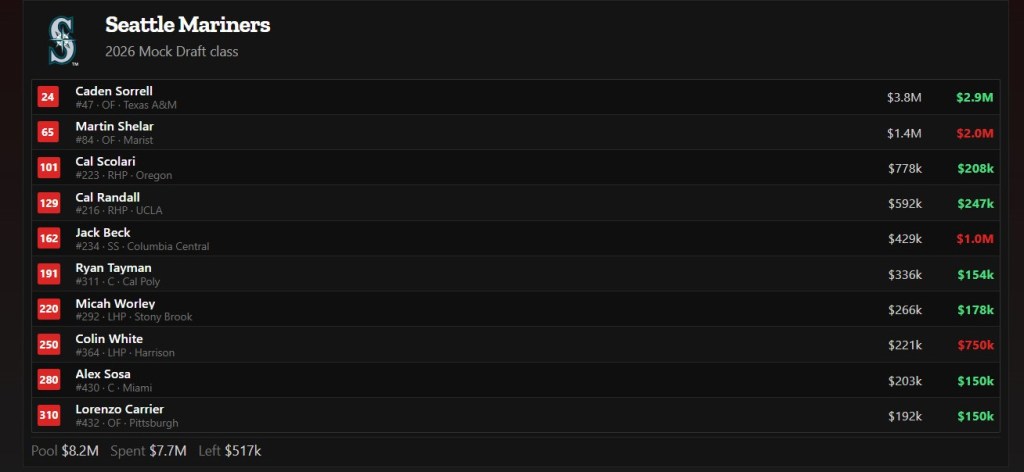
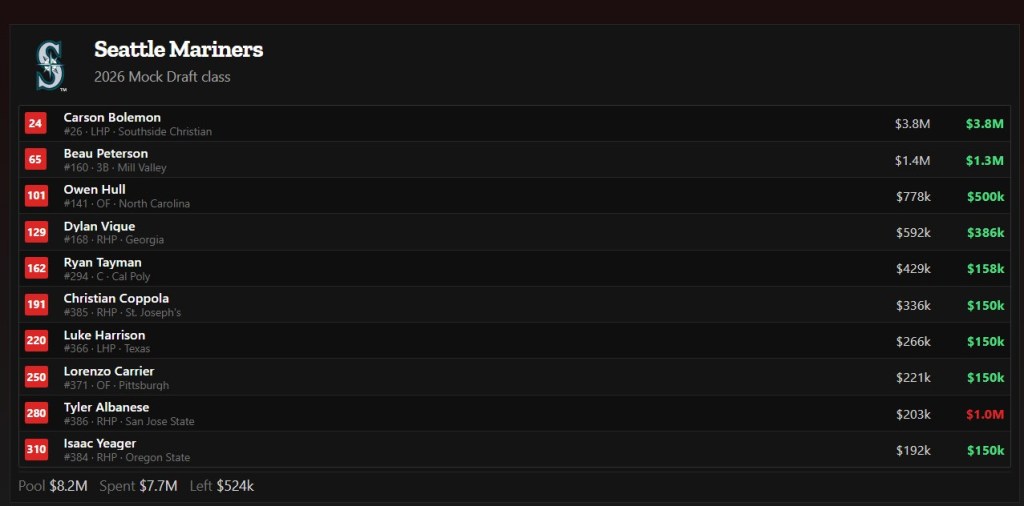
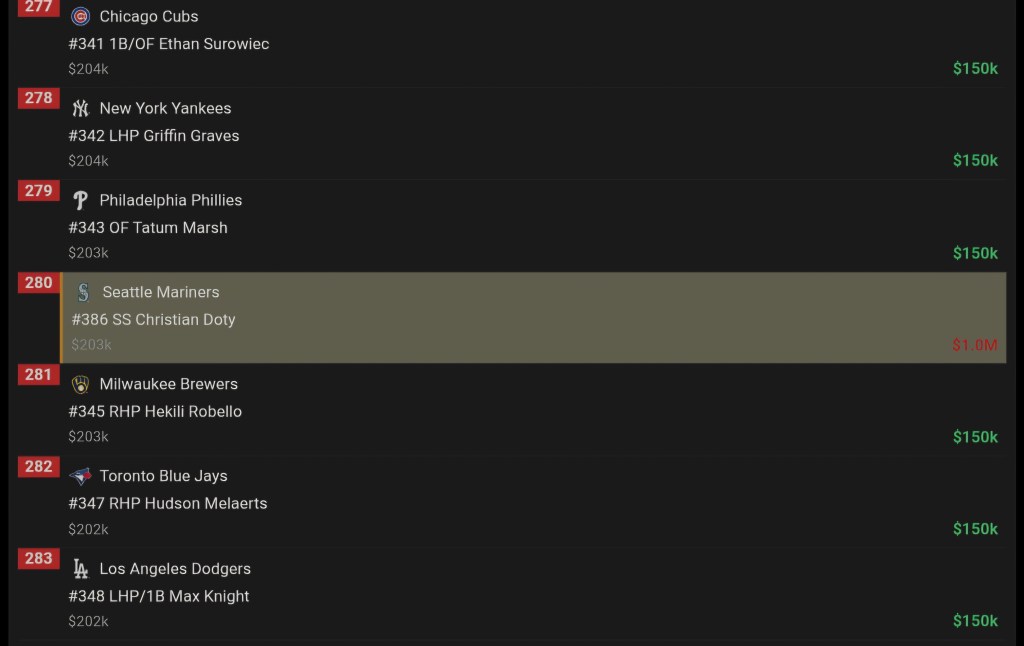
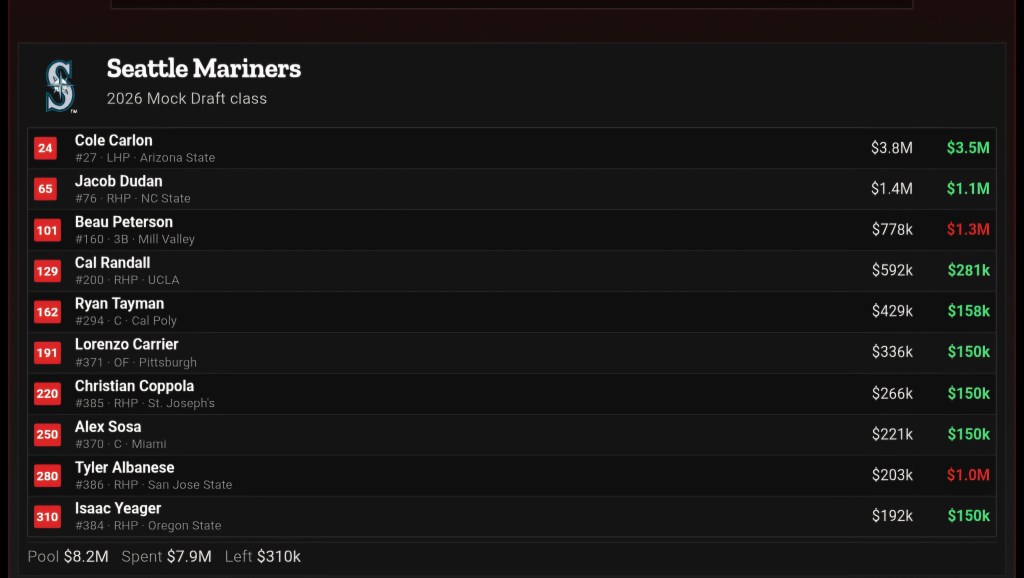


You must be logged in to post a comment.