By Jared Stanger
The 2026 NFL Combine hits next week with the player arrivals starting on Sunday, and the first day of on-field testing and workouts coming on Thursday. I messed around a bit with some online mock draft simulators this morning just to kind of calibrate where player projection is pre-combine, and we’ll have this document to compare to after players get the the SPARQ/RAS bump.
The first thing we have to address is the draft capital. Currently, the Seahawks sit at only four draftpicks. Those fall at roughly #1.32, #2.64, #3.96, and #6.212. This draft is commonly thought of as not being particularly strong in talent, and it’s entirely plausible that John Schneider has seen this drop in talent coming, and he traded picks away to make better use of the resource. It could also be possible that we haven’t seen the entirety of the plan, and that Schneider sensed a late first round draftpick was coming in a draft that has maybe only 15-16 true first round grades, and that he would inevitably be trading back our first pick.
I’m kind of counting on the latter, so I made multiple trades right out of the shoot. Here is what that ended up looking like:
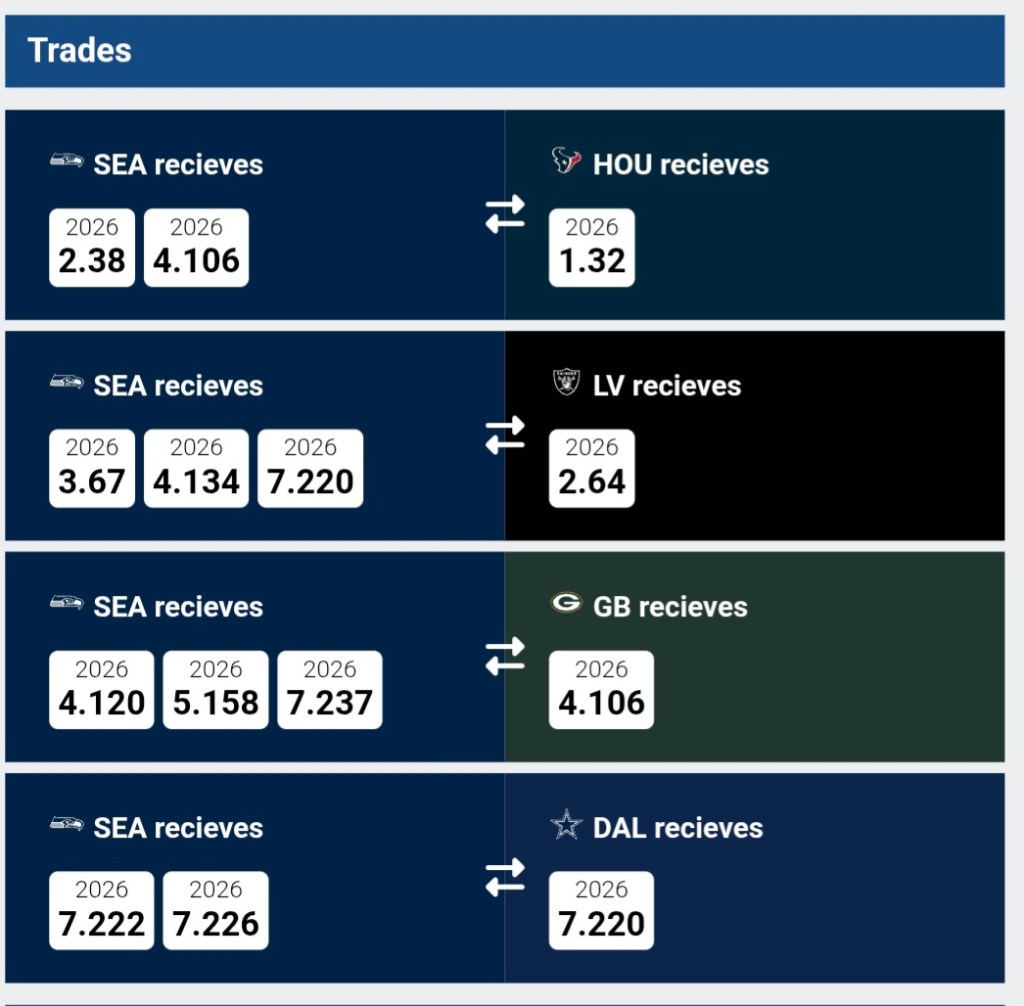
The other thing I’ve been thinking about as the Super Bowl champs, on a team that has used former rookie free agents like Drake Thomas, Jalen Sundell, Josh Jobe, Ty Okada in major roles this season…is Schneider thinking he could use the clout the Seahawks currently have to recruit hard in UDFA rather than using many day three draftpicks??
I’m sure they will do that, but it’s less clear how much useful talent will still be around after the draft. Like, most of the NFL-caliber talent is going to find their way into the 256 draftpicks. So I figured I would sneak in a headstart on rookie free agency with a number of seventh round picks.
So, let’s get to it.
#2.38 – Cornerback, San Diego State, Chris Johnson
I’ve seen/heard the recent discourse that this is a decent corner class. Horseshit. Certainly, I don’t think there are many guys that pass the Schneider/Macdonald “Smart, Tough, Reliable” standard that has marked our draft success(es) over the last four drafts. I think we need to find that guy, and take him early. Chris Johnson ticks so many of the boxes we’re looking for. He’s a smart dude, he’s got great 2025 production, and I think his tape is so consistent. With the Seahawks needing to replace (or re-sign one, and draft one) both Riq Woolen and Josh Jobe; this is a demand meets lack of supply move.
#3.67 – Center, Florida, Jake Slaughter
I, personally, think Center is a bigger need than most people. Yes, Jalen Sundell was a passable starter last year, but Geno Smith was also passable for a time when he was here. And we kind of didn’t recognize/admit at the time that we could upgrade his position until he was gone and Darnold was good for the first two months of the season.
I think this is where Center is at. It’s either we go hard after Tyler Linderbaum in free agency and pay the premium he’ll cost, or we spend a premium pick on the best Center in the draft, and our O-line will be one of the best in the league for the next 3-5 years.
#3.96 – Running back, Arkansas, Mike Washington Jr
Unfortunately, with Ken Walker hitting free agency and Zach Charbonnet coming back from a significant knee injury; we need to backfill the backfield with a pretty decent pick this year. I’m still not totally sure the type of running back that Macdonald wants if given a choice. He sort of arrived in Seattle with our top two backs already in the building, and we haven’t had to draft or sign one since.
Washington is a big back at 6’1″/228lbs, but he reads on film as a pretty fast athlete, as well. I thought he looked really good at the Senior Bowl, so I’d be happy to add him to the RB room.
#4.120 – Edge, Western Michigan, Nadame Tucker
I fully admit that I don’t think Tucker is the type of Edge that Macdonald prefers. He is a smaller, more speed-based rusher. But I think he has some of the most legit passrush chops of all of the DE in this class. And I have a plan to address the edge-setting DE later on.
Boye Mafe is a free agent, and it’s not totally clear if the team will retain Uchenna Nwosu, so it’s possible we will need two Edge replacements.
#4.134 – Linebacker, Oregon, Bryce Boettcher
I think I’ve had linebacker higher in some previous mocks, but it seems like we’re gonna continue to roll with Ernest Jones, Drake Thomas, Tyrice Knight, and I lowkey think there might be some high optimism in the building on practice squad LB Chris Pooh Paul going forward.
But we are set to lose Chazz Surratt to free agency, so we can draft a replacement that can start on special teams, and we develop him to eventually replace Jones in a couple years.
Boettcher is an interesting cat. He is a northwest native coming from Eugene, OR. He was actually drafted in the 13th round of the MLB draft by the Houston Astros in 2024. Last year Bryce totaled 136 tackles, 5.5 TFL, 1.0 sack, 6 PBU, 1 INT, and 2 FF. And he can even play some goalline fullback.
#5.158 – Wide receiver, Texas Tech, Reggie Virgil
I think our wide receiver room is in pretty good shape. Jaxon Smith-Njigba will be getting a new contract soon, I’m sure. Cooper Kupp, Tory Horton, Jake Bobo are all still under contract. We’re probably going to re-sign Rashid Shaheed. Which would mean we’re only losing Dareke Young to free agency. So I don’t think we need a huge investment at the spot. Maybe in 2027 we go back to the well for an early pick at WR.
Virgil was one of the pleasant surprises for me at the Senior Bowl. He measured up at 6’2″/188lbs, and played with good speed, good route-running, and good hands.
#6.212 – Safety, Nebraska, Deshon Singleton
Coby Bryant is set to become a free agent, and it’s possible the team extends him, but in case we don’t; I’ve got Singleton as our next safety in waiting. I’ve been tracking Deshon since the 2024 college season. I think he’s a very solid, high-floor player. If he only becomes a special teams ace…it’s fine. I feel comfortable with Julian Love and Ty Okada as our starters.
#7.222 – Defensive Tackle, South Carolina, Nick Barrett
This pick is mostly a flyer for me. We have some aging DT on the roster in Leonard Williams and Jarran Reed, and not a ton of depth unless Ryley Mills plays 2026 more like he played in the Super Bowl than the rest of his 2025 season. I had some DT I was hoping to pull late in the draft, but most had already been picked in the simulator when I got to this spot. I don’t have a compelling story/case for Barrett other than he did tick a couple of production metrics when I studied this college DT class.
#7.226 – Offensive Line, Washington, Carver Willis
The Seahawks are set on the starting OL at both tackle spots, which is where Willis played for UW in 2025. But…Seattle is potentially losing swing OT Josh Jones to free agency, and I also think Willis could compete for the starting RG job (a position he played for KState earlier in his career). There’s also a possibility Willis just replaces someone like Mason Richman or Bryce Cabeldue as bench OL. Hawks did move on quickly from 2024 draftpick Sataoa Laumea, so maybe they just continue to churn OL bodies until they find the right mix.
It won’t surprise me if Willis is one of the big winners at the Combine for OL. I think he looks sneaky athletic on tape.
#7.237 – Defensive End, LSU, Jack Pyburn
My last pick is one of the guys I looked at only recently. I had the idea that, with a strong/deep class of defensive ends, it might be a good idea to double-dip. It also kinda gave me more leeway to draft Nadame Tucker, who might not be the right ‘type’ of edge rusher. I think Pyburn IS the right type of Macdonald edge-setter, and then it’s just a question of whether or not his passrush can pick up with pro coaching and landing in the Macdonald scheme.
Pyburn is listed at 6’4″/264lbs and registered 52 tackles last year (a lot for a DE), but only 5.5 TFL, 2.0 sacks, and 8 hurries. If he only ends up on the practice squad, or even if he doesn’t make the 70-man roster in September, it’s not a big loss.
Final look at the simulator results:
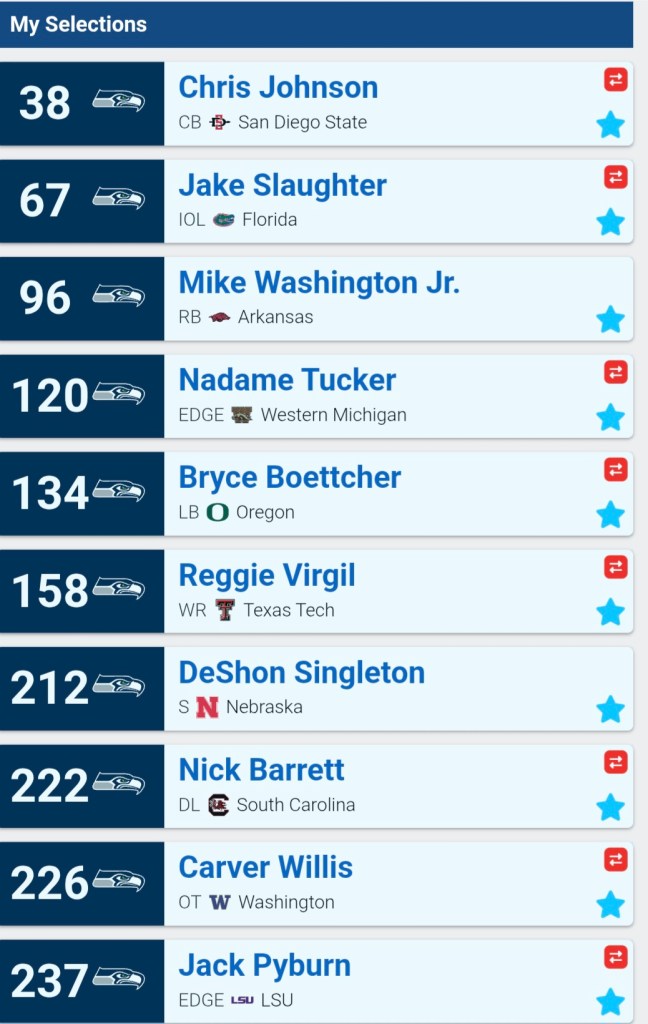
 Seattle Seamocks
You must be logged in to post a comment.