The 2026 NFL Combine hits next week with the player arrivals starting on Sunday, and the first day of on-field testing and workouts coming on Thursday. I messed around a bit with some online mock draft simulators this morning just to kind of calibrate where player projection is pre-combine, and we’ll have this document to compare to after players get the the SPARQ/RAS bump.
The first thing we have to address is the draft capital. Currently, the Seahawks sit at only four draftpicks. Those fall at roughly #1.32, #2.64, #3.96, and #6.212. This draft is commonly thought of as not being particularly strong in talent, and it’s entirely plausible that John Schneider has seen this drop in talent coming, and he traded picks away to make better use of the resource. It could also be possible that we haven’t seen the entirety of the plan, and that Schneider sensed a late first round draftpick was coming in a draft that has maybe only 15-16 true first round grades, and that he would inevitably be trading back our first pick.
I’m kind of counting on the latter, so I made multiple trades right out of the shoot. Here is what that ended up looking like:
The other thing I’ve been thinking about as the Super Bowl champs, on a team that has used former rookie free agents like Drake Thomas, Jalen Sundell, Josh Jobe, Ty Okada in major roles this season…is Schneider thinking he could use the clout the Seahawks currently have to recruit hard in UDFA rather than using many day three draftpicks??
I’m sure they will do that, but it’s less clear how much useful talent will still be around after the draft. Like, most of the NFL-caliber talent is going to find their way into the 256 draftpicks. So I figured I would sneak in a headstart on rookie free agency with a number of seventh round picks.
So, let’s get to it.
#2.38 – Cornerback, San Diego State, Chris Johnson
I’ve seen/heard the recent discourse that this is a decent corner class. Horseshit. Certainly, I don’t think there are many guys that pass the Schneider/Macdonald “Smart, Tough, Reliable” standard that has marked our draft success(es) over the last four drafts. I think we need to find that guy, and take him early. Chris Johnson ticks so many of the boxes we’re looking for. He’s a smart dude, he’s got great 2025 production, and I think his tape is so consistent. With the Seahawks needing to replace (or re-sign one, and draft one) both Riq Woolen and Josh Jobe; this is a demand meets lack of supply move.
Chris Johnson is a 6”0 185lb CB from San Diego St has to be in play for Green Bay at 52! Johnson was excellent in 2025, giving up only 18 completions in 41 targets. With zero touchdowns and four interceptions, his passer rating against was just 16.1. pic.twitter.com/GHkngnX088
I, personally, think Center is a bigger need than most people. Yes, Jalen Sundell was a passable starter last year, but Geno Smith was also passable for a time when he was here. And we kind of didn’t recognize/admit at the time that we could upgrade his position until he was gone and Darnold was good for the first two months of the season.
I think this is where Center is at. It’s either we go hard after Tyler Linderbaum in free agency and pay the premium he’ll cost, or we spend a premium pick on the best Center in the draft, and our O-line will be one of the best in the league for the next 3-5 years.
Jake Slaughter (6’4 305) Florida
+ Over 2,100 snaps played + Allowed just 4 pressures in 2025 + Stays active and seeks contact + Great student-athlete that has multiple academic awards + 84.1 pass block grade in 2025 + 80.2 run blocking grade + 2x team captain
#3.96 – Running back, Arkansas, Mike Washington Jr
Unfortunately, with Ken Walker hitting free agency and Zach Charbonnet coming back from a significant knee injury; we need to backfill the backfield with a pretty decent pick this year. I’m still not totally sure the type of running back that Macdonald wants if given a choice. He sort of arrived in Seattle with our top two backs already in the building, and we haven’t had to draft or sign one since.
Washington is a big back at 6’1″/228lbs, but he reads on film as a pretty fast athlete, as well. I thought he looked really good at the Senior Bowl, so I’d be happy to add him to the RB room.
I fully admit that I don’t think Tucker is the type of Edge that Macdonald prefers. He is a smaller, more speed-based rusher. But I think he has some of the most legit passrush chops of all of the DE in this class. And I have a plan to address the edge-setting DE later on.
Boye Mafe is a free agent, and it’s not totally clear if the team will retain Uchenna Nwosu, so it’s possible we will need two Edge replacements.
A name shooting up draft boards is Nadame Tucker, EDGE, Western Michigan Broncos.
He posted 14.5 sacks and 21 tackles for loss this season.
Favorite attribute: He sets the edge with discipline, forces the RB back inside, and closes down the line to finish TFLs on inside runs. pic.twitter.com/zJpFJJg13L
I think I’ve had linebacker higher in some previous mocks, but it seems like we’re gonna continue to roll with Ernest Jones, Drake Thomas, Tyrice Knight, and I lowkey think there might be some high optimism in the building on practice squad LB Chris Pooh Paul going forward.
But we are set to lose Chazz Surratt to free agency, so we can draft a replacement that can start on special teams, and we develop him to eventually replace Jones in a couple years.
Boettcher is an interesting cat. He is a northwest native coming from Eugene, OR. He was actually drafted in the 13th round of the MLB draft by the Houston Astros in 2024. Last year Bryce totaled 136 tackles, 5.5 TFL, 1.0 sack, 6 PBU, 1 INT, and 2 FF. And he can even play some goalline fullback.
Bryce Boettcher is so important to this @oregonfootball defense.
I think our wide receiver room is in pretty good shape. Jaxon Smith-Njigba will be getting a new contract soon, I’m sure. Cooper Kupp, Tory Horton, Jake Bobo are all still under contract. We’re probably going to re-sign Rashid Shaheed. Which would mean we’re only losing Dareke Young to free agency. So I don’t think we need a huge investment at the spot. Maybe in 2027 we go back to the well for an early pick at WR.
Virgil was one of the pleasant surprises for me at the Senior Bowl. He measured up at 6’2″/188lbs, and played with good speed, good route-running, and good hands.
Reggie Virgil getting a lot of buzz following strong Senior Bowl week… Dawg special teamer back at Miami OH (top of screen)
Scouting separators. Day 3 WRs – Blocking? Elite Trait? Special Teams? Multiple Roles? pic.twitter.com/6Kci5Jhrnx
Coby Bryant is set to become a free agent, and it’s possible the team extends him, but in case we don’t; I’ve got Singleton as our next safety in waiting. I’ve been tracking Deshon since the 2024 college season. I think he’s a very solid, high-floor player. If he only becomes a special teams ace…it’s fine. I feel comfortable with Julian Love and Ty Okada as our starters.
#Nebraska S DeShon Singleton is 6'3 210 and I think his best value comes in coverage as a TE matchup piece in subpackages, whether he's from depth or up on the line. I expect to see that skillset on display in 1-on-1s down at the @seniorbowl#GBRhttps://t.co/NV7ZjIWh9ppic.twitter.com/ic0vUdfTn2
#7.222 – Defensive Tackle, South Carolina, Nick Barrett
This pick is mostly a flyer for me. We have some aging DT on the roster in Leonard Williams and Jarran Reed, and not a ton of depth unless Ryley Mills plays 2026 more like he played in the Super Bowl than the rest of his 2025 season. I had some DT I was hoping to pull late in the draft, but most had already been picked in the simulator when I got to this spot. I don’t have a compelling story/case for Barrett other than he did tick a couple of production metrics when I studied this college DT class.
South Carolina NT Nick Barrett is flying under the radar in a deep NT class. Good mover for his size (6'3 322) who plays with heavy hands and violence at the point of attack. Limited as a pass rusher but should be able to carve out a role in a DL rotation sooner than later pic.twitter.com/kwkc4i3TGf
The Seahawks are set on the starting OL at both tackle spots, which is where Willis played for UW in 2025. But…Seattle is potentially losing swing OT Josh Jones to free agency, and I also think Willis could compete for the starting RG job (a position he played for KState earlier in his career). There’s also a possibility Willis just replaces someone like Mason Richman or Bryce Cabeldue as bench OL. Hawks did move on quickly from 2024 draftpick Sataoa Laumea, so maybe they just continue to churn OL bodies until they find the right mix.
It won’t surprise me if Willis is one of the big winners at the Combine for OL. I think he looks sneaky athletic on tape.
Washington OT 50 Carver Willis plays steady with good lower body movement, balance and anchor. He's strong and shows the ability to really move defenders. https://t.co/HlDsNTDp06pic.twitter.com/btGgMkx4Yl
My last pick is one of the guys I looked at only recently. I had the idea that, with a strong/deep class of defensive ends, it might be a good idea to double-dip. It also kinda gave me more leeway to draft Nadame Tucker, who might not be the right ‘type’ of edge rusher. I think Pyburn IS the right type of Macdonald edge-setter, and then it’s just a question of whether or not his passrush can pick up with pro coaching and landing in the Macdonald scheme.
Pyburn is listed at 6’4″/264lbs and registered 52 tackles last year (a lot for a DE), but only 5.5 TFL, 2.0 sacks, and 8 hurries. If he only ends up on the practice squad, or even if he doesn’t make the 70-man roster in September, it’s not a big loss.
LSU Edge Rusher #44 Jack Pyburn 6’4 264
Pyburn finished with 42 pressures, 5 sacks and 36 stops in his final 2 seasons of CFB
As a pass rusher he wins with power, either converting speed to power or bull rush. Occasionally he will deploy a ghost or use bend to beat a lineman… pic.twitter.com/waoapI8lry
We’re hours away from the Seahawks divisional round playoff game at Lumen Field against our rival 49ers, and I’ve got a new 7-round mock draft for everyone.
A few points of order…at one point a follower raised the question of what happened to the Seahawks’ draftpick they acquired when they traded OT Mike Jerrell to Atlanta. I was like, “oh yeah, what did happen with that?” I finally went back to the news releases from the day of the trade and realized that draftpick was actually a conditional 2027 pick. So it is still in play, just not for this year.
The second point…the Seahawks first round pick. I’ve been advocating that John Schneider could/should trade our first round pick for a veteran player. I think that idea lost it’s plausibility when Seattle secured the playoff first round bye. Which also meant they would draft no higher than #27 overall if they lose today. And that might be #28 at the highest, depending on tie-breakers with Denver.
Optimistically, Seattle might be drafting in the 30’s. I just don’t see NFL teams that might be selling off their blue-chip players on big contracts; would be selling them to a team that is drafting that late in the 1st round. This is why Seattle should have gotten it done at the trade deadline last November…at that time, there was mystery about where their pick would land. Now there is much less mystery, and by the time of the new league year; there will be zero mystery…Seattle’s first rounder is more like a second.
I just don’t think we’re going to be winning any kind of bidding war for Maxx Crosby, or whoever, with our low-value 2026 first round pick. And one can surmise from our roster composition that our 2027 draftpick will be in the 20’s as well.
So……what does one do in a bad draft class, with less than 15 consensus first round grades across the league, and a first round pick that won’t interest teams selling vet talent? We go back to the John Schneider well…trading back.
It’s a very legitimate question on whether John is going to worry much about getting more bites at the apple in the 2026 draft. At the moment, he has put himself in position to make only four picks: 1st, 2nd, 3rd, 6th rounds. Is that the end game, or has he been planning to augment that somehow between the end of the season and the end of the draft? We can only speculate.
Personally, I look at the Seahawks pending 2026 free agents, and I don’t see the names of the team’s best players running out of contract. It’s a group of, essentially, role players. The biggest name is probably Ken Walker. After K9, the list goes Riq Woolen, Josh Jobe, Boye Mafe, Josh Jones, Coby Bryant, Dareke Young. Technically, Rashid Shaheed is also coming up, but I expect they will get him done.
We’re not losing big names, so maybe we don’t need to draft big names. We could, theoretically, plan to draft for the class the year has provided, which has serendipitously lined up perfectly for the free agent class we’re losing. But I think you need more lottery tickets because in a weak draft there is less guarantee that each pick will pay off.
I think we need more picks, not less. Having draft capital allows you to be fluid throughout the draft. It’s much harder to pick select spots to move UP in the draft when you only start with four picks. I will make three trades within the draft.
First…trading back #1.32 to Houston for pick #2.38 + #4.106. Texans currently have nine picks to deal from.
Second…trading back #2.64 to Pittsburgh for picks #3.76 + #4.121 + #6.214. The Steelers currently project to have twelve picks throughout the draft.
Third…traing back #6.214 to the Jets for picks #7.218 + #7.242. The Jets also hold twelve picks going into the draft. All of the teams I’ve used for trades have a ton of draft capital.
#2.38 – Cornerback, San Diego State, Chris Johnson
To my eye; it feels quite obvious that our first pick needs to be a corner. We’re currently set up to lose two starting corners in free agency (ideally, we re-up one of them and draft one), and it’s not a good draft for corners. Need meets depth (or lack thereof).
Chris Johnson just continues to be the guy in this class that has a really high floor. Feels like a Mike Macdonald guy. Listed 6’0″/195lbs.
Chris Johnson ( San Diego State )
Chris Johnson is playing elite ball for SDSU. PFF’s top CB in CFB right now (91.0 DEF, 91.3 COV). He’s allowing 41.9% completions with 3 INTs and 0 TDs when targeted. Sticky, patient, and finishing plays at the catch point. pic.twitter.com/NISawtFKoY
I’m not totally sure about this pick. Macdonald and staff might be all-in on Jalen Sundell. Or maybe there’s a sneaky chance that Seattle gets involved in the Tyler Linderbaum free agency. I just need to see Schneider correct his bias against centers, which is so fucking weird in the first place.
Slaughter has been my guy since early in the 2024 college season, and I love that he is still holding value in the third round.
Jake Slaughter has been a stalwart at Florida, allowing just 22 pressures in 3 seasons as a starter!
Receiver is an interesting position for Seattle this offseason. Their only trade-deadline deal was for a WR, who will immediately become a free agent. Tory Horton has predominantly been an afterthought after spending most of his rookie year on the injured list, something I was always concerned about based on his college career. Cooper Kupp is aging. Dareke Young is a free agent, and I let him walk. Bobo has seen fewer and fewer touches each year, and ended 2025 with only two catches.
Obviously, we don’t need a #1 WR, but there’s a strong argument that we need a legit #2. I don’t know if the current model of JSN dominating target share to the 2025 degree is sustainable. Kupp was Darnold’s #3 in receptions behind TE Barner. Then we see two RB in 4th-5th. This is also the kind of pick that you maybe make a year early, give him 50 catches in year one, and then in 2027, maybe he pops off as the roster changes and he gets more opportunities.
Bell has good size, and a really well-rounded skillset. I like his ability to win in the air. I like his Staten Island swagger. I really want him to continue wearing his #1 jersey from college. He calls himself “Uno” and we could have all kinds of fun with that.
I don’t think Seattle needs an early pick on a linebacker. I think we’re pretty well set next year with All-pro Ernest Jones, and Drake Thomas getting starter reps. But, arguably, we didn’t need a safety when we drafted Nick Emmanwori when we did in 2025. Anyways, if Rodriquez is still on the board this late we run to the podium for him. He immediately deepens our bench and gives us our future replacement for Jones as the MIKE starter in a couple years. It seems that Macdonald likes to kind of take his time installing his defense specifically in his green dot linebacker, so this gives us a great, low-pressure draft cost to take our time with our QB of the defense.
#4.121 – Edge Rusher, Western Michigan, Nadame Tucker
I kind of only see two things Seattle might spend their first pick on: corner or edge. I went with corner because the draft has few of those, while it feels very strong on a certain type of edge. I think we can play more into the depth of edge and wait for one. Especially since he will only be needed to “replace” the snaps of Boye Mafe. He can be a rotational player with a hope for upside.
I’ve narrowed my interest down to Tucker. I think he has more passrush talent to him than most in this draft range. I’m self-aware that Tucker may not be the right TYPE of edge player that Macdonald prefers. I lowkey think a guy named Michael Heldman from Central Michigan might be more of Macdonald’s vibe, but currently Heldman might be able to come to Seattle in rookie free agency.
It’s fitting that Nadame Tucker stepped up when Western Michigan needed him to on 4th down in the MAC Championship. Nasty double-swipe.
Tucker has been the pass rusher in the MAC and has been a monster all season. pic.twitter.com/6XZ1PrlqK5
It still seems strange the way this front office and coaching staff has basically deferred the right guard job to Anthony Bradford. Will they continue to do so another year? It feels like a draft where there will be some late value on OL. We took a couple stabs at this idea in 2025 with Bryce Cabeldue and Mason Richman. Both have remained on the roster, while ultimately not overtaking Bradford.
Stephens comes from the same Iowa scheme that Richman came from, but is a much more accomplished player. He’s kind of the sneaky third-best known name from that Hawkeye OL behind center Logan Jones and right tackle Gennings Dunker.
We will be asking Stephens to flip from left guard at Iowa to right guard in Seattle.
Beau Stephens was Iowa's best offensive lineman in the game against Oregon. He routinely made impactful blocks in the run game while his teammates struggled to contain Bear Alexander and A'Mauri Washington. #NFLDraft#NFLDraft2026#2026NFLDraftpic.twitter.com/Ee7sjbOGQy
Much like most of this mock, for this draft, for this offseason; the goal might only need to be to replace role player with role player. In this case, we need a replacement for Coby Bryant. Singleton is a favorite of mine going back to the 2024 season. He’s a very high-floor, strong fundamental player. I love adding him to the DB room and letting him build from special teams and we go from there.
#7.242 – Tackle, Washington, Carver Willis
In the NIL era…and specifically in the UW/Fisch era…I have grown disenchanted with watching my beloved Huskies. I find it really difficult to connect with these random rosters of brand new transfer players every year. I don’t know who they are, where they come from, when they’re going to leave UW for another school.
In that spirit, I had not had a targeted viewing of LT Carver Willis until he was recently added to the Senior Bowl roster. After playing RT in 2024 for KState, Willis was the Husky LT this year. Listed 6’5″/312lbs, with sneaky athleticism on tape; Willis will slot into the backup OT role currently occupied by Josh Jones.
I watched new transfer portal UW OT commit Carver Willis so you don’t have to- here are my favorite clips from him as KSU RT in 2024.
Willis excels at finishing in the run game, and also has a good anchor in pass sets. Instantly becomes UW’s best OL on the roster.#GoHuskiespic.twitter.com/ZUNKHHS6WS
I had planned to make these tiered draft pieces by position group for most positions, but I’ve been slacking through the holidays. Today I’m back on my bullshit and looking at running backs. Seahawks are currently looking at a free agency period where Kenneth Walker is at the end of his contract and unrestricted, and George Holani will be an exclusive rights free agent. It remains to be seen if they will pay him. The team HAS made in-season contract extensions this year with Charles Cross, Eric Saubert, Abe Lucas. If both team and player were eager for a reunion; we would have likely seen the extension.
I’m not convinced the Seahawks want him back. Certainly not on a veteran deal with Walker being paid above his current rookie scale. I suspect Mike Macdonald is looking for a different type of runner.
With Seahawks limited 2026 draft capital; it will be tough to project them using one of their four current picks on a RB. But, as you’ll soon see, I think this might be a draft cycle that you can prioritize RB in rookie free agency. John Schneider and his staff seemed to go pretty aggressive in the 2025 UDFA phase where they acquired guys like Jared Ivey, Amari Kight, Connor O’toole, Nick Kallerup.
This leads us to a refresher on the structure of these pieces on the tiers of the 2026 Draft. Basically, I’m looking for the best player from three tiers of investment: high, mid, low cost. For the Edge Rushers, I called high cost the 1st to 2nd round. Running back typically carries lower positional value, and this year there aren’t likely more than one name that will be picked in the 1st round. So I’m calling high cost for RB; 2nd to 3rd round. Mid = 4th to 7th. And I’m calling low for RB the entirety of rookie free agency.
High round:
Not only do I not really see a running back I would imagine Seattle would draft in the first round; I kinda don’t see anyone they would take in the first three rounds. I like Jonah Coleman very much, but in my analytics study of the RB class; Coleman didn’t really ping.
Emmett Johnson from Nebraska is ranked #84 on the big board, and hit on a few of my metrics, but failed on others. The guy is crazy elusive, but didn’t score highly on running after contact and a couple others.
Emmett Johnson isn’t much of a home run threat, but he has the vision and short-area quickness to hit doubles & singles at a very high rate. So creative weaving through traffic and finding escape routes from his peripheral.
The highest ranked RB that did ping was Penn State’s Kaytron “Fatman” Allen from Penn State. Listed 5’11″/219lbs, Allen has 1300 rushing yards this year with 15 TD’s. Consensus big board has Allen as the #124 player in the class, which actually lands mid-4th round. Until we get testing data at the Combine; I suspect Allen might test on the slower side.
Mid round:
I’m honestly fudging things a bit to get this mid-tier in here. For whatever reason; the media has a dogshit perception of this RB class. Miami RB Mark Fletcher, the guy who has basically been carrying the Miami offense in the college playoffs, is not ranked draftable. He is a Junior that, due to Miami’s playoff run, has not announced his draft intention. But even if you look at his 2027 draft value it comes in as UDFA.
Fletcher is listed at 6’2″/225lbs and rushed for 1080 yards and 10 TD this year after missing two games near the middle of the season. Up until recently, I was more or less assuming Macdonald likes a RB that resembles something he worked alongside and had to defend in Baltimore where guys like Kenyan Drake and Gus Edwards were bigger backs getting the bulk of the carries.
But recently Seattle has been adding guys like Velus Jones (6’0″/204lbs), Myles Gaskin (5’10″/200lbs), Kenny Mcintosh (6’0″/204lbs) to various parts of the roster, as well as having some rumored interest in Devon Achane (5’9″/191lbs) at the recent trade deadline. It’s a position group without total clarity of where Macdonald’s true vision lies because he has never, really, had to acquire an RB1 or RB2 since he’s been here. The only RB we’ve seen John and Mike draft since Mike arrived was 2025 when they picked Damien Martinez in the 7th round. Martinez was 6’0″/217lbs, but he was shortlived for the roster; and his “replacements” were primarily the smaller backs I just mentioned.
I am moving forward with my projections based on my own speculation of what I THINK would work best in this offense. I think Fletcher ticks a lot of the boxes.
This is where things really popped for my research, which means you probably don’t NEED to draft a RB. I got multiple guys that came up really interesting and the media has no clue.
Kaelon Black & Roman Hemby – The two guys sharing carries in the same Indiana backfield both scored very similarly in my study. Black is listed 5’10″/211lbs and rushed for 898 yards and 8 TD, while Hemby is listed 6’0″/210lbs and rushed for 1007 yards and 7 TD. Hemby has a little better standing nationally for draft projection as a guy that is barely outside the range of top 256 players on the board.
Hemby is possibly a tougher runner, while Black is a bit more explosive. Black is a better pass-blocker, while Hemby is a better pass-catcher. Two really intriguing players with great intangibles.
Kejon Owens – Owens is a 5’11″/210lb back coming out of Florida International who ran for 1300 yards and 11 TD’s, with bigtime explosive plays on tape. He reminds me a bit of Ken Walker.
Panthers tacking it on with this 32-yard TD by @kejon_owens
Dontae Mcmillan – Listed 5’10″/203lbs, Mcmillan played at Eastern Michigan but he’s actually from Seattle. He has very good explosive numbers, but on tape I fear he might test a little slow in the forty. He ran for 1000 yards this year, but only 4 TD. I don’t know that Mcmillan would be my #1 RB I’d sign in UDFA, but as a Seattle guy; I think if you offer him a deal; he’ll take it.
Eastern Michigan RB Dontae McMillan(@Dontaemcmilla28) was a problem for defenses all season long — very few could stop him.
McMillan carried the ball 177 times for 1,014 yards and 4 TD’s, while gashing teams through the air with 33 receptions for 375 yards and 3 TD’s.#G5… pic.twitter.com/AOZyLPuiHP
Robert Henry – Listed 5’9″/205lbs, Henry ran for 1045 yards on only 151 carries, and added 9 TD. In spite of not being the biggest back, Henry posted some of the best scores on running after contact.
I think the Seahawks should punt on RB in the actual draft, and then offer guaranteed money to two RB in the rookie free agency period. If they can swing it; one of the Indiana guys and Kejon Owens would be very interesting.
As I’ve been locating, cataloging, documenting various aspects of this draft cycle; it started to occur to me there might be a post, or series of posts, illustrating various tiers of draft capital investment. In a big-picture view, this can help to establish positional priorities, and it may also lock in the tiers of talent across all positions that can help evolve a general draft strategy of when to focus your draft picks vs when to bail from draft ranges.
The first position group I’ve decided to take a closer look at is one that draft media has long said is a strength of this year: the Edge rushers. As I dug into the position in as comprehensive a manner as I could; I discovered multiple new names to add to my board, which I think supports the idea that this is a deep group.
Edge also feels particularly relevant to the Seahawks due to the news/rumors that came out during the trade deadline build-up where-in impending free agent Edge Boye Mafe was being floated as a trade away candidate. Seattle may be anticipating a good Edge draft and willing to let Mafe walk as a free agent for a potential compensatory draftpick, and replace Mafe with youth.
The format for these pieces, which I’m currently planning to do for all position groups, will be to identify a candidate(s) at a high price point (1st-2nd round), a mid price point (3rd-5th round), and a low price point (6th round-UDFA). These candidates will be weighted as much to what I believe to be current Seahawk traits under John Schneider as the buyer for a Mike Macdonald menu.
High round:
I did some pretty intensive research into what I think Macdonald likes in his Edge players. I tried to be pretty objective to the traits I think he likes, I allowed each player to have one category where they fell below standard, but they could not have two strikes against, and this led to some interesting eliminations, and certainly to some VERY interesting additions.
After going through multiple levels of eliminations; I only came away with one name still in consideration that currently has projection in the top 64 picks/top two rounds: Missouri Edge Zion Young. It should be noted there are five names that survived my process, and Zion finished fifth of five of those names.
Young has 15.0 TFL, 6.5 sacks, 11 hurries in 11 games so far this year, and he has projection in roughly the middle of the second round.
I was not super high on Zion Young (#9 6’5 265lb) during summer scouting but he is playing great
He is matching his run defense (16 Def Stops) w/ his pass rush (28 Pr 5 sacks 7 QB hits 2 FF)
Again, I only came away with one player in this range: Miami Edge Akheem Mesidor. Mesidor had some interesting pings in studying the group. He has posted 12.0 TFL, 7.0 sacks, 4 hurries, 4 forced fumbles in 10 games. His consensus draft ranking puts him in the third round. I think this is an interesting idea. A trench player from a blue chip program is never far from Schneider’s heart.
#Miami DL Akheem Mesidor is going to be a very attractive option early day-three (6th year) for teams looking to capitalize on this deep edge class
This is where I felt things got really interesting. This is where I came away with three names that survived all rounds of elimination without accruing two strikes. All three of these guys currently are projecting as undrafted free agent types. Some of that will change with decent athletic testing at the Combine. Some of that will change simply because the media is less aware of these guys than NFL teams actually are.
#1 – From SMU we have Edge Cameron Robertson, who has missed three games this year, but was back in the lineup for SMU’s most-recent game vs Louisville on November 22nd. In the eight games Robertson has played, he has posted 9.0 TFL, 5.0 sacks, 3 hurries.
SMU EDGE Cameron Robertson is a rock solid player.
Week in and week out he just does his job. Strong edge setter, disciplined to containment, has length + power to push pockets.
#2 – From Central Michigan, we have Edge Michael Heldman. There’s something about the recent chatter about the Seahawks acquiring Maxx Crosby, a highly productive college player that came from Eastern Michigan and was drafted in the 4th round, that makes me intrigued with Heldman and the next guy I will talk about. Heldman has recorded 13.0 TFL, 9.5 sacks, 9 hurries in eleven games this year.
(Just for reference…Crosby in his draft year posted 19.0 TFL, 7.5 sacks, 7 hurries in twelve games.)
#3 – From Western Michigan we have Edge Nadame Tucker. Tucker was part of my recent mock draft that was primarily tape-based, and he looks even more intriguing after seeing him come out as still highly relevant in this more analytics-based study. He has 18.0 TFL, 12.0 sacks, 12 hurries, 4 forced fumbles in twelve games. He did come up short in one of my metrics, but in every other category; he really looked like a potential fit for Macdonald.
This is a very exciting player that draft media is not caught up on…yet.
Western Michigan EDGE Nadame Tucker can play on Sundays #NFLDraft
I did a separate piece of analysis this week just trying to gauge Seattle’s interest in various position groups, and it really did make it seem they may be putting emphasis on Edge rusher(s). But then the question becomes: “does emphasis mean chronological priority?” Does needing an Edge rusher on your roster mean you force a pick on one in a draft that may see some quality guys fall further down due to depth of the class? Now, I’m not saying they wait until rookie free agency to get one of the three guys I highlighted as currently projected there…I suspect that will change by April. But it might mean you can get one on day three of the draft (like Crosby).
My priority list currently goes: Tucker, Heldman, Mesidor. In that order.
We’re now a week past the trade deadline and we have an update on what picks the Seahawks have left after acquiring Rashid Shaheed from New Orleans. It is commonly being reported that Seattle has four picks left, but I think it’s five*. At the end of the preseason, we traded OT Mike Jerrell to Atlanta for a conditional 7th round pick. I did some digging and I don’t see any reason why people aren’t counting that pick other than, possibly, they’re cynical that Jerrell will hit the triggers (most likely games active or season snap count rate) to secure the pick for Seattle. But for now I’m going to include it.
So, Seattle has the picks at roughly #1.29, #2.61, #3.93, #6.207, #7.224. If we get to the draft and haven’t traded our first round pick for a veteran player; I really think John Schneider will trade back their first to get some more picks. I’m actually projecting two trades: #1.29 goes to Cleveland for picks #2.38, #4.104, #5.151 and then I have our pick #3.93 going to Denver for pick #4.103 and #4.130. Final draft pick allotment:
The next thing I’m taking a look at to inform this mock draft will be the Seahawk 2026 unrestricted free agents. We’re due to lose CB Josh Jobe, Riq Woolen, and Shemar Jean-Charles, DE Boye Mafe, LB Chazz Surratt, OT Josh Jones, RB Ken Walker, S Coby Bryant, WR Rashid Shaheed and Dareke Young. TE and DT have really good continuity into next year.
Seeing three CB as potential roster losses, and then knowing that this draft is not that strong at CB is a huge problem, to me. I’m kind of pushing a pick up for need, but it’s not a huge problem because some of the other positions we “need”, like WR and DE, have pretty good depth in this class.
#2.38 – Cornerback, San Diego State, Chris Johnson
I think we need to re-sign one of Jobe or Woolen, but then also draft a CB as early as possible. Johnson was in my previous mock but at a later round. Now I’m just cutting to the point. He’s 6’0″/195lbs, and for the year so far he has 3 INT, 7 PBU, 40 tackles, 2.0 TFL.
Chris Johnson ( San Diego State )
Chris Johnson is playing elite ball for SDSU. PFF’s top CB in CFB right now (91.0 DEF, 91.3 COV). He’s allowing 41.9% completions with 3 INTs and 0 TDs when targeted. Sticky, patient, and finishing plays at the catch point. pic.twitter.com/NISawtFKoY
Personally, I just don’t think Jalen Sundell nor Olu Oluwatimi are the future of our Center position. We need to actually address it with some urgency. Slaughter was my favorite college center in the 2024 season, and I haven’t really seen much to move someone ahead of him. I know Logan Jones from Iowa is a touted athlete with good zone blocking experience, but I just like Slaughter’s brain more.
@GatorsFB Jake Slaughter, who is in the conversation to be the top center off the board in 2026, has picked up right where he left off of last season.
Obviously, the narrative has changed on Sam Darnold. But it’s probably not the last time it does. He’ll be recency biased to death based on his two most recent games for a while.
That isn’t really what this mock pick is about. I’ve never been a fan of Drew Lock, and I’ve consistently had my doubts on Jalen Milroe. I would like to take another midround shot at finding a developmental QB. Maybe Sam Darnold continues his current play and Mensah will be an inexpensive backup QB for 2-4 years, maybe Darnold reverts to his Jets’ form and Mensah becomes a starter sooner than we’d guess in November 2025. Doesn’t matter. One thing this draft does have is depth at QB. The first round may be a QB landmine, but there are a number of guys with middle round projection and yet some upside.
Mensah is listed 6’3″/205lbs, and currently playing to a 69.8% completion, 8.7 ypa, 24 TD to 4 INT, and a 165.07 passer rating. Basically, top 15 numbers for all QB’s this year. He is a redshirt sophomore this year after spending two years at Tulane, the most recent of which he started 13 games.
I think we’ve seen enough of the Mike Macdonald defense over the last year and a half to recognize it can be massively impacted by not having the right kind of guy playing linebacker. Ernest Jones really stabilized that position when he was acquired last year…Drake Thomas has been doing some really interesting things since becoming a starter a few weeks ago…Tyrice Knight had probably the best game of his career this week with Jones inactive with his injury. All of those guys have team control for at least another year. Rodriguez is just gonna be a guy we use to take the roster spot of Surratt, while also believing Rodriguez could slip into that green dot player a year or two down the road.
Rodriguez is listed 6’1″/235lbs, and he’s putting together an impressive 2025 campaign with 91 tackles, 9.5 TFL, 1.0 sack, 3 INT, 5 PBU, and he leads the country with 7 forced fumbles.
I like this class of Guards, with a few that are college Tackles that likely kick in to Guard. For me, I’m drawn to a guy that CAN play tackle so that we have a de facto replacement for Josh Jones, but then you also get another warm body to challenge for the starting Right Guard job.
Casey is listed 6’5″/311lbs and he’s a very Northwest guy…college in Idaho after high school in Oregon. It’s a fun story to close the circuit going pro in Washington.
Love the power Boise State OL Kage Casey plays with. Should be considered a top IOL for the 2026 class pic.twitter.com/0N2dwfVCh4
After trading for Rashid Shaheed, and the subsequent press conference commentary that it seems Shaheed and the Seahawks will look to create a contract extension for him; I think we can look for a different type of WR in the next draft. In a literal sense, we’re looking to replace Dareke Young on the roster, but watching Barkate’s tape I also found myself thinking of a different receiver.
Barkate is listed 6’1″/195lbs, and so far he has posted 50 catches for 824 yards, 16.48ypc, and 5 TD in 9 games.
#6.207 – Edge Rusher, Western Michigan, Nadame Tucker
I have this idea of what Mike Macdonald covets in his Edge Rushers. Tucker is not that. After including the Macdonald type guy in my outline prior to writing this mock; I kind of abandoned it and went with the guy that looks like a potential future NFL contributor that was available late in the draft. This is a draft with some projected depth at DE, so we’re hoping to hit on one from that depth.
Tucker is listed 6’3″/250lbs with 38 tackles, 15.0 TFL, 9.5 sacks, 8 hurries, and 3 FF for the year. There have been numerous reports that Seattle was close to trading away Boye Mafe last week, so it seems we need to be expecting that he won’t be back for 2026 once he enters free agency next March. The big question going forward is: “what is their idea for replacing him?” Do they have a DE trade in mind that they may revisit after the season? Is there someone on the roster or practice squad that they see upside in, and will look to elevate next year? Or, are they thinking they could trade Mafe away and find someone in a deep DE draft?
CODE RUSH OF THE DAY: Speed Bull Pull Rip by @nadame_tucker
Ken Walker is another impending free agent, and it’s really not clear what Seattle might intend to do with him. For the first half of the season, they’ve really been closely monitoring K9’s pitch counts. Are they simply trying to maintain his health to get him to the postseason? Or, maybe, more cynically, they may be trying to keep his free agent price lower so as to allow them to re-sign him cheaper.
Fletcher is listed 6’2″/225lbs, and has 636 yards rushing and 9 TD’s for the year.
The only free agent I haven’t really addressed via draftpick is Coby Bryant. I do have a short list of priority free agents, one of which is Nebraska Safety Deshon Singleton. In a down draft year; it’s tough to expect much, if any, talent to fall to undrafted free agency, so these names can be taken with a grain of salt, but right now I’ve got names like Singleton, LB Jack Kelly, OG Justin Pickett that would be amazing to sign after the draft.
Tomorrow marks, roughly, week six of the college season, so we’ve got a pretty good idea of the players that have fallen out of favor from preseason mocks, and those that are rising to replace them. Unfortunately, it appears more and more like this isn’t a good year for the draft. Certainly, not in the first round. If the Seahawks were to trade their 2026 first rounder for some kind of veteran blue chip player that will help us right now; it would be a very calculated and shrewd move. I’m not going to project that move. Anyways, outside of Maxx Crosby, I’m not sure there are many of this caliber player that are also on bad teams right now, that Seattle could acquire.
I tend to think John Schneider will make some kind of move(s) prior to this trade deadline. Those moves would inevitably include some kind of draft compensation switching hands. I have a couple ideas on those types of moves I would like to see, but I am not including them in this mock. We can revisit the post-trade-deadline draft capital in November.
For now…Seattle only owns six 2026 draftpicks. Those picks fall roughly at: #1.23, #2.54, #3.85, #4.120, #5.160, #6.183.
In terms of Crosby and the Edge rusher position…I would LOVE to acquire that type of player. I have such roster envy when I see the teams with elite edge rushers. But…I have documented Mike Macdonald’s own words describing that his defensive scheme is designed to be a team passrush by design. He doesn’t NEED that elite edge rusher. Would he take one if one were to fall in the Seahawks lap in the draft?? Probably.
That brings me to my next point: when I studied this overall draft class in terms of depth of talent; I found that the two strongest positions were quarterback and edge rusher. Does this mean 1st round grade? Not necessarily. But I feel confident that if you take a dart-throw at one (or both) of those positions as a late 1st round positioned team, all the way back to the third, maybe fourth, round; you have a puncher’s chance of hitting on something great.
For me, with Sam Darnold playing as well as he has, at the contract value he is playing under, with two more QB on the roster for cheap through (at least) 2026, and with the way this college QB class is still painfully moving through transition of who the media THOUGHT would be the relevant QB’s in preseason to the eventuality of the guys that will ACTUALLY be the 1st round names and later the NFL franchise guys; I just can’t imagine Seattle’s first round pick is a QB.
I could see this more like the scenario we saw unfold in the 2025 draft where Seattle took their top guys at positions the NFL undervalues, or they could force drafting players from the shallower position groups this class that line up with Seattle “needs”. I think it’s too early to present a mock of the latter in terms of the 1st round. My mock drafts are always based around the current market price of players, and as such, in October, I can still find those need positions at later rounds.
My pick for the first round will be following the strategy of drafting from the strength of the particular draft class.
#1.23 – Defensive End, Oregon, Matayo Uiagalelei
Matayo Uiagalelei is a 6’5″/272lb junior OLB/DE. He is the brother of Charger backup quarterback DJ Uiagalelei, and cousin to UW edge Taitai Uiagalelei. He is the leading passrusher for the #6 defense in the country and his 2025 statline goes: 11 tackles, 5.0 TFL, 4.0 sacks, 2 hurries, 3 PBU.
The Seahawk roster currently has Demarcus Lawrence on a three-year deal that could be a one-year deal with only $4.6mill dead-cap in 2026. Uchenna Nwosu has one more year left with an $8.5mill dead-cap hit. Boye Mafe is on the last year of his rookie deal, and Derick Hall has one more year remaining on his. We do need some reinforcements at the Edge position.
Matayo vs the run:
Matayo Uiagalelei and Bear Alexander completely blowing up this outside zone concept: pic.twitter.com/xtt5Zwlti6
In my opinion, Seattle needs get more out of their corner and inside linebacker rooms. They may address one, or both, of these positions via trade in the next few weeks. In the meantime, I am addressing both in the draft.
Chris Johnson is a 6’0″/195lb senior corner for the Aztecs with 29 tackles, 1.0 TFL, 2 INT, 6 PBU, and a FF on the year. As with most of my October mock drafts every year; many of my early picks will be higher on media boards by April. But for now we can get CJ here.
I have yet to find many suitable CB for this draft class, which puts a higher priority on drafting one than many other positions. I could, conceivably, see Schneider draft one in the 1st round with two of his current starting CB set to be free agents.
San Diego St's Chris Johnson has been one of the best CBs in the nation. Great job reading and locking down the initial route, then transitions on the out of structure element to get back in position pic.twitter.com/u9dwfuU8bj
After two years of Mike Macdonald, it has become clear how important the inside linebacker position is to him. And he has no patience for guys that can’t grasp his scheme. The only mild surprise is that he hasn’t used more resources to secure quality players at the positions.
Jake Golday is a throwback to a prior era of linebacker as a 6’4″/240lb athlete at the position. He has 49 tackles, 3.0 sacks, 1 PBU, and a FF on the year. He will rise throughout this process.
Jake Golday continues to stand out in a really strong LB class. I think there are 3 future Pro Bowl LBs playing college football in Ohio right now.
He’s an elite athlete compared to most sub-LBs, but at 6’3”/240 you aren’t making any tradeoffs in run support. Plays blocks as… pic.twitter.com/109TUv4meX
After five weeks of NFL football…I think the conversation on Sam Darnold is turning from “his contract makes it easy to get out of his deal after a year” to “this is a great, cost effective contract to have on our starting QB for the next three years.” I don’t mind that because I, personally, am not a fan of our backup situation. I’ve never liked Drew Lock, and I still have considerable reservations on Jalen Milroe. I don’t mind drafting another QB in a middle round in 2026, giving him two years to backup Darnold and learn the system (and the league), and then trade away one of Lock/Milroe for draft capital. As long as we’re using mid-round picks to do it; I think it’s a worthwhile endeavor.
At the same time…this quarterback draft class is completely off the rails. The preseason guys have completely fallen off. Off fell Nico Iamaleava, and Sam Leavitt, and Cade Klubnik. Still falling off are Drew Allar and Garrett Nussmeier. I still have my doubts about Carson Beck, but at the moment I can’t say his play has fallen off. And then I think Arch Manning and Lanorris Sellers are prime candidates to stay in school another year.
Rising in their places: Fernando Mendoza, Julian Sayin, Jayden Maiava, Luke Altmyer, Dante Moore, Ty Simpson, Darian Mensah, Sawyer Robertson, and Beau Pribula. I’ve sort of tentatively circled the trio of Altmyer, Robertson, and Pribula as the three I’m focusing on. All three have had reasons to be excited so far.
Robertson leads the country in passing yards and passing TD’s.
Altmyer is second in the country in YPA, 7th in comp %, 5th in passer rating, and he’s one of three QB in the country with at least 10 TD and 0 INT that have thrown over 140 pass attempts (but the only one from a power 5 school).
Pribula’s highest ranking is completion % where he ranks third in the country, but he has Mizzou undefeated and the #14 team in the country.
I’ve recently had to cut back on my ranking of Robertson because of comments he has made in press conferences that, I think, point to him not having the personality I seek in a leader that wants to win like a sociopath. Like, I think he’s a mentally healthy human being, but mentally healthy human beings don’t generally win Super Bowls.
I have my reasons for choosing Pribula over Altmyer…most of which I’m not going to get into in this mock. Suffice to say; he is my current pick until his draft stock rises and I have to make some tougher choices. At the moment, I’m thrilled to get him in the third round.
This is NOT a good class of tight ends. Certainly not compared to the 2025 class. It would be incredibly smart for a few junior TE to declare early. That’s what Norfleet is. He’s a physical specimen at 6’6″/260lbs, and I’ve enjoyed seeing his physicality in his run-blocking and pass-catching when I’ve been watching Pribula’s tape. His numbers aren’t overwhelming at 20 catches, 174 yards, 8.70 ypc, but 4 TD’s is good enough for tied for 24th in the country in receiving TD for all targets, and tied for first amongst all TE.
Beau Pribula hits Brett Norfleet for #Mizzou’s first offensive play of the game.
There was a draft of this mock where I had Seattle taking ANOTHER first round Guard. That might be pushing John Schneider too hard on something he isn’t totally comfortable doing, after he finally broke from tendency and drafted Grey Zabel in the first last year. I’m not sure if a Center would also be pushing it, too (I do love Jake Slaughter, but he might only cost a second, anyways).
But also, I started looking at Justin Pickett. He is a 6’7″/320lb senior OL on the same side as the buzzy draft name, Brian Parker, only Pickett gets like 1% of the same publicity.
One of my favorite things to do in mock drafting is to draft backwards. Who are the guys you absolutely love, that you would bang the table for, that are currently available in the 5th-6th rounds? Okay, write those guys in pen in those late rounds FIRST, and then circle back to the top of the draft where you can take other positions with even less pressure to take a need.
I have a pro player-comp for Pickett in mind, which I can’t put on record right now. I will say the comp is a pro bowl player that was drafted on day three of his particular draft.
Pickett is #77 in these couple snaps, playing at right guard. That first snap looks like a textbook mirror drill from the NFL Combine.
Duke OT Brian Parker II has put up a 95.1 run blocking and 88.2 pass blocking grade this season according to PFF
He likely kicks inside at the next level but YHIHF, Parker can be a dominant center in the NFL with his blend of good footwork, good technique, and ability to… pic.twitter.com/qbRH7jxsd3
I’m aware that this mock draft is lacking. It’s lacking in volume, for one. It’s lacking in player for pick trades, and it’s lacking in any kind of trade back within the draft to add picks. And, I think, it’s lacking in a WR.
Some drafts you go into them trying to find stars, some drafts you go into them trying to fill free agent holes on your roster, and some drafts you go into them looking to make pointed improvements to your returning roster. For me, this year is kind of the latter. Can we improve RG over Anthony Bradford? Can we improve TE over Brady Russell? Can we improve QB over Drew Lock? Can we improve LB over Tyrice Knight? Can we improve CB over Riq Woolen? Can we improve DE over Uchenna Nwosu?
The 2026 Seahawk roster is in a good place. Our impending unrestricted free agent list goes: Josh Jones (backup OT), Boye Mafe (0 sacks), Johnathan Hankins (still on NFI), Ken Walker, Josh Jobe, Eric Saubert (TE3-4), Chazz Surratt (LB4-5), Coby Bryant, Riq Woolen, Dareke Young (WR5). That’s maybe five starters, but one of which we may already be actively shopping in trade and likely won’t be re-signed. If you did nothing else in terms of free agency; the mock draft I’ve laid out above gets you replacements for Mafe, Saubert, Surratt, Woolen without spending a dime above rookie contracts. And then some of the 2025 starters become 2026 backups. You’ve lengthened your lineup. Which might be the best case scenario for this draft cycle.
It’s becoming more and more commonly written and discussed that the 2025 MLB Draft is not very strong at the very top of the class. This is truly unfortunate because Seattle had previously seemed to get quite lucky to end up with the #3 overall pick this year in the draft lottery, when their earned draft position was closer to #15 overall. As I’ve been studying this draft class; I’m really struggling to find a guy that feels worthy of the third pick. In my previous mock, my thought was to try to find upside with that pick by drafting one of the high school players, but even that wasn’t super satisfying. Thinking like a football draft student…I really wanted to find a way to trade down the third pick. This isn’t allowed under the rules of the MLB Draft structure.
Then, a few days ago, I woke up at, like, 3:30 in the morning with this idea…
In the MLB Draft, if you don’t sign your draftpick in the first or second round; you will get to draft at the same slot plus one the following year. This means that the Mariners, if they don’t sign the guy they draft with the #3 pick next month, will be awarded the #4 overall pick in the 2026 Draft. So you would, ostensibly, be trading down one slot and one year.
The Mariners WILL NOT do this. No MLB team does this. The primary reason that teams don’t do this is that the signing bonus allotment for every team is aligned directly with the order of their picks, and in the top 10 rounds, the bonus allotment that coincides with a specific pick will be forfeited from their total bonus pool if they don’t sign the player at that slot.
In exact terms of the 2025 Draft…due to the high value of their lottery pick at #1.3, plus a compensatory competitive balance pick they were awarded at #1.35 overall, Seattle has ended up with the largest total bonus pool of all 30 MLB teams. This is only true if they sign all eleven of their picks in the top ten rounds. The M’s total bonus pool for the top ten rounds is: $17,074,400. The bonus pool assigned to the #3 pick alone is: $9,504,400. If the Mariners don’t sign whoever they end up drafting there; their bonus pool immediately shrinks to $7,570,000. This is a loss of 55% of their potential spending. And that pool can be spent in any way the team sees fit, as long as they sign someone at each draftpick. This new amount would take Seattle from the most bonus pool in MLB, to the fifth-worst bonus pool.
But here is where the conversation gets interesting. Seattle, in their 2025 season, are currently not playing to a level that they would make the playoffs. They are currently on pace to earn the #14 overall pick for the 2026 Draft. That pick would also be entered into the Draft Lottery for next year where they could win a pick in the top six or seven in that class. Seattle could, conceivably, end up with two picks in the top eight overall, and certainly two picks in the top fifteen. And, in baseball drafts, the talent level can swing wildly from year to year. Thirteen months away from the 2026 Draft, the early opinion is that next year’s class is easily better than this year’s.
If you followed this strategy…the 2026 Draft could be franchise (re)defining for the Seattle Mariners. And I think it’s worth doing.
So……in this mock draft, I am not terribly concerned with who we/Seattle drafts at #3. I think you draft a high school player, simply because they are the most likely to give the optics of being hard to sign away from their college commitment. It could be a college player…Kumar Rocker was recently an un-signed college player when he was drafted #10 overall in the 2021 Draft, he didn’t sign and returned to Vanderbilt, and then he signed after being picked with the #3 overall pick in the 2022 Draft. But, again, the optics will look better with a prep player.
#1.3 – RHP, Corona HS, Seth Hernandez
The top two high school players are IF Ethan Holliday and Hernandez, and there’s pretty good odds that one of the two will be available at #3. Righthanded HS pitching is notoriously the most-risky category to draft early, and Hernandez is one of the older players coming out of the prep class, as he will turn 19 on June 28th. Hernandez is currently, and ironically, committed to go to college at Vanderbilt. He may actually have a pretty high asking price to sign this year, so it would look believable if they didn’t end up signing him.
Again, the downside to this is, honestly, not the loss of a player at the third pick…the loss is the flexibility to make moves via overslot deals later on in the draft. They COULD still draft and negotiate to make those kind of picks happen, but it would be harder, and probably with less-talented players.
#1.35 competitive balance – RHP, Louisville, Patrick Forbes
To me, I look at Forbes as a guy that might actually be deserving of being picked with the #3 pick. There are four pitchers at the top of the college leaderboard in SO/9…three of the four are lefthanded. The #2 guy is a reliever that has enough innings to qualify for rate stats, and the #1 and #4 guys are Liam Doyle and Kade Anderson…two starters that are getting talked about as top five overall picks. So Forbes would be the steal of the group if actually acquired at #35.
Forbes is a 6’3″/220lb, well-built, former two-way player with athletic movements and already touching triple digits. And, counter to Seth Hernandez being old for a high school player, Forbes is young for a college draft-eligible player. Patrick will turn 21 on July 11 this year…two days before the first night of the draft. This probably matters for teams like Seattle. They drafted Jurrangelo Cijntje last year when he was only one month past his 21st birthday.
It’s a mild disappointment not to get a lefthander from our first pick, but just like the general consensus is trending toward “the top ten of this class is not strong”; the consensus also believes this class has decent depth and is strong in lefthanded pitching throughout.
Anyone want over a minute of Patrick Forbes filth? I got you.
FB up to 98, sat 93-96 throughout the night with flat approach angle and significant life upstairs. Two breakers (81-84 and 87-89), flashed feel for a CH, too. 11 whiffs on the heater alone.
Speaking of LHP…as I’ve been trying to formulate my backwards-forward draft modeling; in order to pass on the LHP that fill out the top 10 overall of this draft, I need to feel comfortable with who I can get later on. Obermueller is one of the guys I’ve landed on. He’s only listed 6’0″/170lbs, and he’s probably shorter in reality, but the stuff looks like a Seattle kind of guy. The fastball is up to 98mph, and there are other things in the profile that look like our analytics.
I hadn’t looked at JQI before I wrote my first Mariner mock last month, but once I did; I had to find a way to draft him. This is a guy that is 6’5″/230lbs, he plays a very strong defensive centerfield, he has hit 16 HR with 85 RBI in 61 games this year, he’s gotten on-base at a .523 clip, AND he’s stolen 36 bags in 43 attempts. That sounds like five tools to me.
Of all the touted Seattle prospects on our farm right now; there are almost no outfielders other than Laz Montes. If we could draft a fast-moving college outfielder now, by the end of the 2026 season, Randy Arozarena will be a free agent, and Victor Robles will have a club option to be picked up (or not).
— George Mason Baseball (@MasonBaseball) May 4, 2025
#4.122 – RHP, Abilene Christian, Dominick Reid
Reid is a 6’3″/201lb righty starter that transferred from Oklahoma State to Abilene this year to, presumably, get more opportunity in the rotation rather than in the bullpen. He’s got a 3.36 ERA, 1.109 WHIP, 11.4 SO/9 in 15 starts.
Massive Dominick Reid fan. His fastball sits 93-96 from a 5.6’ release with 7’ of extension. Throws his slider at 83 mph with depth and 8” of sweep. The best pitch is his CH w/ 15” of ASR, which flashes with negative VB. Also mixes a SI and SLV at times pic.twitter.com/FX1rKQZphQ
It’s kind of tough to find relief pitchers for the baseball draft because there are so many schools and even more pitchers, but no great way to filter for just relief innings. When I see any kind of reference to a good reliever; I try to make a note of the name to research him when I can, if not immediately. Craig is one of those names. Once I heard his name, I checked for his tape and his statline, and he was instantly the top reliever in my pitching metric. Listed 6’5″/209lbs; Craig has the prototypical build. His mechanics and stuff all looked good once I found some tape of him. The only yellowflag was that he will be 24 years old the week before the draft. I’m not sure this matters that much, as Seattle drafted a few over-aged college relievers just last year (including 24 y/o Charlie Beilenson in the 5th round). If we need to make some bonus slot room, this is the first spot we can save a good chunk.
Both Cross and Boston Smith would be candidates for underslot deals as potential senior-sign guys. I’ve basically ignored the prep players in this mock that might need overslot money, so I don’t really feel the need to worry about underslotting anyone either. Everybody is simply getting slot.
Cross is a 6’0″/215lb infielder that hit .396/.526/1.173 with 12 HR, 50 BB, 35 SO, and 15 SB this year. I’m, honestly, a bigger fan of his intelligence and leadership than his statline, and I still like his statline.
The emotional leader for @GoBearcatsBASE and the @Big12Conference Player of the Year, Kerrington Cross can beat you with power (12 HR) or his legs (13 SB).
The third baseman leads the Big 12 and ranks eighth nationally in on-base percentage at .525. pic.twitter.com/HQgdFGc8BK
I had Coppola in my previous mock, but his positioning might have been too high for his age and injury redflags. Plus, he was touched up a bit in his most-recent CWS start. In the 7th round, he looks more like Seattle’s 2024 draftee from the 11th round, Christian Little, who was also a once highly-touted pitcher from an SEC school whose college career never managed to take solid footing.
Coppola is a 6’8″/245lb southpaw whom has only managed a total of 49.1 innings pitched across his four-year college career, but whose stuff has earned him a 2.53 ERA, 0.984 WHIP, and 18.1 SO/9 when he has managed to pitch this year. If he falls this far, Coppola is the ideal type of high-reward player you’d love to get with a low-risk pick like this. He may end up a lights-out, high-leverage reliever and that will help him maintain his health.
• 6-8 LHP w/ tilt & extension • high volume strike thrower in 1st start • 2 out pitches. Will throw CH as 3rd pitch • Looks completely back to form in 2025@pierce_coppola | #MLBDraftpic.twitter.com/Z51pLhr0t0
Behind Cal Raleigh there’s only Harry Ford and then Josh Caron as catchers on Seattle’s top 30 prospect list. So I’m spending another top 10 pick on a catcher. Galvan strikes me as a guy that our pitching staff will love to throw to. Great receiving/throwing/leadership skills. The bat is okay at .296/.452/1.065 with 15 homers last year.
I’ve been trying to look at some of the things that Seattle might have seen in 4th rounder Bryce Miller, 6th rounder Bryan Woo, 12th rounder Logan Evans that led them to draft them, and for them to make it to MLB in fairly short order. I don’t know that I have it nailed, but Hickson is a guy that popped for me as a potential pitcher in that vein. Listed 6’2″/208lbs with 3.82 ERA, 1.288 WHIP, and 11.1 SO/9 this year.
Davion Hickson (@RiceBaseball) name to circle this spring. 94-96; T97 (20IVB/4HB) from slight low release. SL 84-86 (-3IVB/14HB) upwards 2688 RPM w/ depth. Went to CH @ 87-89 (11IVB/16HB) to LHH. Explosive armspeed; traits. ‘25 elig @PG_Draftpic.twitter.com/NspJhVk5lb
I had Georgia’s Robbie Burnett in a similar place in my previous mock, but after digging a bit deeper I realized that Burnett has primarily been playing LF this year for the Bulldogs. Freeman has been playing mostly 2B (with some RF) for Georgia State. He can switch-hit and for the year slashed .349/.504/1.236 with 16 HR, 61 BB, 57 SO, and 15 SB.
Hawks has a similar story to recent #1 overall pick Paul Skenes. Both started at the Air Force Academy, both transferred to an SEC school, both showed dominance in their respective roles for said SEC school. Hawks has been exclusively a reliever posting a 1.60 ERA, 0.800 WHIP, 11.8 SO/9 with 8 saves in 18 appearances.
Sawyer Hawks SLAMS the door and Vanderbilt survives a Wright State scare 👀
— 11Point7 College Baseball (@11point7) May 31, 2025
#12.362 – 1B, Loyola Marymount, Beau Ankeney
This late in this mock, I’m kind of looking to fill some holes and draft some positions/profiles I may not have added up to this point. So I was looking for a 1B with some power and I found Ankeney. Listed 6’4″/235lbs, Beau built on a pretty solid 2024 season at Grand Canyon University after transferring to Loyola where he hit .358/.453/1.164 with 22 HR, 69 RBI, 30 BB, 53 SO in 57 games. His batspeed really caught my eye.
Liked Beau Ankeney (‘25 elig.) a lot in '24 and he's stepped it up in '25. Slashing .342/.440/.625 w/ 13 HRs. Ultra physical 6-4/235 frame that generates easy 70-grade juice (115 max EV) he's getting to consistently. Improved BB% and K% as well. @PG_Draft follow. 🎥: @lmulionsBSBpic.twitter.com/Hbq4dH7nlt
I had Velazquez in my previous mock. I’m moving him down a few rounds because I’m still not seeing him getting much buzz. He’s a senior-sign player that will be 23 in September. He was previously riding the bench for Vanderbilt, but transferred to Austin Peay to get more opportunity. And this year, with that opportunity, he hit .364/.479/1.207 with 18 HR, 32 BB, 32 SO.
OPPO TACO FOR THE LEAD‼️🌮@RaymondVelazq15 leaves the yard for the second time today and delivers a huge hit in the eighth!
I have two LHP that showed up back-to-back on my pitching metric with nearly identical profile. Book and Jordan Gottesman, from Northeastern, are both 22 year old lefthanded starting pitchers getting by more on pitchability than present stuff. But I like a guy that can control the zone that we can try to build the velo with.
Book’s 2025 went: 3.53 ERA, 0.992 WHIP, 12.7 SO/9, 2.1 BB/9. And he’s got the more prototypical pitcher frame at 6’4″/215lbs.
Colton Book of @SJUHawks_Base is my @d1baseball Player Spotlight this week, a LHP in really good company, currently 5th in the nation in strikeouts (64)
Stuff isn't overpowering but he gets a lot of swing-and-miss on his fastball (86.7 average velo), also throws a SL, CB and CH pic.twitter.com/RAcfmQwz3S
Another guy that is already 22 years old and a senior-sign. Humphreys plays a very strong defensive centerfield. He hit .353/.457/1.135 with 17 HR, 38 BB, 38 SO, and 21 SB. It’s a nice, well-rounded profile with a lefthand profile. After writing the bulk of this mock I found a new source that had Humphreys going way earlier than this, which makes sense. His profile shouldn’t last this long. But I can’t fit him in earlier in this version.
I had Smith in my previous Mariner mock, but in an earlier round. After seeing more of him during the CWS regionals, and not seeing his stock go up; I’ve decided to wait on him a bit. Listed 5’10″/195lbs; Smith has hit .330/.498/1.269 this year with 26 HR, 57 BB, 52 SO, and 16 SB. And he’s a lefty-hitting catcher. Like Humphreys, I would tend to think we need to pick him earlier than this.
— Wright State Baseball (@WSURaidergang) May 30, 2025
#17.512 – RF, Kent State, Jake Casey
At this point, most draft big board listings have run out of players after naming 500. So I’m really just guessing approximate draft value from names that I pinned at some point and who aren’t listed in the 500.
My first choice in these last four is kind of a superstitious pick, of which most of the story I’m not going to get into. Suffice to say…Casey is a 6’2″/190lb lefty-hitting OF that hit .356/.500/1.236 this year with 17 HR, 37 BB, 56 SO, and 20 SB. He is also a legacy player being the son of former all-star 1B, Sean Casey.
Lynch is a bullpen piece for CCU with closer experience. He transferred there after stops in Bellingham and Bellevue Community College. Lynch is an Everett, WA native standing 6’4″/234lbs with a 0.59 ERA, 1.043 WHIP, 10.0 SO/9, 2.9 BB/9 and 8 saves season line.
#20.602- SS, Bryant, Drew Wyers
Seattle has a pretty strong farm system full of shortstop prospects, so I didn’t really make drafting one a priority. But it’s still important to draft one to fill out your minor league roster(s).
Wyers is listed 6’2″/200lbs and hit .407/.521/1.231 this year with 11 HR, 26 BB, and only 17 SO in 45 games.
HOME RUN!
Drew Wyers ties the game with a two-run shot to left center.
Have been mighty impressed by '26 SS Jacob Lombard this weekend. Across 3 games, he's gone 6-for-8 with 2 2Bs, 1 3B and 7 RBIs. Big league body at 6'3" and 185-pounds. Relatively compact, yet explosive operation. Hands drift a little in load, normal stride. Super engaged… pic.twitter.com/1YHO0HzxCL
‘26 OF Brady Harris (@tcabaseballjax) stays on a breaking ball & lines it off the wall in RCF for a triple B1. Such an impressive offensive profile; recognizes well, premium bat speed & exits + a truly dynamic athlete. #Gators commit. #PGHSpic.twitter.com/LN5RNRPeYy
North Carolina draft-eligible sophomore RHP Ryan Lynch.
Loud debut from Ryan Lynch (rhp, @DiamondHeels). 6'3" 235-pounds. '26 eligible. Riding, power fastball. High spin, swing-and-miss stuff. Here's video of three of the Ks.
The MLB Draft is less than two months away, taking place this year July 13th-15th and this could, not unlike the 2025 Seahawk draft, become an organization-changing draft. The change began months ago when Seattle moved up from the 15th overall pick to the third overall pick in the draft thanks to the draft lottery. In addition, Seattle was awarded pick #35 at the end of the first round in the “Competitive Balance round”. These two high selections, and the slotted draft bonus pool that comes with them, have put Seattle into the driver’s seat as the team in all of MLB with the biggest allotment of draft bonus pool.
The Mariners will enter the draft with $17,074,400 in bonus pool. This will mean tremendous flexibility in how they manipulate their selections in July. They will be able to buy out higher caliber, and/or more, of this year’s best high school players from their college commitments by creating bonus surplus with selective underslot picks/signings. This could mean a higher upside draft than we’ve seen in the Dipoto era.
Certainly, we will see the highest overall draftpick in the Dipoto era. The previous high pick was 2020 when Seattle drafted Emerson Hancock at #6 overall. And it ties the highest pick the Mariners have made since 2012 when they drafted Mike Zunino at #3.
Now, unfortunately, there is a downside. I think all of these draft windfalls might be coming at a pretty bad time in terms of the quality of the draft. I, personally, don’t really love this draft class. There is no Paul Skenes, no Travis Bazzana at the top of the class. I don’t love the consensus top three players in most mock drafts. The top prep hitter, Ethan Holliday, feels stiff and unselective. The top prep pitcher, Seth Hernandez, has mechanics that I really don’t like. The top college pitcher, Jamie Arnold, is my favorite of the three, but even him I have questions on.
I would love to see Seattle go sort of unexpected and take a mild reach on someone at #3, sign him for underslot, and then attack their next few picks for upside. I think this might be a draft you consider taking three high school players in your top four picks.
Seattle needs more pitching prospects. The M’s recently became MLB’s richest farm system with nine unique players on the top 100 list, but the top seven of their nine are all position players. The two pitchers recently added are their top two picks from the 2024 Draft, Jurrangelo Cijntje and Ryan Sloan, and are ranked #92 and #96 respectively.
They may force pitching pick(s) early and often this draft. But I wouldn’t necessarily do that.
For those concerned with giving underslot deals to a player at #3…that’s not really historically relevant. Travis Bazzana was signed for underslot at #1.1 last year and Paul Skenes was signed for underslot at #1.1 two years ago. Max Clark was signed for underslot as a high school draftee at pick #1.3 also in 2023. It’s actually easier, and therefore more common, to go underslot when you draft early because the slotted money starts so much higher.
#1.3 – SS, Corona High School, Billy Carlson
A high school teammate of Seth Hernandez, Carlson is arguably the best defensive shortstop in the draft. He’ll definitely stick at short going forward. And I think his bat is underrated. He’s got more power than he’s credited with, and there could be more coming as he gains strength. He’s currently listed at 6’1″/185lbs.
Carlson doesn’t have the profile of 2019 #2 overall draftpick Bobby Witt Jr who had a thicker build and MLB bloodlines, but I feel like Carlson has the makeup to become a guy that is a multi-year all star and Gold Glover in the vein of Witt, Gunnar Henderson, or (my closest comp) Dansby Swanson.
Carlson is committed to Tennessee and he’s the #6 player on the MLB.com big board. If you draft him at #3, where the slot bonus is $9,504,400, but sign him for a value of $8.5mill, a value somewhere between the 4th and 5th pick, you’ll have another $1mill for later picks.
This is a very interesting pick location. You could try to flip your bonus savings from the first pick to a prep player that has slid down the draft due to signability requirements, you could treat this pick like your first pick from 2024 when you draft the best college righthander available at slot, or you could reach on a guy with lower ranking on national boards and just give him the bonus value at 35 that would be called overslot at 57. I’m kinda going with the middle option with Forbes.
Forbes is a 6’3″/220lb righthanded pitcher that won’t be 21 until two days before the draft. He was a two-way player his freshman year at Louisville, and so he’s technically only been focusing exclusively on pitching the last two years, and it’s only been 2025 that he’s been exclusively a starting pitcher. So there’s some reason to believe that his statline this year hides the fact that there’s still growth/upside to unlock in him.
At present, Forbes has used a repertoire featuring a fastball that is up to 100mph, that really explodes up in the zone, and a nasty slider, to strikeout over 14.00 per nine. His third pitch, a changeup, still needs work and more frequent use to stay in the rotation. But, at minimum, he should have a floor as an elite reliever a la Matt Brash.
The bonus for this pick is $2,758,300, and I’m probably trying to get Forbes for $2.5mill of that due to his young age and college eligibility still left.
If Seattle goes high school again here for an overslot deal…I prefer the bats including local product Xavier Neyens from Mount Vernon, MLB-legacy player Quentin Young (nephew of Delmon and Dmitri), or Sean Gamble. Neyens is a big-power, lefty hitting 3B. Young is probably a 3B as well, but has some of the best prep power from the right side. And Gamble reminds me a bit of Corbin Carroll, and probably profiles as a future OF that hits from the left side.
Anyone want over a minute of Patrick Forbes filth? I got you.
FB up to 98, sat 93-96 throughout the night with flat approach angle and significant life upstairs. Two breakers (81-84 and 87-89), flashed feel for a CH, too. 11 whiffs on the heater alone.
I love this draft throughout for lefthanded pitching. I hope Seattle comes away with 3-4 pretty intriguing southpaws in the top 10 rounds. Slawinski is probably my favorite lefty from the high school group. He’s not the velo king of the group, but I just love the clean mechanics and the pitchability. At 6’3″/180lbs, there’s enough frame to add some velo as he gets stronger.
The slot value for this pick is $1,636,800 and I definitely think we need to go overslot to get him away from his college commitment to Texas A&M. Last year, Seattle drafted Ryan Sloan, the #19 player on the MLB board, at pick #2.55 overall. They signed him for $3.00mill…well above the slot of $1.64mill. It might take a similar figure to get Slawinski secured. We have $1mill surplus from the first pick, so we’ll need another $363k savings from any of our later picks.
Johnny Slawinski (@j_slawinski3) was absolutey dominate today in front of @FiveToolSTX. The LHP racked up 1️⃣7️⃣ strikeouts in 6.1 shutout innings with just 4 hits and 0 BB allowed. Pounded the zone all game and ended with an incredible feat of 400 career strikeouts.
This is the first pick that is a little harder to predict. Historically, Seattle has used their third round pick on multiple occasions to save some bonus money to channel to their earlier picks. This year, however, after going underslot at #1.3, we might be able to target another prep player that is still available and give him overslot here. But just who that player might be is the hardest part to predict.
The bonus allotment for #91 is $851,800. Draft signees love some good, round numbers, so if we can bump that amount up to $1.0mill, we could get another upside prep player. Ethin Bingaman comes from the same high school team as Carlson and Hernandez (and Brady Ebel). He reminds me a bit of Patrick Forbes only three years earlier in his development. He’s currently a two-way player, but I’m going to take him as a pitcher. 6’1″/200lbs and with a fastball that presently touches 95mph with ride.
I’m pretty intentional when I look for catchers in these baseball mock drafts, and Galvan fits pretty closely to what I’m looking for. Listed 6’0″/205lbs, and hitting .299/.453/1.088 on the year with 14 HR and 46 RBI. He will be 22 years old in June, so there may be some wiggle room for bonus. I’m underslotting him about $117k.
Coppola is an interesting case. He’s a 6’8″/245lb lefty starter that shows up as the #1 pitcher in my analytic study that I do every draft cycle. The problem is the guy has only made 15 appearances across four college seasons since 2022. He made one start in 2022, missed all of 2023, made 8 starts in 2024, and he’s currently at 6 starts this year. Huge medical redflags.
But when he’s been healthy, he’s been one of the toughest AB’s a college hitter can face. So we’re taking a calculated gamble here that our pitching program can unlock some way(s) to either keep him healthy, or simply recreate him as a dominant long-reliever, maybe closer. And, obviously, due to the risk, we sign him for only $400k…$61k underslot.
— Florida Gators Baseball (@GatorsBB) May 16, 2025
#6.182 – LHP, St Joseph, Colton Book
Another college lefty, Colton Book is a bit harder to find video of, but he popped in my pitching study as one of the best values in the draft. At 6’4″/210lbs he certainly looks the part on paper. He’ll be 23 years old in August, so we get him with some senior savings (~$50k). This year he has posted a 3.20 ERA, 0.931 WHIP, 12.6 SO/9 line across 80+ innings. Signing bonus: $300k.
Colton Book of @SJUHawks_Base is my @d1baseball Player Spotlight this week, a LHP in really good company, currently 5th in the nation in strikeouts (64)
Stuff isn't overpowering but he gets a lot of swing-and-miss on his fastball (86.7 average velo), also throws a SL, CB and CH pic.twitter.com/RAcfmQwz3S
After studying about 100 of the top draft-eligible college hitters; Ray Velazquez came out as one of this year’s top 10. And there is some pedigree here, as Velazquez played for Vanderbilt in 2024. This year, he’s hitting .377/.487/1.261 with 18 HR and 57 RBI. Another slight underslot signing at $250k due to age (23 in September).
OPPO TACO FOR THE LEAD‼️🌮@RaymondVelazq15 leaves the yard for the second time today and delivers a huge hit in the eighth!
I don’t have much reason for the order I’m mocking most of these guys past the top 150 picks, as most big boards available via the media don’t currently go beyond 150. I have no reference point for how the industry sees some of these players. I’ve only passively used the thought: I value catcher over third base, third base over second base, etc.
Burnett has been a very strong player for the Bulldogs this year, hitting .318/.492/1.224 with 20 HR, 66 RBI, and 17 SB. He has split time on defense between (in order): right field, second base, left field, center field.
These last three picks I’m back on track bonus-wise to allow each to receive exactly slot.
Gilley is an over-aged (almost 24) righthander that has mixed between 11 starts and 6 relief appearances, and sports a combined 3.88 ERA, 1.101 WHIP, 10.5 SO/9 over 62.2 innings.
Boston Smith is another catcher that ticks most of the boxes I’m looking for, but in this case he brings the bonus attribute of hitting lefthanded. A smaller physical backstop, Smith is 5’10″/195lbs and has hit .322/.494/1.222 with 21 HR, 60 RBI, and 15 SB.
TThe 2025 NFL Draft starts six days from today. I may squeeze in a final mock next week, but as players have been ascending/descending value as we get closer, I’ve been running through simulations to try to pin down best strategy and gameplan. In doing that, I thought it might be fun to show you three of those simulations to kind of show some of the similarities and some of the pivot points where we might try some different things.
For me, every mock begins with a trade down. I’m not convinced Schneider will do this. Sometimes you just can’t do the trade in reality because reality is: you need a willing trade partner. But I WANT this trade. Badly.
The first trade in the mock is: #1.18 to Philadelphia for picks #1.32 + #2.64 + #5.161. Philly has a really strong roster, they may not have many holes to fill, so the idea of moving up for a player may appeal to them. It’s very appealing to me to not be precious with the #18 pick because I think this is one of those years the first round isn’t awesome. I much prefer stacking picks on day two, and Philadelphia is one of the few teams you can get a first AND a second in trade back, and then the fifth just rounds out the values.
MOCK #1
#1.32 – DE, Ohio State, JT Tuimoloau
This is the starting point of all three of these mocks. It’s kind of just an educated hunch on my part. And that’s all I have to say about that…for now.
In this first version of these trio of mocks; I’m going to stick with our next pick at #2.50 and not trade up. I could see Seattle being aggressive this year on TE. I, personally, don’t like the value of a first round TE. Historically, those players aren’t the most elite at their position, and the sweet spot has actually been in the second to early third.
#2.50 – TE, Miami, Elijah Arroyo
Although Seattle has had Mason Taylor in for an official visit, it is Arroyo that pops in pretty much every analysis I’ve done for the position, especially when isolating for receiving vs blocking TE’s. And, actually, Arroyo doesn’t score terribly as a blocker.
We’ve heard rumors that Seattle is looking for a big bodied WR type after the departure of DK Metcalf, and I kinda think Arroyo should get some consideration in that category. His 16.86 yards per reception mark was #1 in the country for TE, and it was also top 50 in the country for all positions.
My only hesitation with this pick is that I do kinda get some Austin Sefarian Jenkins vibes from Arroyo. But that could have potentially been said about Travis Kelce and Rob Gronkowski when they were coming out of school. If Arroyo matures appropriately; we get a steal. If not…we might get a Netflix documentary.
As I’ve experimented with simulators with multiple trades; at some point I discovered I could accomplish much of what I was looking to do with fewer, bigger trades. One that I really came to like was Seattle trading pick #2.52 + #3.82 + #3.92 to Carolina, where former Seahawk scout Dan Morgan is the GM now, and the return to Seattle is #2.57 + #3.74 + #4.111 + #4.114.
The primary reason for this trade is: moving up in the third round, and I think we can afford to do it because I think there will be multiple options we will like at #2.57.
#2.57 – QB, Louisville, Tyler Shough
There was a time when I wasn’t comfortable risking to wait on taking a QB. I recently came to better appreciation for Will Howard, and Seattle invited Jalen Milroe to a 30 visit, so they must have some comfortability with him. Now, having some level of comfort with a QB mix of: Jaxson Dart, Shough, Milroe, Howard…I think I feel safer waiting until this pick to draft one.
#2.64 – DT, Nebraska, Ty Robinson
Robinson has been a mainstay of my mock drafting this year, and one of my biggest challenges has been trying to move around the board with enough precision to still draft him as his stock has risen.
I’ve experimented with taking OL here and trying to get Robinson in the 3rd, but I’ve found this is the more consistent path to accomplishing my favored overall draft.
#3.74 – OC, Georgia, Jared Wilson
Do I think Wilson is still on the board this late? Not really. But if I’m given the option of pushing down the position that John Schneider openly hates, or pushing down the position that Seattle drafted as the first pick ever in the Mike Macdonald era; I’m pushing down the Center, and getting Ty Robinson earlier than the national media thinks.
#4.111 – RB, Miami, Damien Martinez
This is the biggest gap between picks in this mock (37 picks), and so when you finally get to the other side of it…you kind of have a bunch of things you want to pick. Fortunately, Seattle has two picks in a four-pick span.
It felt like, as I’ve experimented with multiple passes through simulations, the running backs I covet have more consistently been picked before I was able to get them. I’m currently looking at a group consisting of Martinez, DJ Giddens, and Bhayshul Tuten as targets with this pick. With the new OC; I’m not totally certain which kind of RB he prefers, and so this trio kind of represents some different “type” options. Tuten was really fast and ran a lot of zone concepts in college. Giddens is sort of mid-speed, mid-size and has the most shiftiness. Martinez is the biggest, slowest of the three, but also represents the most thumping, contact balance style.
#4.114 – WR, Washington St, Kyle Williams
The biggest change I’m consistently making in my mock drafts recently, is that I’m moving on from Dont’e Thornton. Between Arroyo at TE, and the two WR I’m bringing in with this mock; I kinda think I’m getting a better overall version of what Thornton is, and what DK was in aggregate, without some of the holes in their game, by going after receivers the way I am in this mock.
I’ve had Williams in prior mocks, and I’m coming back to him again now, after Seattle included him in their 30 official visits. He might be Doug Baldwin 2.0.
#4.137 – OL, Connecticut, Chase Lundt
Lundt was primarily the RT for Connecticut last year, but as I’ve been studying it…he’s actually kind of the poor-man’s version of Tate Ratledge in this class. Ratledge was almost 6’7″/308lbs at the Combine with 32 2/8″ arms…Lundt was 6’7 1/2″, 304lbs, with 32 5/8″ arms. Lundt may end up at guard with that arm length. I wouldn’t give up on him at RT, but his quicker path to play time might come as a guard.
#5.161 – CB, California, Nohl Williams
I really like this spot to draft a CB. If Seattle can get either Williams or Zah Frazier; I think we’ll have underrated options to usurp either Josh Jobe or Riq Woolen from the starting lineup, and we’ll get better as a defense at tackling from both of Williams/Frazier.
Williams is not the fastest CB available, but his personality profile kind of reminds me of Quandre Diggs but in a corner body. This guy has a ton of “fuck around and find out” to his vibe. Which Riq does not have. And I think Riq is not long for the roster under Macdonald.
#5.172 – LB, Ohio State, Cody Simon
To me, there isn’t a ton of logic to drafting a linebacker in the first three rounds, when your picks ideally are starters, after Seattle brought back Ernest Jones. Plus, this draft doesn’t have a good class of LB. The better logic is: get a backup with upside. In that regard, I’ve landed on Simon as my favorite option.
With multiple picks in quick succession at 172 & 175; I would like to move down 175 and add a couple picks in the sixth round. Trade #5.175 to the Chargers for picks #6.181 + #6.209.
#6.181 – WR, Arkansas, Isaac Teslaa
This might be my riskiest call. Not risky in terms of the player, but risky in terms of waiting so long to get him. I think Teslaa might be quietly an ascending player in real draft rooms. He’s a legit 6’4″/214lbs and ran a 4.43s forty, with great overall athletic testing. THIS, along with Arroyo’s running/receiving ability, is why my first WR pick for Seattle was 5’11”.
Teslaa might be poor man’s Emeka Egbuka. I have trouble picking Egbuka in the first round when our roster currently holds Jaxon Smith Njigba and Cooper Kupp, but getting Egbuka-lite in the 6th round is fine by me.
#6.209 – DT, Florida, Cam Jackson
I really have zero feel for what Seattle is doing with their open nose tackle spot with the absence of Johnathan Hankins. They aren’t bringing NT’s in for visits, so we can’t get a feel for their NT body type. Maybe they actually want to move forward with the combo of Byron Murphy and Jarran Reed getting their NT snaps.
Regardless, I think there are enough draftable NT in this class to at least take a flyer on someone late. I’ve got Jackson, Nazir Stackhouse, and Cam Horsley as options. Hell, if he falls far enough, get JJ Pegues back in the mix.
#7.223 – OL, Kansas, Bryce Cabeldue
In ten years, we may look back on this draft class and judge the success/failure of it based on Cabeldue. If they draft him, if they don’t, if he’s good, if he’s not. Cabes started all 12 Jayhawk games at Tackle last year, so he might be kind of a more athletic of Jake Curhan from a couple years ago. My research says his arms were measured 33 2/8″, which is borderline acceptable for an OT, but I could see him also becoming a pretty good OG. I might give him first shot at the LG opening.
#7.234 – RB, Texas Tech, Tahj Brooks
Honestly, I’m not sure how I ended up with this pick in this mock. I may have lost track of where I was in the mock, or which mocks I had got a RB. It’s not super important as it’s the last pick. This pick could be a second TE…it could be a third WR…it could be a safety, which I really haven’t found one I like.
In reality, it might be good to draft a fullback here, but most of the guys I’ve sort of passively studied for fullback aren’t even available in the simulation.
In these subsequent mocks; if a player matches up with the same player at the same pick as a prior mock; I’m not giving any commentary. I will only go into the new moves of each variation.
MOCK #2
Trade back #18 to Philly again.
#1.32 – DE, Ohio State, JT Tuimoloau
Now, at some point in the early 2nd round; I think it’s potentially likely that Seattle will trade up from one of their two picks. Because we added a 5th rounder from Philly; I am willing to package #50 plus one of their 5th rounders to move up six spots to try to cut in line for a certain player. I’ve found the highest I can trade up without using a 3rd or 4th round pick is to get to Dallas’ #44. So it goes: #50 + #175 to Dallas for #44.
#2.44 – CB, East Carolina, Shavon Revel
I’ve talked in the recent past that I kinda think Seattle is looking to draft a Corner earlier than we might realize with, basically, no turnover in the Corner room after last year. I think we might be prepping to FORCE some turnover. So we need reinforcements. I really like Revel. I hated when he got hurt, but at the same time, his injury is the only reason he’s potentially still on the board here.
He measured at the Combine 6’2″/194lbs with 32 5/8″ arms. Legit big corner size. Reports are that he’s got low 4.40 speed when healthy. His injury was an ACL, which could be concerning, but Seattle did bring him in for a 30 visit so that they could get their own doctors to give him a physical.
This pick FEELS more like what Seattle wants to do than my personal projection of Nohl Williams.
Again, we do the big trade with Carolina for multiple pick swaps.
#2.57 – QB, Louisville, Tyler Shough
#2.64 – DT, Nebraska, Ty Robinson
#3.74 – OC, Georgia, Jared Wilson
#4.111 – TE, Oregon, Terrance Ferguson
After Arroyo, Ferguson might be the second-best receiving TE in this draft. Some of his metrics stack up really favorably with some of the best TE in the NFL currently. This would be a great value if he’s still on the board.
#4.114 – RB, Miami, Damien Martinez
#4.137 – OL, Connecticut, Chase Lundt
#5.161 – WR, Arkansas, Isaac Teslaa
In this version of a mock, Kyle Williams was not picked in favor of the TE earlier, so I’m using an earlier pick on Teslaa. Which, honestly, feels like a more probable range for Teslaa to be picked.
#5.181 – LB, Ohio State, Cody Simon
#6.209 – DT, Florida, Cam Jackson
#7.223 – OL, Kansas, Bryce Cabeldue
#7.234 – WR, Kansas, Quentin Skinner
As I wrote earlier, I’m moving on from Dont’e Thornton in all mocks. I think his price has gotten too high for what he is. He’s not a complete player. And that seemed more palatable when I was getting him in the 5th round.
Quentin Skinner is kind of poor-man’s Thornton. At 6’4″/195lbs, he’s a bit skinner than Dont’e, and his pro day speed was reportedly more in the 4.51s range when Thornton ran laser-timed 4.30s flat. But Skinner gives you similar skillset. He ranked #3 in the country in yards per catch (Thornton was #1). I really like Skinner’s willingness to give up his body for the catch. I really like who Skinner is between the ears. Drafting him at this range, maybe you sneak him onto the practice squad for the year, but in 2026 he slots nicely into a replacement for MVS.
MOCK #3
We’re starting with a similar thought process, but a slightly different trade. I don’t think this is nearly as plausible as the Philly trade, but I ran it through the simulator and the results were just too good not to wish on.
This time I’m going to trade #18 to Buffalo for picks #1.30 + #2.62 + #4.132. Buffalo has three picks in quick succession in the fifth that go: 169, 170, 173. I think adding one of those instead of a fourth is more likely. And, really, I could have done this structure with Philly for their fourth rounder at #134. I kinda like the pivot to Buffalo because their second round pick is a little higher than Philly, but also…Buffalo begins the draft with ten total picks to Philly’s eight. Buffalo might be more willing to move around the board.
#1.30 – DE, Ohio State, JT Tuimoloau
Same trade with Dallas to move up.
#2.44 – CB, East Carolina, Shavon Revel
#2.57 – QB, Louisville, Tyler Shough
#2.62 – DT, Nebraska, Ty Robinson
#3.74 – OC, Georgia, Jared Wilson
#4.111 – WR, Washington State, Kyle Williams
#4.114 – TE, Oregon, Terrance Ferguson
#4.132 – OL, Connecticut, Chase Lundt
#4.137 – WR, Arkansas, Isaac Teslaa
#5.181 – LB, Ohio State, Cody Simon
#6.209 – DT, Florida, Cam Jackson
#7.223 – OL, Kansas, Bryce Cabeldue
#7.234 – DS, Wisconsin, Hunter Wohler
I really don’t love this Safety class, so I haven’t really spent much time forcing a pick there. Seattle has Julian Love and Coby Bryant returning. They signed D’Anthony Bell in free agency. I feel okay pushing safety down, if not off, the board.
Really, for this particular mock, I should have done running back here. Actually, a fullback might be the most realistic call.
Wohler has some interesting traits and production on his resume. He could be a nice special teams player out of the gate, and you see if you can develop him.
Ultimately, these mocks aren’t that different, and that is by design. There really shouldn’t be wild swings in variation. Not if you have a plan. There are a couple inflection points. In the second round…trade up or stand pat? In the second round…CB or TE? In the fourth round…which offensive skill position(s) do you take and which order?
There’s also player alternates for many of these picks. QB at #57…if Shough is gone, I think the current thought is Will Howard next. If you miss on Ty Robinson…the next guy at that profile might be a Jordan Burch or Saivion Jones. I talked about Zah Frazier being alternate to Nohl Williams. I talked about the running back alternates. Jalin Conyers is still of great interest to me if you miss on Ferguson. Teddye Buchanan is alternate to Cody Simon at LB.
If I had to choose one of these mocks as my #1 goal…of course it’s Mock #3. The luxury of having an extra 4th instead of an extra 5th allows me to get Kyle Williams, Terrance Ferguson, AND Isaac Teslaa. That’s beautiful, to me.
The negatives of Mock 3 are: 1) no running back. I’m like 90% sure John and Mike draft a running back at some point in this strong RB class. 2) I really don’t like pushing Jared Wilson into the third round. Maybe I should have used one of the 2nd’s on him, and tried to get Zah Frazier as my CB later on instead of Revel. In some ways that makes more sense with Revel’s injury, and Frazier’s full athletic testing. If healthy…I like Revel better, but it’s a big question. It sort of feels like the 2018 draft…Seattle drafts Rashaad Penny at #1.27 over Nick Chubb (#2.35) because Penny had immaculate medicals, and Chubb was coming off injury, but Chubb ended up the more productive career player by almost 5000 rushing yards.
The big question on all of these mocks is: what do you do with nose tackle? I think Seattle has been hiding something in their official visits. One of those things, I presume, is interior offensive line. I think there are clean prospects in that group that have allowed them, somewhat, to stay away. But the other spot is nose tackle. I just have a weird hunch that we’re all kind of disregarding an early pick on nose tackle too easily in the last month. Maybe Kenneth Grant, maybe Derrick Harmon, but the guy I’m super-intrigued by is Tyleik Williams. He feels like a guy that makes so much sense on paper, but who is never really connected to Seattle. And then they pick him and everybody is like, “whoa, didn’t see that coming.”
Tyleik, like Shavon, would make total sense as a target of the trade up scenario with Dallas. So maybe let’s start seeing that coming.
The NFL announced this year’s compensatory picks yesterday, so the official draft board is all but set (pending the known trades becoming official at beginning of the official league year at 1pm PST today). The Seahawks ended up with some good news: ending up with comp picks in the 4th, 5th, and 5th instead of the projected 4th, 5th, 6th.
So they have ten picks. I really, really want thirteen picks. I know this is improbable…John Schneider has never had more than eleven picks in a single year…but I’m still going to make the moves that get me there.
With the addition of a 2nd rounder from the DK Metcalf trade, and a 3rd rounder in the Geno Smith trade; Seattle has the luxury of how they value trading back their first pick. The way I see the board, I think they don’t need to add a 2nd. Instead, I’ve taken a trade that allows them to add two in the 3rd. I think this draft is very strong into the beginning of day three, or the end of the 4th round. Third round picks are very valuable.
The trade is #1.18 to Kansas City for their picks #1.31 + #3.66 + #3.95.
Trades in the actual draft are harder to execute than they are in draft simulators, so I tried to limit myself to only two trades. The second deal sends #3.92 to Carolina for their picks at #4.111 and #4.114.
#1.31 – DE, Ohio State, JT Tuimoloau
Schneider has given the line about IOL getting over-drafted and over-paid…then, in recent media interviews, he’s kinda only digging in on that philosophy…and he really hasn’t paid any of the free agent OL this week, so I think we take him at his word and don’t use a first round pick on IOL.
There has been zero chatter in quite some time about Tuimoloau, and his draft stock in the media is actually 20-25 picks lower than this. Part of my strategy in this mock is to overdraft, basically, everyone so that I can repeat the results in the simulator.
JT had one of the most productive seasons of all DE in the class. We don’t have athletic testing yet, but his Combine weigh-in has him at 6’4″/265lbs with 33 3/4″ arms. One quick aside on all Combine arm length measurements that will be included in this piece: for whatever reason the Combine listed shorter arm measurements for most players that were also measured at the Senior Bowl by about a half-inch. I’m tending to give everyone that additional length back. So JT becomes 34 1/4″.
Seattle recently cut Dre’mont Jones and re-signed Jarran Reed. It currently feels like there are more snaps that will be available at DE than DT with Big Cat and Murphy returning at DT while Nwosu is an injury question mark at DE, so I’m feeling like the early pick will be weighted to going DE.
When it comes to size, strength, and play style, the #Packers aren't going to find many better fits at edge than Ohio State's JT Tuimoloau.
Lethal speed to power.
Lacks nuance and needs to develop more counters, but fits the mold for what Green Bay is looking for in a 4-3 DE. pic.twitter.com/RoXQBMW82L
I believe, if memory serves, I had Ratledge as a Seattle pick in my mock going back to October 2024. I went away from that some while he was recovering from an injury, but after his strong showing at the Combine, let’s get back in the Ratledge business.
He’s 6’7″/308lbs with 32 1/4″ (**32 3/4″) arms and ran a 4.97s forty with great explosivity in the jumps. And the tape was always good.
I’m resigned to the idea that there is only one true college center that is worth drafting in this class, and it is Wilson. There are some OT or OG college players that may move in to Center, but Wilson is the only one that played there last season. As of when I’m writing this, Seattle has missed out on Drew Dalman and Ryan Kelly in free agency. You can make the argument that 2024 draftpicks Christian Haynes and Sataoa Laumea’s play may improve with the hiring of Klint Kubiak, and moving to more of a zone blocking scheme. I’m not sure the same applies to Olu Oluwatimi. They need to prioritize Center in the draft.
Weighing in at 6’3″/310lbs with 32 3/8″ (**32 7/8″) arms, Wilson ran the fastest forty time of all OL at 4.84 seconds. And, really, the more I dig into him the more I want him on the team. If Seattle can’t add a veteran leader at Center, it might be a bit of a hack to add two guys from the same college OL that already have pre-existing chemistry.
This is a bad center class, but Jared Wilson is a top 50 player for me. Some of the cleanest tape of any OL this year pic.twitter.com/dvQV4Gq5Ty
Yes, Seattle just signed Sam Darnold. I really think that’s the Matt Flynn half of the Flynn/Russell Wilson double move from the 2012 offseason. The bigger question, to me, is “who is Schneider’s guy?” Shough is MY guy, but I’m not convinced he will be Schneider’s. Some other possibilities would be Riley Leonard, Will Howard, Quinn Ewers. I would hate for it to be Ewers, and I’d be more indifferent to Leonard or Howard.
Shough is the old man of this QB class, and I’m sure people look at his career and want to tag him with the “injury-prone” label, but each of his injuries was a broken bone. It has not been soft-tissue, knees, etc. A broken bone is kind of a bad luck injury. And Shough had three of them.
But at the Combine Shough went in to Indy, measured one of the bigger-framed QB’s at 6’5″/219lbs, he competed in all of the tests outside of agility runs, and his numbers there were quite good with a 4.63s forty, 32″ vert, and 9’09” broad jump. His throwing session was also, arguably, the second-best behind Jaxson Dart in terms of accuracy, but probably a tick better than Dart if you consider arm strength.
The buzz is starting to work its way around on Louisville QB Tyler Shough, a player that really flashed on tape pre-Senior Bowl leading to a 3rd round eval in January for me.
These are two throws that are considered elite at any level of the sport. Full eval:… pic.twitter.com/I6hymPuQ2A
I’ve had two DT in just about every mock I’ve put out in the last 3-4 months: Ty Robinson and JJ Pegues. In this draft, after they brought back Jarran Reed, I’m forcing myself to make a call and only keep one of my guys. I’m going with Robinson for his better passrush. Pegues I think can pressure the QB, but ultimately he’s more of a run-defender, and when he showed up at the Combine at only 309lbs (down from listing at Ole Miss of 325lbs), and only ran a 5.15s forty…I think we can find a nose tackle later on.
Robinson also cut weight pre-Combine to 288lbs at 6’5″, but Robinson ran the fastest forty time of all DT at 4.83s. He’s got position versatility, especially if he stayed at 288, so he could be a replacement for Dre’mont Jones, or he can pair with Leonard Williams at DT for 3rd down passing situation NASCAR packages, etc.
IDL Ty Robinson
I was scouting Nash Hutmacher, when Ty literally forced me to launch his scouting as he caught my eye
If one word had to define him, it would be impressive. That's what you'll say to yourself when you see his ability to penetrate the Line of Scrimmage
I feel like people are saying they like this cornerback class. I do not. Lots of short-armed, pretty skinny guys. There are literally two CB that I find draftable after the 1st round. I’m very much forcing this pick to get my “1A” guy.
Williams is 6’0″/199lbs with only 30 3/4″ (**31 1/4″) arms, and he ran only a 4.50s forty with just modest scores in the jumps. But, on tape, Williams is a very productive corner who posted 7 INT and 9 PBU last year. He’s a pretty aggressive player, he tackles well, but I’m just hesitant on him cause I’m sort of reading his personality with a bit of a darkness to him. Which we’ve seen Seattle bring in with Richard Sherman, Brandon Browner, Earl Thomas. Those were the guys that were productive, but you could also throw in, like, the Malik McDowell’s of their history. Can he be regulated? If I’m even reading him correctly.
A prospect I’m surprised isn’t talked about more is #Cal CB Nohl Williams…
▪️Led the nation in INTs ▪️Good in man coverage ▪️Physical throughout the route ▪️Plus instincts/eye discipline
🎥: Here’s 2 minutes of some of his best plays of the season, including the 7 INTs 👇 pic.twitter.com/pvsbzMBfjG
Possibly the first question mark pick, in terms of position, in this mock. Does Seattle need an OT? Starters Charles Cross and Abe Lucas will be returning for the final years of their rookie deals (Cross eligible for 5th year option), and they made a minor free agent move to sign Josh Jones as a swing OT/OL. Also, is Lundt even an OT in the pro’s? His Combine found him to have 32 5/8″ arms. Even with the conversion I’m using, he would still be sub-34″ at 33 1/8″.
I would just like to see them get a young guy, with four years of club control, in a draft that is strong with (especially) RIGHT tackles, that they can stash behind two guys on the last year of their deals. And, similar to getting two Georgia guys in the 2nd, Lundt could have some immediate chemistry with his college teammate from 2023, Christian Haynes. Mini-hack.
UConn tackle Chase Lundt is one of the most athletic run blockers I’ve ever seen at the college level. Executing these pulls/climbs/backside cutoffs at almost 6-7 is absurd
Ernest Jones was re-signed last weekend, so I backed down a bit from drafting a linebacker earlier in the draft, while still targeting a player with some traits that I’m looking for. Simon did not test at the Combine, but weighed in at 6’2″/229lbs. I wish he was more in the 235lb range, but with a 6’2″ frame, maybe he can add weight as we go.
He was a pretty productive player for the Buckeyes with 112 tackles, 12.5 TFL, 7.0 sacks, and 7 PBU in 15 games last year.
When you have Cody Simon and Sonny Styles attacking the Quarterback good things happen💫😈 pic.twitter.com/e4BArEGQdC
This might be another point in this mock where my draft philosophy will strongly contrast from Schneider. I could easily see John draft a WR earlier than this. After losing Tyler Lockett and DK Metcalf, it would make a lot of sense. I, personally, just see that there are some sneakier WR upside players that they could try to find later on. We could draft the Jaxon Smith Njigba player (again), or we could try to find the Puka Nacua player from the same class.
Williams is a 5’11″/190lb receiver that ran a 4.40s flat forty at the Combine after posting season totals of 1198 yards and 14 TD. Check out the video vs likely top 5 overall pick Travis Hunter:
Washington State WR Kyle Williams vs man coverage:
I really didn’t study Teslaa until the last week-10 days when I was doing some further diligence on the whole WR class. If you want to push a position group down your board, you need to know all of the options available later on.
Teslaa measured 6’4″/214lbs at the Combine and ran a 4.43s forty. His jumps were very strong, but what really caught my eye was the fact that he ran a 6.85s three-cone and a 4.05s shuttle, the latter of which was 1st amongst WR.
He actually played primarily the slot for Arkansas last year, and his agility scores aren’t that different from Cooper Kupp (6.75 cone, 4.08 shuttle).
Isaac TeSlaa scored a 9.97 RAS, including a 4.43 40, 39.5” vertical, and 4.05 shuttle….
But how’s the tape? Well…
➖ good run blocker ➖ 0 career drops ➖ WILD contested catching (54%) ➖ 68% of snaps from the slot ➖ dominant at Hillsdale, 2 years at Arkansas (883yds, 5 TD) pic.twitter.com/KfrV6GQVbT
Necessity is the mother of invention, and similarly when you need to push a position down your board, you actually can make interesting discoveries. I think there’s a ton of reason that Seattle might take a TE earlier than this…I really like Terrance Ferguson, and he tested very well…but I found multiple data points that started pointing me towards Conyers, and therefore getting to take advantage of drafting other positions earlier.
Jalin measured 6’4″/260lbs with 33 1/4″ (**33 3/4″) arms at the Combine, and ran an acceptable forty time of 4.74s, but led all TE in the shuttle (4.27s) and the three-cone (6.94s) while also placing top four in group in both jumps.
He’s also kind of bargain basement Tyler Warren in the sense that Conyers was a Swiss Army knife player for Texas Tech, with 8 carries and 2 TD rushing, and 1 pass attempt and 1 TD throwing the ball. In 2023 he had 22 rushing attempts. Could this be Seattle/Kubiak’s 2025 version of Taysom Hill?
As I talked about earlier, I found it necessary to start looking at lower-cost options for the nose-tackle replacement for Johnathan Hankins. I’ve settled on Stackhouse. He didn’t have much production this year, but at the Combine he measured 6’4″/327lbs with 32 1/2″ arms (**33″), and ran 5.15s in the forty. It was the same forty time Pegues ran, but Stackhouse is about 20 pounds heavier.
I literally ran this mock draft through a simulator earlier today to get a feel for if it could work. I was honestly looking to spend this pick on a third WR in Dont’e Thornton. Thornton was off the board, and although I had some other players in mind with a similar skillset to Thornton, I think they might also be available as undrafted free agents. I decided to pivot to something totally different. Then, a couple hours after running through the simulator and missing on my WR3, news came out that Seattle is signing Marquez Valdes Scantling. Perfect. They can push the Thornton profile to UDFA.
(For the record, MVS is 6’4″/206lbs and ran a 4.37s forty coming out of college. Thornton is 6’5″/205lbs and ran 4.30s…so that’s the right profile, I think. My UDFA target will be Quentin Skinner from Kansas. Listed 6’5″/195lbs, but he wasn’t invited to the Combine, so we’re waiting for his pro day to get more intel.)
Very next play, Jalon Daniels rips a dot to Quentin Skinner for the TD.
Kansas went on to lose the game, but there were some big positives, largely that JD6 and Skinner looked more like themselves. pic.twitter.com/4lliM3opMG
I think Seattle needs a safety more than most people that follow the team. They cut Rayshawn Jenkins leaving Julian Love and Coby Bryant as the incumbents. I think Wohler brings a different element than both of those guys at 6’2″/213lbs (he played at 218lbs for Wisconsin). He only ran a 4.57s forty, but Julian Love only ran 4.54s, and former Macdonald safety in Baltimore, Kyle Hamilton, only ran 4.59s.
Wohler had 71 tackles in 11 games last year from the safety spot, after finishing with 120 tackles in 13 games in 2023. He’s a very high-floor player, to me. Bring him in at low cost, develop him at whatever pace you need to without the demand of having to start immediately…use him on special teams, etc…and see if maybe he might end up like a Talanoa Hufanga, who was drafted in the 5th round and went on to be a pro bowler.
Wisconsin S Hunter Wohler is a prototype box safety with a monstrous motor, awesome closing speed, and HUGE hitting ability 👀
I really like how this draft is able to unfold after acquiring those additional picks in trade. The draft should have a ton of flexibility. And I already liked how this class of players stacked up for what Seattle needs to add. I’m excited.
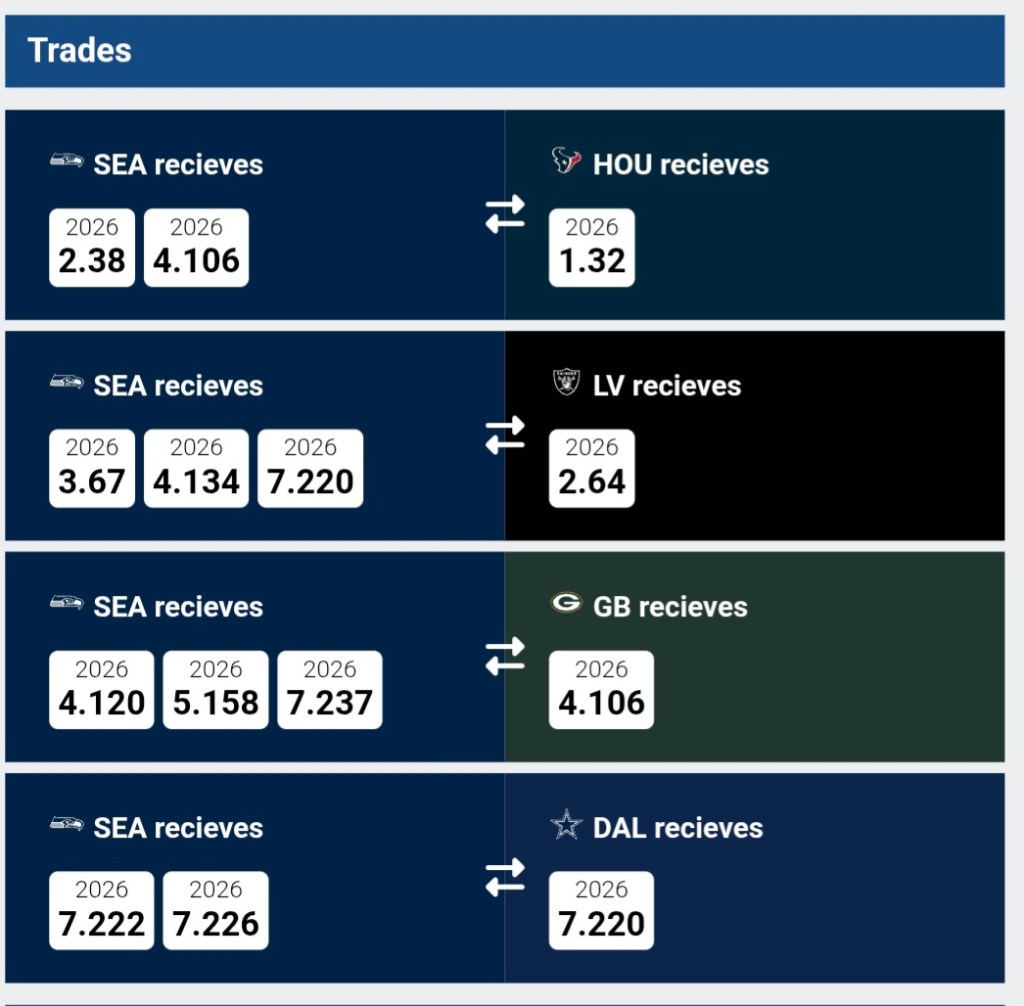
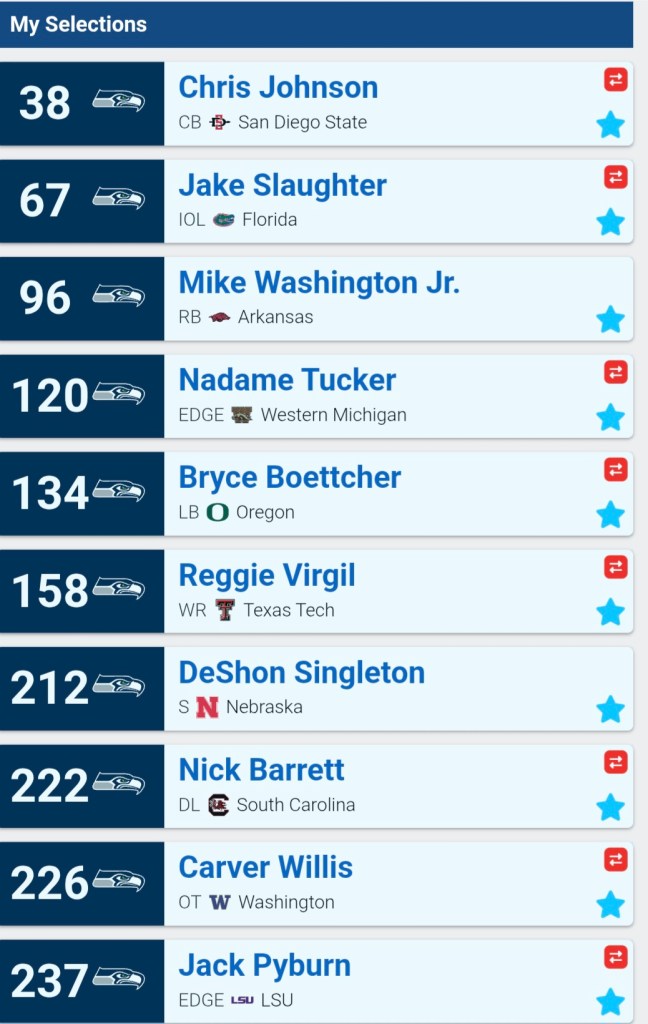
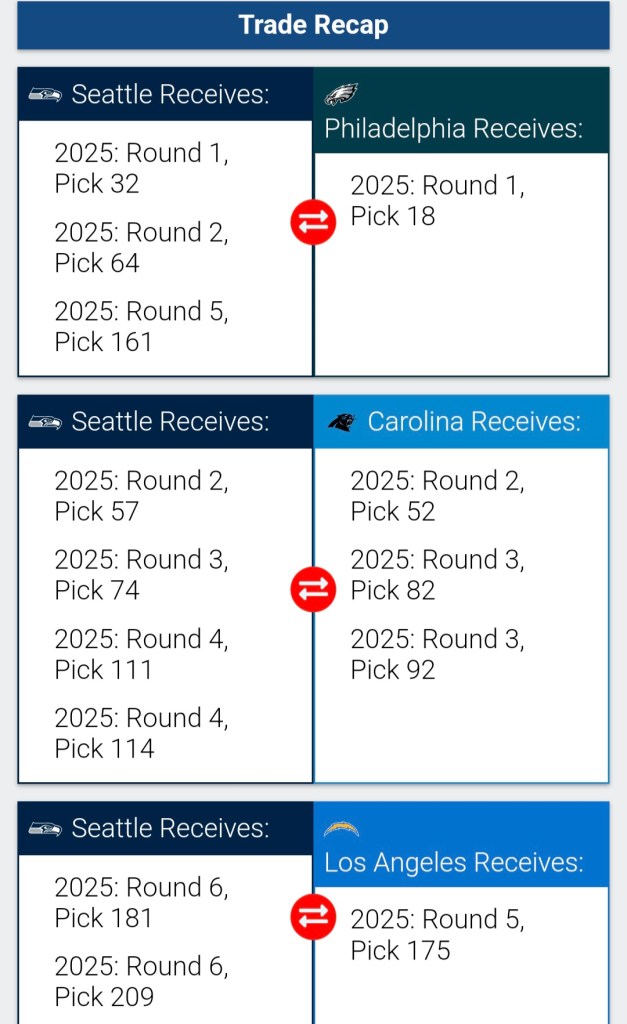
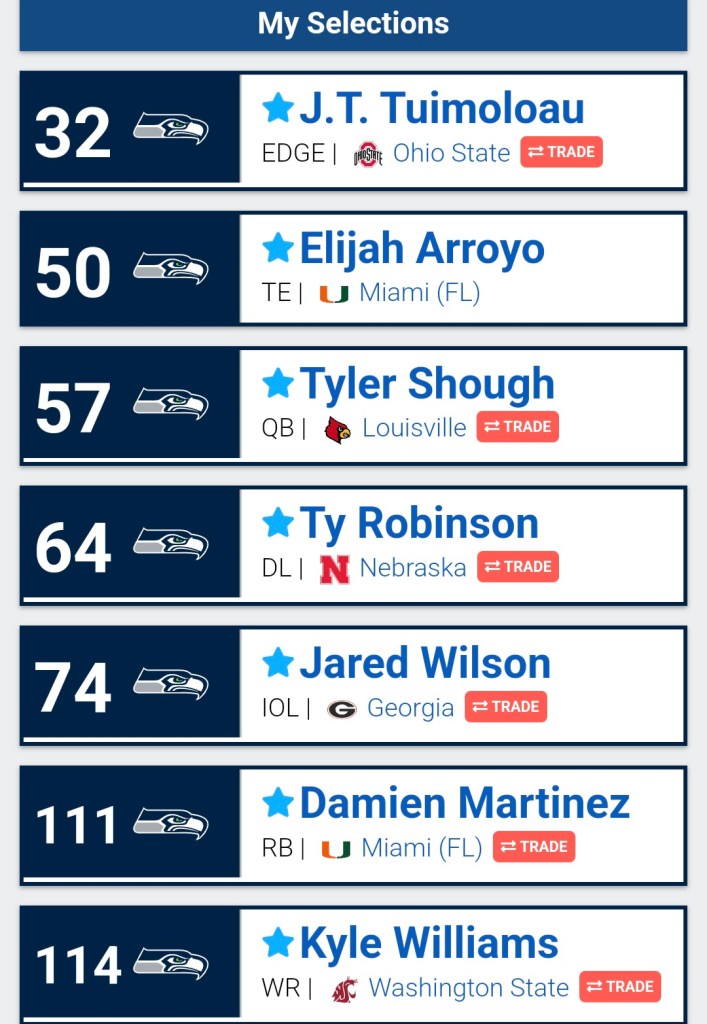
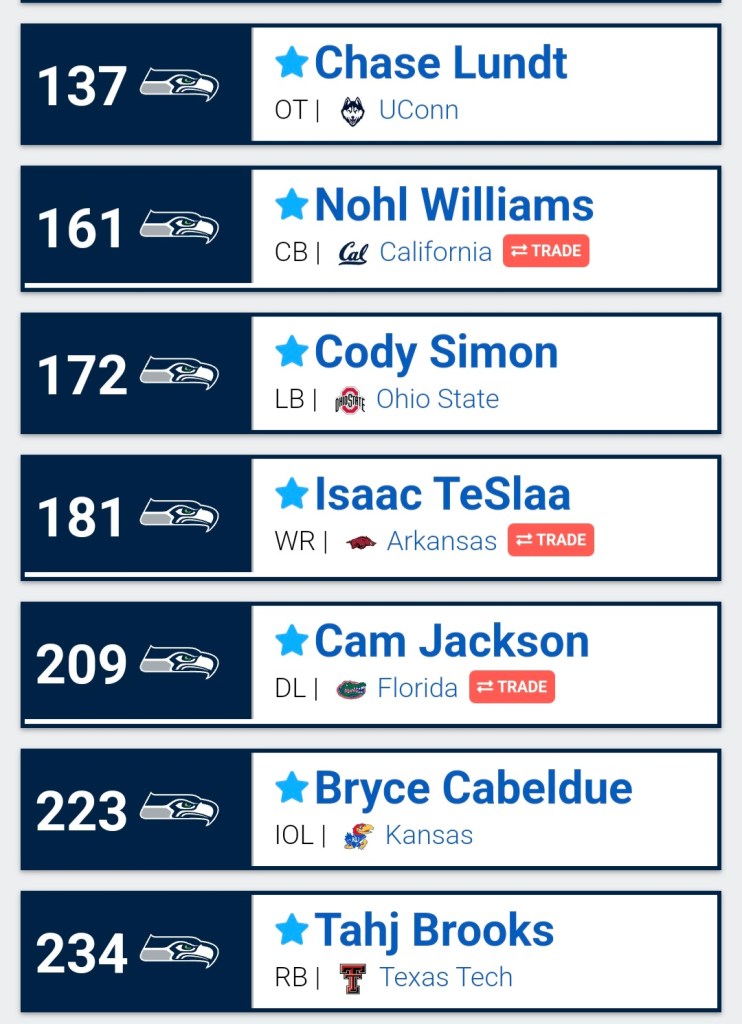
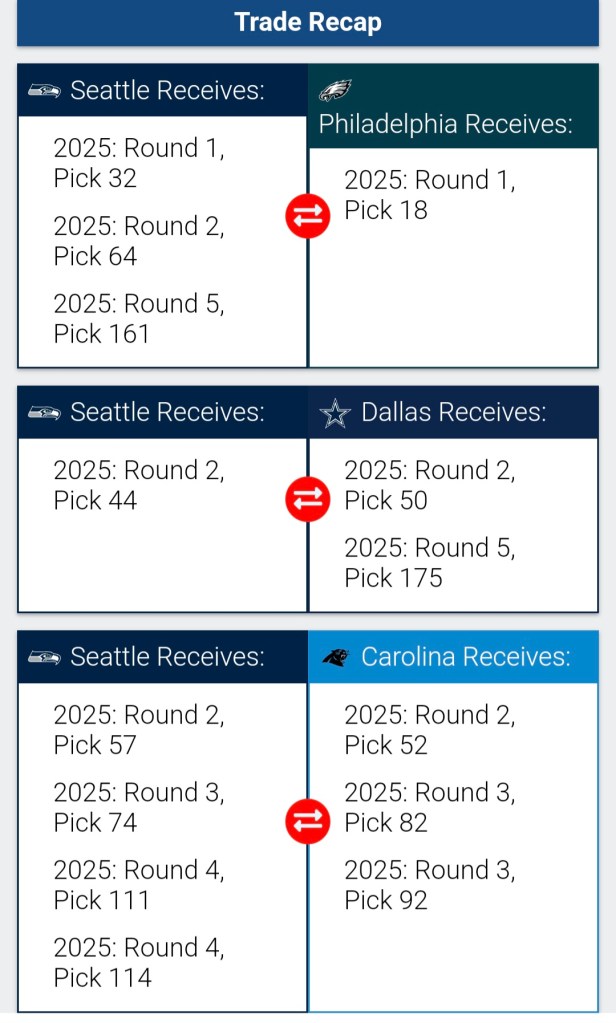


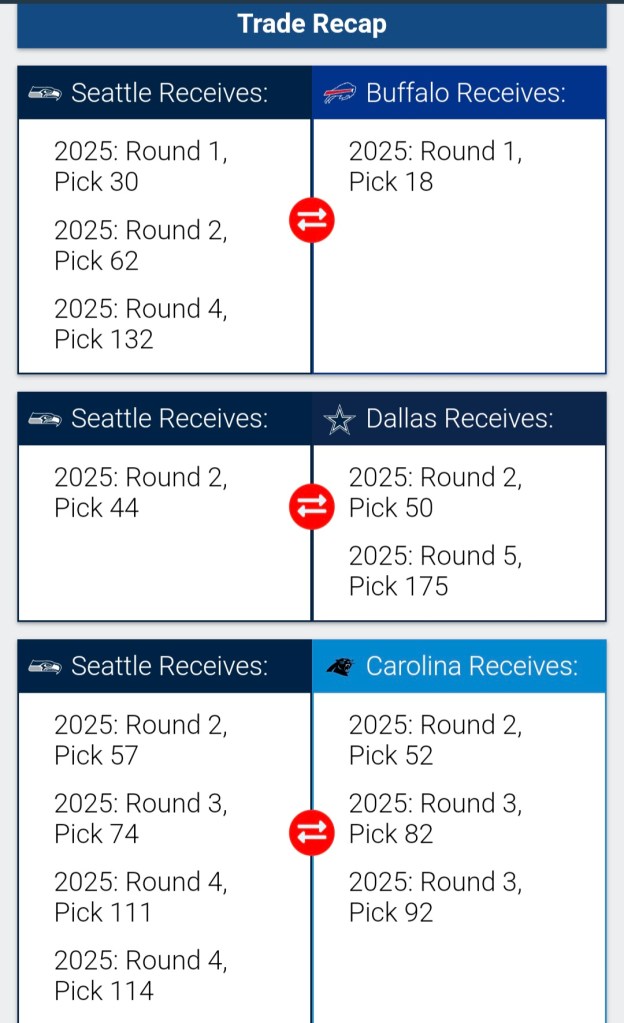
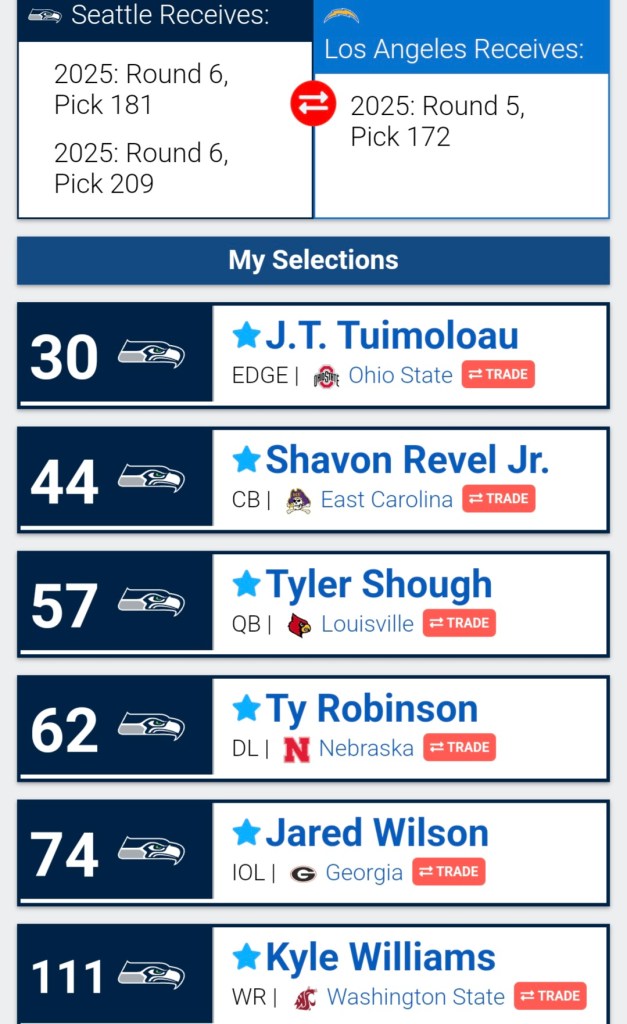
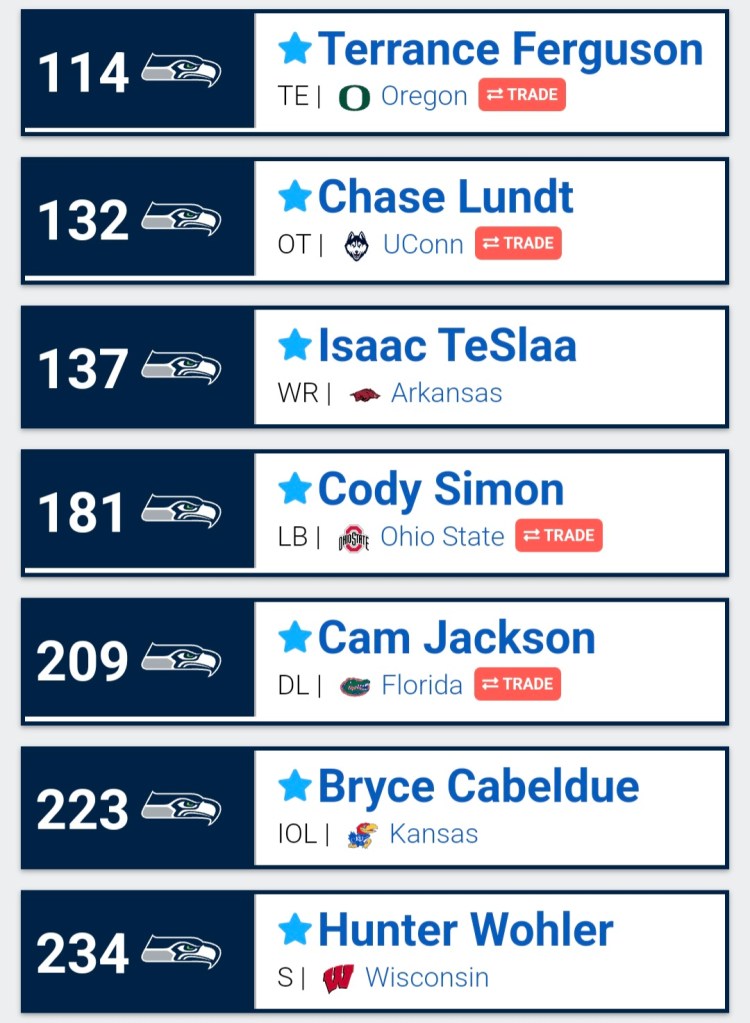
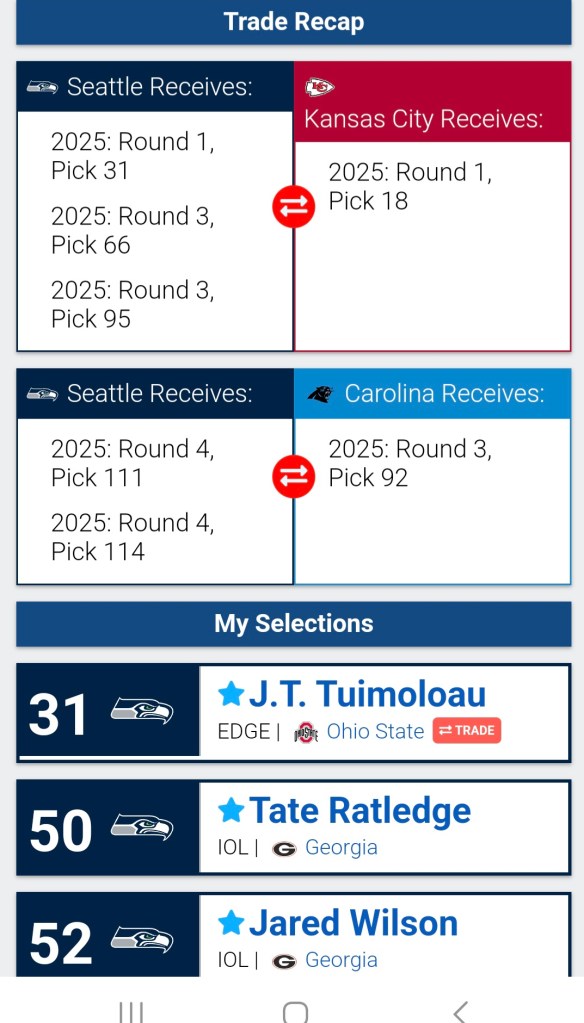
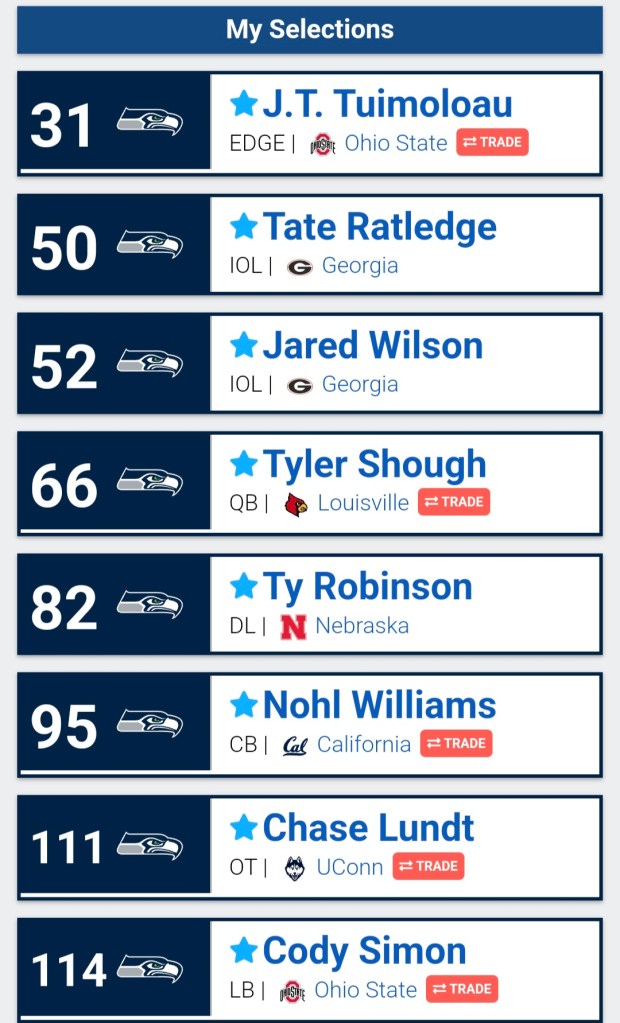
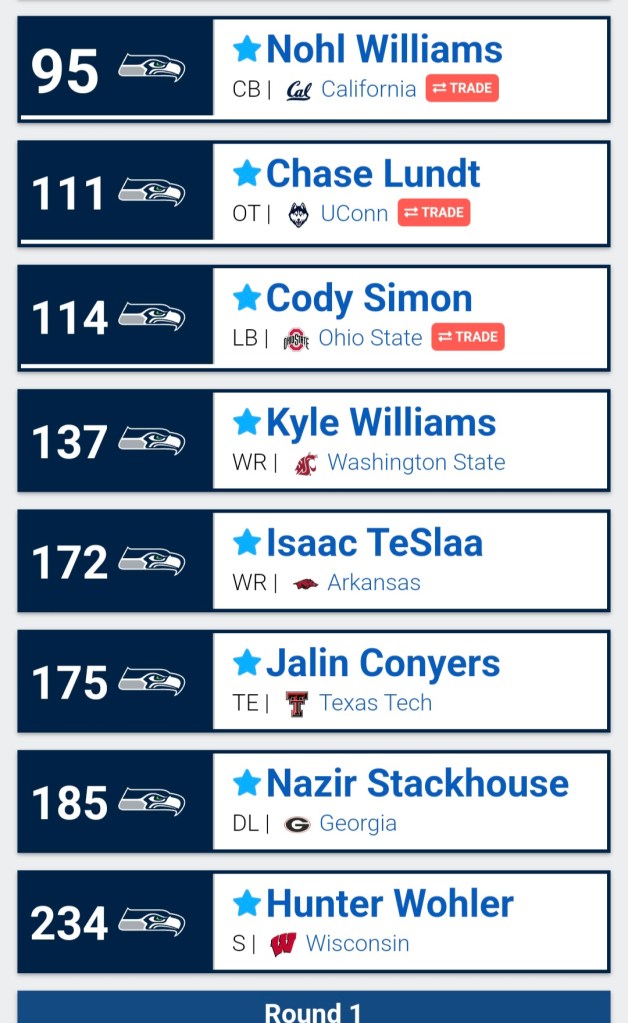
 Seattle Seamocks
You must be logged in to post a comment.