Seahawks draft targets: Edge Rusher

By Jared Stanger

As I’ve been locating, cataloging, documenting various aspects of this draft cycle; it started to occur to me there might be a post, or series of posts, illustrating various tiers of draft capital investment. In a big-picture view, this can help to establish positional priorities, and it may also lock in the tiers of talent across all positions that can help evolve a general draft strategy of when to focus your draft picks vs when to bail from draft ranges.

The first position group I’ve decided to take a closer look at is one that draft media has long said is a strength of this year: the Edge rushers. As I dug into the position in as comprehensive a manner as I could; I discovered multiple new names to add to my board, which I think supports the idea that this is a deep group.

Edge also feels particularly relevant to the Seahawks due to the news/rumors that came out during the trade deadline build-up where-in impending free agent Edge Boye Mafe was being floated as a trade away candidate. Seattle may be anticipating a good Edge draft and willing to let Mafe walk as a free agent for a potential compensatory draftpick, and replace Mafe with youth.

The format for these pieces, which I’m currently planning to do for all position groups, will be to identify a candidate(s) at a high price point (1st-2nd round), a mid price point (3rd-5th round), and a low price point (6th round-UDFA). These candidates will be weighted as much to what I believe to be current Seahawk traits under John Schneider as the buyer for a Mike Macdonald menu.

High round:

I did some pretty intensive research into what I think Macdonald likes in his Edge players. I tried to be pretty objective to the traits I think he likes, I allowed each player to have one category where they fell below standard, but they could not have two strikes against, and this led to some interesting eliminations, and certainly to some VERY interesting additions.

After going through multiple levels of eliminations; I only came away with one name still in consideration that currently has projection in the top 64 picks/top two rounds: Missouri Edge Zion Young. It should be noted there are five names that survived my process, and Zion finished fifth of five of those names.

Young has 15.0 TFL, 6.5 sacks, 11 hurries in 11 games so far this year, and he has projection in roughly the middle of the second round.

Mid round:

Again, I only came away with one player in this range: Miami Edge Akheem Mesidor. Mesidor had some interesting pings in studying the group. He has posted 12.0 TFL, 7.0 sacks, 4 hurries, 4 forced fumbles in 10 games. His consensus draft ranking puts him in the third round. I think this is an interesting idea. A trench player from a blue chip program is never far from Schneider’s heart.

Low round:

This is where I felt things got really interesting. This is where I came away with three names that survived all rounds of elimination without accruing two strikes. All three of these guys currently are projecting as undrafted free agent types. Some of that will change with decent athletic testing at the Combine. Some of that will change simply because the media is less aware of these guys than NFL teams actually are.

#1 – From SMU we have Edge Cameron Robertson, who has missed three games this year, but was back in the lineup for SMU’s most-recent game vs Louisville on November 22nd. In the eight games Robertson has played, he has posted 9.0 TFL, 5.0 sacks, 3 hurries.

#2 – From Central Michigan, we have Edge Michael Heldman. There’s something about the recent chatter about the Seahawks acquiring Maxx Crosby, a highly productive college player that came from Eastern Michigan and was drafted in the 4th round, that makes me intrigued with Heldman and the next guy I will talk about. Heldman has recorded 13.0 TFL, 9.5 sacks, 9 hurries in eleven games this year.

(Just for reference…Crosby in his draft year posted 19.0 TFL, 7.5 sacks, 7 hurries in twelve games.)

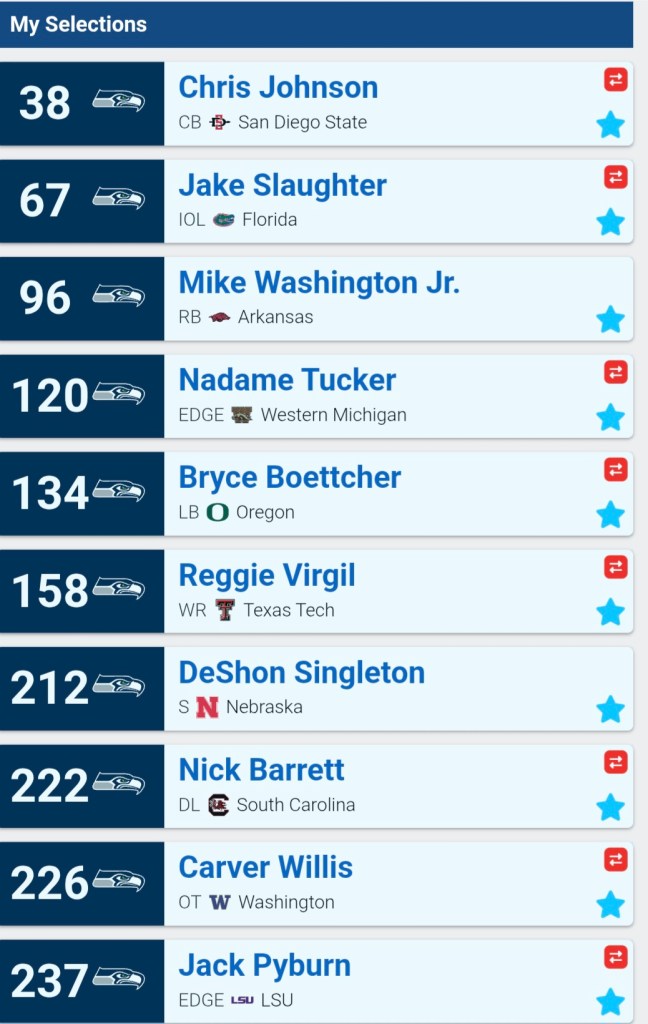
#3 – From Western Michigan we have Edge Nadame Tucker. Tucker was part of my recent mock draft that was primarily tape-based, and he looks even more intriguing after seeing him come out as still highly relevant in this more analytics-based study. He has 18.0 TFL, 12.0 sacks, 12 hurries, 4 forced fumbles in twelve games. He did come up short in one of my metrics, but in every other category; he really looked like a potential fit for Macdonald.

This is a very exciting player that draft media is not caught up on…yet.

I did a separate piece of analysis this week just trying to gauge Seattle’s interest in various position groups, and it really did make it seem they may be putting emphasis on Edge rusher(s). But then the question becomes: “does emphasis mean chronological priority?” Does needing an Edge rusher on your roster mean you force a pick on one in a draft that may see some quality guys fall further down due to depth of the class? Now, I’m not saying they wait until rookie free agency to get one of the three guys I highlighted as currently projected there…I suspect that will change by April. But it might mean you can get one on day three of the draft (like Crosby).

My priority list currently goes: Tucker, Heldman, Mesidor. In that order.

Mariners offseason plan

By Jared Stanger

I’ve been spending some time this weekend thinking about what the Mariners could do this offseason, after signing Josh Naylor, to improve upon their 2025 season. What combination best fills the holes of free agency while staying within the structure of budget that is certainly at play from ownership?

This is what I came up with.

I’m sure this won’t be the most popular structure, and I’m fairly certain the front office has a plan that will be perceived more popular, but this is my pretty objective thought.

#1 – Sign one of the posted Japanese players.

It’s been a minute since Seattle has had a substantial Japanese presence on the roster, but I think there is value, both on the field and off, to be found there.

I’ve targeted 3B/1B Kazuma Okamoto as the Japanese signing I would pursue. Yes, he is the older of the two big bats, but the power is not that much less, and I think the pitch recognition is so much better and should travel. I think many people think Okamoto is JUST a first baseman, but I like his tape at third, where he won Gold Gloves as recently as 2022, I believe, to be adequate to replace Eugenio Saurez.

As far as Geno…it’s hard to say goodbye to him. I think he brought an emotional character to the clubhouse that was important in both of his stints here. If Geno would be willing to take the same money as I’m proposing Kazuma takes; I would probably just keep the continuity with Geno.

Speaking of the contract…most industry writers project Okamoto gets 3-4 years, and then it’s a pretty wide range of money from, like, $12 to $16mill AAV. I’ve budgeted him at three years, $40.5 million, or $13.5mill AAV.

#2 – Trader Jerry season.

We may NEED to see some trades this winter. Having spent on Naylor, and with the club expected to spend decently on someone else in free agency, we’re going to need to augment the roster with some younger, cheaper, but still MLB-proven, players. We have the farm system that should support making some of these moves.

Trade #1: In my model, I found that if Jorge Polanco gets the contract he’s projected to get; it will be one of the better values in all of MLB. If Seattle does go that route…hey, cool. It’s probably not a bad move. But I, personally, just worry about extending too many of these players that are aging out of their prime.

So, my first trade would be to send the #75 prospect in all of MLB, and the #7 prospect on the M’s top 30, OF Jonny Farmelo, plus our #18 prospect, RHP Michael Morales, to the St Louis Cardinals for IF/OF Brendan Donavan.

The Cardinals have the #5 prospect in all of baseball, JJ Weatherholt, set to debut in 2026, so they’re going to need a position for him to play, and so maybe they make Donovan available.

Donovan has position flexibility, but he spent 82 of his 97 starts last year at second base, and that will be where I pencil him in for Seattle in 2026.

In terms of the return going to the Cards…honestly, this is my most important trade, so I give them their first choice of any of our #6-#8 prospects, Michael Arroyo, Farmelo, or Jurrangelo Cijntje. But when I looked at their farm system; it just felt like they could use outfield help more than 2B or pitching.

Donovan is an Arbitration-2 player about to turn 29 in January, with club control through 2027, and he should cost roughly $5.75mill this year. Last year he hit .287/.353/.775 with 10 HR, 50 RBI in 118 games.

Trade #2: In order to replace some of the power lost by Polanco not being re-signed; I’m going to try to add some in the outfield. I am sending the Detroit Tigers #8 prospect SHP Jurrangelo Cijntje plus OF/IF Luke Raley in order to acquire OF Kerry Carpenter.

Carpenter destroyed Seattle in the postseason, so Mariner fans may have some mixed emotions about this one, but Carpenter is a 28 y/o who hit 26 HR in 130 games last year, with a slash line of .252/.291/.788, but a career OBP of .322, so we’re gonna try to straighten some of that back out.

Raley ends up the short straw between he and Dom Canzone in terms of who we would prefer to retain as a bench lefty outfielder. His ability to backup 1B is also now covered by Okamoto. There just really isn’t space for him, and he’s also the more expensive of he and Canzone, as he was projected to make $1.75mill next year. That’s not nothing when we’re pushing as hard as we can up against the “salary cap”.

Carpenter has three years of club control remaining, and he should cost about $3.5mill this year depending on arbitration. He may end up in true platoon with Victor Robles in right field, as Carpenter hit righties at a .257 clip while Robles hit .213 against them, and then Robles hit lefties .289 while Carpenter hit .217 off them.

I’m sure a lot of fans, and probably the front office, bristle at the idea of trading away Cijntje, but we’re holding onto Ryan Sloan and 2025 first rounder Kade Anderson, who probably fit better in the timeline of our pitching development/cost progression anyways. I felt like we NEEDED to part with someone quality to get an MLB player with “now” ability and cheap club control. That looked like Cijntje.

Trade #3: I’ve got a couple of smaller trades that fans may not immediately recognize, but trust me…I didn’t so much fucking homework on these. I’m sending 2B Cole Young to the Kansas City Royals for righthanded reliever Lucas Erceg.

Erceg kind of ends up a cap casualty for the Royals who have probably a tighter budget than Seattle, and will have multiple arbitration raises to work through. Erceg is a bit older as he will turn 31 early in the 2026 season, but he has club control through 2029, and should cost about $2.00mill this year. It’s not that different from when Seattle got ahold of Paul Sewald in his age 31 season.

Erceg has been a very solid reliever for the last two years between Oakland and Kansas City posting sub-4.00 ERA’s including a 2.64 mark last year. His strikeouts were down a bit in 2025, but his velo and pitch metrics are still very strong.

Young becomes somewhat expendable with Donovan acquired and Colt Emerson nipping at his heels in AAA already. Emerson may, eventually, be the replacement for JP Crawford at SS in 2027, but he probably has to start somewhere else when he debuts in 2026. In a scenario where Emerson plays 2B; Donovan could play LF with Randy Arozarena benched vs RHP. The Royals like this trade as they can either make Jonathan India available in trade immediately, or slot Young in as his replacement in 2027 and give him another year to develop.

Trade #4: This is the smallest, but perhaps sneakiest, trade of all. I’m sending #12 prospect OF Tai Peete to the San Francisco Giants for lefthanded reliever Erik Miller.

Miller is a big boy at 6’5″/268lbs and he posted a 1.50 ERA, but pedestrian 6.0 BB/9 and 6.6 SO/9 numbers across 36 appearances and 30.0 innings for the Giants in 2025. His season ended early when he was placed on the IL in early July with elbow soreness from which he never came back. Obviously, this trade would be contingent on a physical, but I like the “buy-low” nature here in order to acquire a lefty that touches 99mph with run. And he’s only 28 in February with club control through 2029 and should only cost $820k this year.

Even if the injury is still not fully resolved; there is enough meat on the bone that this could be a useful trade across the life of the deal. This could end up sort of resembling when Seattle acquired Andres Munoz while he was in injury recovery for the Padres. We got Munoz on August 30, 2020 after he didn’t appear at all for SD that season, and he didn’t pitch for Seattle until October 3rd, 2021.

After all of these transactions, the Mariner rotation remains fully intact. The defense should be better with Donovan > Polanco, and potentially Ben Williamson starting at 3B with Okamoto at DH. Power rates may be down a bit, but contact rates should be better (really, we are mistakenly taking credit for Saurez’ 49 homeruns, when in fact he only hit 13 for SEA). The farm system maintained our top 6 prospects, along with keeping guys like SS Felnin Celesten, C Luke Stevenson, OF Yorger Bautista, SS Nick Becker from the top 15. And we didn’t blow our remaining (expected) $23mill budget surplus on one guy. We’ve addressed 2B, 3B, OF, RHP, and LHP. We’ve got relatively younger without becoming inexperienced, and we’ve left room for minor league promotions.

New Roster:

C- Raleigh, Ford
1B- Naylor, Okamoto
2B- Donovan, Rivas
SS- Crawford, Rivas
3B- Williamson, Okamoto
LF- Arozarena, Donovan, Canzone
CF- Rodriguez, Robles
RF- Carpenter, Robles, Canzone
DH- Okamoto, Carpenter

SP1- Woo
SP2- Gilbert
SP3- Kirby
SP4- Castillo
SP5- Miller

CL- Munoz
RHRP- Brash, Bazardo, Erceg, Hoppe
LHRP- Speier, Miller, Ortiz

Seahawk November mock

By Jared Stanger

We’re now a week past the trade deadline and we have an update on what picks the Seahawks have left after acquiring Rashid Shaheed from New Orleans. It is commonly being reported that Seattle has four picks left, but I think it’s five*. At the end of the preseason, we traded OT Mike Jerrell to Atlanta for a conditional 7th round pick. I did some digging and I don’t see any reason why people aren’t counting that pick other than, possibly, they’re cynical that Jerrell will hit the triggers (most likely games active or season snap count rate) to secure the pick for Seattle. But for now I’m going to include it.

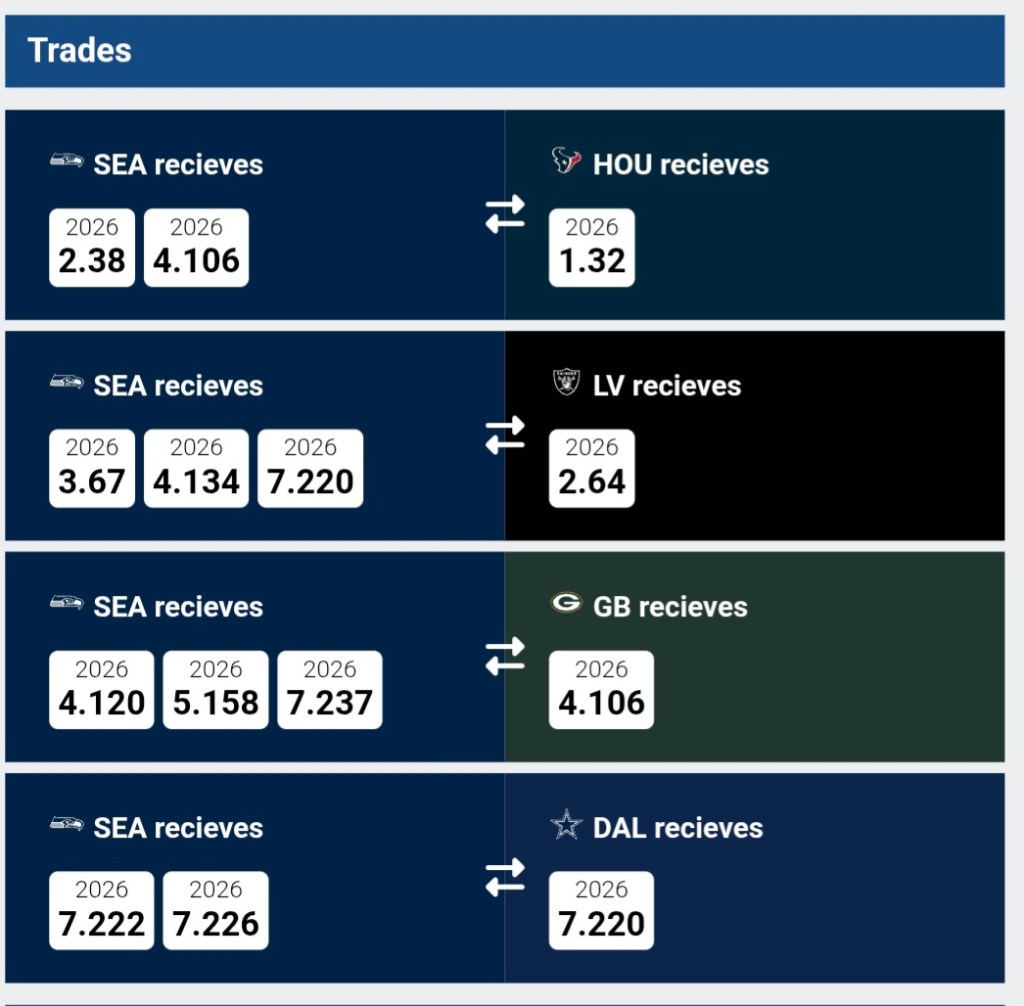
So, Seattle has the picks at roughly #1.29, #2.61, #3.93, #6.207, #7.224. If we get to the draft and haven’t traded our first round pick for a veteran player; I really think John Schneider will trade back their first to get some more picks. I’m actually projecting two trades: #1.29 goes to Cleveland for picks #2.38, #4.104, #5.151 and then I have our pick #3.93 going to Denver for pick #4.103 and #4.130. Final draft pick allotment:

#2.38
#2.61
#4.103
#4.104
#4.130
#5.151
#6.207
#7.224

The next thing I’m taking a look at to inform this mock draft will be the Seahawk 2026 unrestricted free agents. We’re due to lose CB Josh Jobe, Riq Woolen, and Shemar Jean-Charles, DE Boye Mafe, LB Chazz Surratt, OT Josh Jones, RB Ken Walker, S Coby Bryant, WR Rashid Shaheed and Dareke Young. TE and DT have really good continuity into next year.

Seeing three CB as potential roster losses, and then knowing that this draft is not that strong at CB is a huge problem, to me. I’m kind of pushing a pick up for need, but it’s not a huge problem because some of the other positions we “need”, like WR and DE, have pretty good depth in this class.

#2.38 – Cornerback, San Diego State, Chris Johnson

I think we need to re-sign one of Jobe or Woolen, but then also draft a CB as early as possible. Johnson was in my previous mock but at a later round. Now I’m just cutting to the point. He’s 6’0″/195lbs, and for the year so far he has 3 INT, 7 PBU, 40 tackles, 2.0 TFL.

#2.61 – Center, Florida, Jake Slaughter

Personally, I just don’t think Jalen Sundell nor Olu Oluwatimi are the future of our Center position. We need to actually address it with some urgency. Slaughter was my favorite college center in the 2024 season, and I haven’t really seen much to move someone ahead of him. I know Logan Jones from Iowa is a touted athlete with good zone blocking experience, but I just like Slaughter’s brain more.

#4.103 – Quarterback, Duke, Darian Mensah

Obviously, the narrative has changed on Sam Darnold. But it’s probably not the last time it does. He’ll be recency biased to death based on his two most recent games for a while.

That isn’t really what this mock pick is about. I’ve never been a fan of Drew Lock, and I’ve consistently had my doubts on Jalen Milroe. I would like to take another midround shot at finding a developmental QB. Maybe Sam Darnold continues his current play and Mensah will be an inexpensive backup QB for 2-4 years, maybe Darnold reverts to his Jets’ form and Mensah becomes a starter sooner than we’d guess in November 2025. Doesn’t matter. One thing this draft does have is depth at QB. The first round may be a QB landmine, but there are a number of guys with middle round projection and yet some upside.

Mensah is listed 6’3″/205lbs, and currently playing to a 69.8% completion, 8.7 ypa, 24 TD to 4 INT, and a 165.07 passer rating. Basically, top 15 numbers for all QB’s this year. He is a redshirt sophomore this year after spending two years at Tulane, the most recent of which he started 13 games.

#4.104 – Linebacker, Texas Tech, Jacob Rodriguez

I think we’ve seen enough of the Mike Macdonald defense over the last year and a half to recognize it can be massively impacted by not having the right kind of guy playing linebacker. Ernest Jones really stabilized that position when he was acquired last year…Drake Thomas has been doing some really interesting things since becoming a starter a few weeks ago…Tyrice Knight had probably the best game of his career this week with Jones inactive with his injury. All of those guys have team control for at least another year. Rodriguez is just gonna be a guy we use to take the roster spot of Surratt, while also believing Rodriguez could slip into that green dot player a year or two down the road.

Rodriguez is listed 6’1″/235lbs, and he’s putting together an impressive 2025 campaign with 91 tackles, 9.5 TFL, 1.0 sack, 3 INT, 5 PBU, and he leads the country with 7 forced fumbles.

#4.130 – Offensive Line, Boise State, Kage Casey

I like this class of Guards, with a few that are college Tackles that likely kick in to Guard. For me, I’m drawn to a guy that CAN play tackle so that we have a de facto replacement for Josh Jones, but then you also get another warm body to challenge for the starting Right Guard job.

Casey is listed 6’5″/311lbs and he’s a very Northwest guy…college in Idaho after high school in Oregon. It’s a fun story to close the circuit going pro in Washington.

#6.151 – Wide Receiver, Duke, Cooper Barkate

After trading for Rashid Shaheed, and the subsequent press conference commentary that it seems Shaheed and the Seahawks will look to create a contract extension for him; I think we can look for a different type of WR in the next draft. In a literal sense, we’re looking to replace Dareke Young on the roster, but watching Barkate’s tape I also found myself thinking of a different receiver.

Barkate is listed 6’1″/195lbs, and so far he has posted 50 catches for 824 yards, 16.48ypc, and 5 TD in 9 games.

#6.207 – Edge Rusher, Western Michigan, Nadame Tucker

I have this idea of what Mike Macdonald covets in his Edge Rushers. Tucker is not that. After including the Macdonald type guy in my outline prior to writing this mock; I kind of abandoned it and went with the guy that looks like a potential future NFL contributor that was available late in the draft. This is a draft with some projected depth at DE, so we’re hoping to hit on one from that depth.

Tucker is listed 6’3″/250lbs with 38 tackles, 15.0 TFL, 9.5 sacks, 8 hurries, and 3 FF for the year. There have been numerous reports that Seattle was close to trading away Boye Mafe last week, so it seems we need to be expecting that he won’t be back for 2026 once he enters free agency next March. The big question going forward is: “what is their idea for replacing him?” Do they have a DE trade in mind that they may revisit after the season? Is there someone on the roster or practice squad that they see upside in, and will look to elevate next year? Or, are they thinking they could trade Mafe away and find someone in a deep DE draft?

#7.224 – Running Back, Miami, Mark Fletcher

Ken Walker is another impending free agent, and it’s really not clear what Seattle might intend to do with him. For the first half of the season, they’ve really been closely monitoring K9’s pitch counts. Are they simply trying to maintain his health to get him to the postseason? Or, maybe, more cynically, they may be trying to keep his free agent price lower so as to allow them to re-sign him cheaper.

Fletcher is listed 6’2″/225lbs, and has 636 yards rushing and 9 TD’s for the year.

The only free agent I haven’t really addressed via draftpick is Coby Bryant. I do have a short list of priority free agents, one of which is Nebraska Safety Deshon Singleton. In a down draft year; it’s tough to expect much, if any, talent to fall to undrafted free agency, so these names can be taken with a grain of salt, but right now I’ve got names like Singleton, LB Jack Kelly, OG Justin Pickett that would be amazing to sign after the draft.

Seahawks Mocktober

By Jared Stanger

Tomorrow marks, roughly, week six of the college season, so we’ve got a pretty good idea of the players that have fallen out of favor from preseason mocks, and those that are rising to replace them. Unfortunately, it appears more and more like this isn’t a good year for the draft. Certainly, not in the first round. If the Seahawks were to trade their 2026 first rounder for some kind of veteran blue chip player that will help us right now; it would be a very calculated and shrewd move. I’m not going to project that move. Anyways, outside of Maxx Crosby, I’m not sure there are many of this caliber player that are also on bad teams right now, that Seattle could acquire.

I tend to think John Schneider will make some kind of move(s) prior to this trade deadline. Those moves would inevitably include some kind of draft compensation switching hands. I have a couple ideas on those types of moves I would like to see, but I am not including them in this mock. We can revisit the post-trade-deadline draft capital in November.

For now…Seattle only owns six 2026 draftpicks. Those picks fall roughly at: #1.23, #2.54, #3.85, #4.120, #5.160, #6.183.

In terms of Crosby and the Edge rusher position…I would LOVE to acquire that type of player. I have such roster envy when I see the teams with elite edge rushers. But…I have documented Mike Macdonald’s own words describing that his defensive scheme is designed to be a team passrush by design. He doesn’t NEED that elite edge rusher. Would he take one if one were to fall in the Seahawks lap in the draft?? Probably.

That brings me to my next point: when I studied this overall draft class in terms of depth of talent; I found that the two strongest positions were quarterback and edge rusher. Does this mean 1st round grade? Not necessarily. But I feel confident that if you take a dart-throw at one (or both) of those positions as a late 1st round positioned team, all the way back to the third, maybe fourth, round; you have a puncher’s chance of hitting on something great.

For me, with Sam Darnold playing as well as he has, at the contract value he is playing under, with two more QB on the roster for cheap through (at least) 2026, and with the way this college QB class is still painfully moving through transition of who the media THOUGHT would be the relevant QB’s in preseason to the eventuality of the guys that will ACTUALLY be the 1st round names and later the NFL franchise guys; I just can’t imagine Seattle’s first round pick is a QB.

I could see this more like the scenario we saw unfold in the 2025 draft where Seattle took their top guys at positions the NFL undervalues, or they could force drafting players from the shallower position groups this class that line up with Seattle “needs”. I think it’s too early to present a mock of the latter in terms of the 1st round. My mock drafts are always based around the current market price of players, and as such, in October, I can still find those need positions at later rounds.

My pick for the first round will be following the strategy of drafting from the strength of the particular draft class.

#1.23 – Defensive End, Oregon, Matayo Uiagalelei

Matayo Uiagalelei is a 6’5″/272lb junior OLB/DE. He is the brother of Charger backup quarterback DJ Uiagalelei, and cousin to UW edge Taitai Uiagalelei. He is the leading passrusher for the #6 defense in the country and his 2025 statline goes: 11 tackles, 5.0 TFL, 4.0 sacks, 2 hurries, 3 PBU.

The Seahawk roster currently has Demarcus Lawrence on a three-year deal that could be a one-year deal with only $4.6mill dead-cap in 2026. Uchenna Nwosu has one more year left with an $8.5mill dead-cap hit. Boye Mafe is on the last year of his rookie deal, and Derick Hall has one more year remaining on his. We do need some reinforcements at the Edge position.

Matayo vs the run:

Matayo passrush:

#2.54 – Cornerback, SDSU, Chris Johnson

In my opinion, Seattle needs get more out of their corner and inside linebacker rooms. They may address one, or both, of these positions via trade in the next few weeks. In the meantime, I am addressing both in the draft.

Chris Johnson is a 6’0″/195lb senior corner for the Aztecs with 29 tackles, 1.0 TFL, 2 INT, 6 PBU, and a FF on the year. As with most of my October mock drafts every year; many of my early picks will be higher on media boards by April. But for now we can get CJ here.

I have yet to find many suitable CB for this draft class, which puts a higher priority on drafting one than many other positions. I could, conceivably, see Schneider draft one in the 1st round with two of his current starting CB set to be free agents.

#3.85 – Linebacker, Cincinnati, Jake Golday

After two years of Mike Macdonald, it has become clear how important the inside linebacker position is to him. And he has no patience for guys that can’t grasp his scheme. The only mild surprise is that he hasn’t used more resources to secure quality players at the positions.

Jake Golday is a throwback to a prior era of linebacker as a 6’4″/240lb athlete at the position. He has 49 tackles, 3.0 sacks, 1 PBU, and a FF on the year. He will rise throughout this process.

#4.120 – Quarterback, Missouri, Beau Pribula

After five weeks of NFL football…I think the conversation on Sam Darnold is turning from “his contract makes it easy to get out of his deal after a year” to “this is a great, cost effective contract to have on our starting QB for the next three years.” I don’t mind that because I, personally, am not a fan of our backup situation. I’ve never liked Drew Lock, and I still have considerable reservations on Jalen Milroe. I don’t mind drafting another QB in a middle round in 2026, giving him two years to backup Darnold and learn the system (and the league), and then trade away one of Lock/Milroe for draft capital. As long as we’re using mid-round picks to do it; I think it’s a worthwhile endeavor.

At the same time…this quarterback draft class is completely off the rails. The preseason guys have completely fallen off. Off fell Nico Iamaleava, and Sam Leavitt, and Cade Klubnik. Still falling off are Drew Allar and Garrett Nussmeier. I still have my doubts about Carson Beck, but at the moment I can’t say his play has fallen off. And then I think Arch Manning and Lanorris Sellers are prime candidates to stay in school another year.

Rising in their places: Fernando Mendoza, Julian Sayin, Jayden Maiava, Luke Altmyer, Dante Moore, Ty Simpson, Darian Mensah, Sawyer Robertson, and Beau Pribula. I’ve sort of tentatively circled the trio of Altmyer, Robertson, and Pribula as the three I’m focusing on. All three have had reasons to be excited so far.

Robertson leads the country in passing yards and passing TD’s.

Altmyer is second in the country in YPA, 7th in comp %, 5th in passer rating, and he’s one of three QB in the country with at least 10 TD and 0 INT that have thrown over 140 pass attempts (but the only one from a power 5 school).

Pribula’s highest ranking is completion % where he ranks third in the country, but he has Mizzou undefeated and the #14 team in the country.

I’ve recently had to cut back on my ranking of Robertson because of comments he has made in press conferences that, I think, point to him not having the personality I seek in a leader that wants to win like a sociopath. Like, I think he’s a mentally healthy human being, but mentally healthy human beings don’t generally win Super Bowls.

I have my reasons for choosing Pribula over Altmyer…most of which I’m not going to get into in this mock. Suffice to say; he is my current pick until his draft stock rises and I have to make some tougher choices. At the moment, I’m thrilled to get him in the third round.

#5.160 – Tight End, Missouri, Brett Norfleet

This is NOT a good class of tight ends. Certainly not compared to the 2025 class. It would be incredibly smart for a few junior TE to declare early. That’s what Norfleet is. He’s a physical specimen at 6’6″/260lbs, and I’ve enjoyed seeing his physicality in his run-blocking and pass-catching when I’ve been watching Pribula’s tape. His numbers aren’t overwhelming at 20 catches, 174 yards, 8.70 ypc, but 4 TD’s is good enough for tied for 24th in the country in receiving TD for all targets, and tied for first amongst all TE.

#6.183 – Guard, Duke, Justin Pickett

There was a draft of this mock where I had Seattle taking ANOTHER first round Guard. That might be pushing John Schneider too hard on something he isn’t totally comfortable doing, after he finally broke from tendency and drafted Grey Zabel in the first last year. I’m not sure if a Center would also be pushing it, too (I do love Jake Slaughter, but he might only cost a second, anyways).

But also, I started looking at Justin Pickett. He is a 6’7″/320lb senior OL on the same side as the buzzy draft name, Brian Parker, only Pickett gets like 1% of the same publicity.

One of my favorite things to do in mock drafting is to draft backwards. Who are the guys you absolutely love, that you would bang the table for, that are currently available in the 5th-6th rounds? Okay, write those guys in pen in those late rounds FIRST, and then circle back to the top of the draft where you can take other positions with even less pressure to take a need.

I have a pro player-comp for Pickett in mind, which I can’t put on record right now. I will say the comp is a pro bowl player that was drafted on day three of his particular draft.

Pickett is #77 in these couple snaps, playing at right guard. That first snap looks like a textbook mirror drill from the NFL Combine.

I’m aware that this mock draft is lacking. It’s lacking in volume, for one. It’s lacking in player for pick trades, and it’s lacking in any kind of trade back within the draft to add picks. And, I think, it’s lacking in a WR.

Some drafts you go into them trying to find stars, some drafts you go into them trying to fill free agent holes on your roster, and some drafts you go into them looking to make pointed improvements to your returning roster. For me, this year is kind of the latter. Can we improve RG over Anthony Bradford? Can we improve TE over Brady Russell? Can we improve QB over Drew Lock? Can we improve LB over Tyrice Knight? Can we improve CB over Riq Woolen? Can we improve DE over Uchenna Nwosu?

The 2026 Seahawk roster is in a good place. Our impending unrestricted free agent list goes: Josh Jones (backup OT), Boye Mafe (0 sacks), Johnathan Hankins (still on NFI), Ken Walker, Josh Jobe, Eric Saubert (TE3-4), Chazz Surratt (LB4-5), Coby Bryant, Riq Woolen, Dareke Young (WR5). That’s maybe five starters, but one of which we may already be actively shopping in trade and likely won’t be re-signed. If you did nothing else in terms of free agency; the mock draft I’ve laid out above gets you replacements for Mafe, Saubert, Surratt, Woolen without spending a dime above rookie contracts. And then some of the 2025 starters become 2026 backups. You’ve lengthened your lineup. Which might be the best case scenario for this draft cycle.

Mariner 2025 draft redux

By Jared Stanger

The 2025 MLB Draft is now in the books. Teams have three more days, I believe, to sign their draftpicks from this class, and so we have bonus figures on over 80% of the total player pool. Something I’ve done for a few years now after the draft is to put together a post-draft mock that incorporates the actual draft position of players, as well as factoring the bonus figures they sign for, in order to document a plausible full draft that Seattle could have made.

My rules for this:

Obviously, I can’t draft someone at pick #35 that came off the board at pick #34. I do allow myself to “reach” on players as much as I want.

The 21 total draft selections must be players that have signed with their respective teams. I can’t pick a high school player, for example, that turned down opportunity to go pro in favor of attending college. I do allow myself to draft a player that went undrafted, but signed as UDFA.

The 21 players’ bonuses must total under the bonus pool Seattle went into the draft with, and, for picks in rounds 11-20, any bonus over $150,000 will count towards the bonus pool for rounds 1-10.

Lastly, it’s not a rule, per se, but I did have a guideline where I tried to draft the same as Seattle did in terms of position ratios. Seattle drafted 13 pitchers, 8 bats…so that was my target. If Seattle drafted three catchers…I tried to draft three catchers. But sometimes I would fudge a bit in order to match traits (power righthanded bat) instead of defensive position.

One more note before we start…I had heard before the draft that Seattle was struggling to find a way to actually spend the amount of bonus pool money they had, which was the second-biggest pool in all of MLB. I kind of get that now. It really was hard to find ways to spend the last, roughly $800-900k. Once you get out of the top 75 picks, or so, there really aren’t many high school players that received overslot deals, and that I also liked as prospects.

I had briefly considered taking someone other than Kade Anderson at pick #3 in order to see how a bigger underslot deal there could affect the rest of the draft. It really wasn’t going to do anything for me beyond the third round. And it wasn’t even much of a difference-maker in terms of who I could target in the top 100 picks.

So we begin the same as Seattle.

#1.3 – LHP, Louisiana State, Kade Anderson

The only other real thought for me here was to reach on Patrick Forbes. I really liked Forbes. Forbes was picked at #1.29 and signed for $3.00mill. That’s $5.8mill less than Anderson got. And I can’t take Forbes at the Mariners’ next pick at #35. The optics just don’t work.

I don’t love Anderson as a prospect. I think he’s more similar to Emerson Hancock than Logan Gilbert, etc. But Hancock has made it to the show, and he’s had some good stretches of pitching in Seattle. He may still get better in time. But if you re-drafted 2020 now and still took Hancock at #6 over Garrett Crochet (pick #11), Pete Crow Armstrong (pick #19), Jordan Westburg (pick #30); I think you’re crazy. There will be players taken after Anderson that are better than him. And Forbes might be one.

Obviously, Anderson maintains the same bonus of $8.8mill.

#1.35 – SS, Don Bosco Prep, Nicky Becker

This pick and the second round pick could be interchanged with no real difference in the grand scheme. I moved Becker up because as the actual draft was unfolding; I was uncomfortable with how slim the prep shortstop board was getting, and I would have pulled the trigger on Becker here.

He gets the same bonus here that Seattle gave him at #57: $2.75mill.

I am passing on Luke Stevenson because there is a lefthanded college catcher further down the board that I prefer.

#2.57 – LHP, Lyndon B Johnson HS, Johnny Slawinski

Seattle drafted a prep lefthanded pitcher in their actual 19th round in Cam Appenzeller, who quickly confirmed he was already on campus at the University of Tennessee and wasn’t sure why Seattle drafted him.

In my case, I get my favorite prep lefty, and he did sign with the Angels for $2.5mill.

#3.91 – 3B, Foothills HS, Tim Piasentin

This is the biggest move away from Seattle’s actual draft that I am making. Seattle did not draft any third basemen, and were pretty limited in the number of prep players they drafted. I thought all along leading up to this draft that the best move was to be aggressive on the upside of the prep players, rather than the high floor with little upside of the college class.

I liked Piasentin pre-draft, but had never really found a spot for him without knowing his bonus request. He signed with Toronto for only $747,500, which is only about $100k more than what Seattle actually spent on Griffin Hugus with their literal third round pick. I think that’s a steal.

#4.122 – RHP, UNCW, Zane Taylor

I had Taylor in my mocks pre-draft, and I still think Seattle should have drafted him. His now stuff profiles very well to me, and he cost $36k less than what they paid Mason Peters. The thing I noticed about Seattle’s actual draft class this year was that they seemed to be avoiding guys that were older, true “senior sign” candidates. Which, to me, is a weird thing to decide as a wholesale strategy. But Seattle drafted some older guys in 2024, and have had numerous injury issues from that class, so maybe this is their fix for that.

#5.152 – C, Wright State, Boston Smith

Again, Smith was in most of my mock drafts. He’s a lefthanded, power-hitting, good defensive college catcher. Very similar profile to Luke Stevenson. The difference is…age. Stevenson is only recently 21 years old…Smith will be 23 later this year. But…Smith’s hit tool, and eye at the plate are currently better than Stevenson’s.

Boston signed with the Nats for only $50k. So this is a huge savings to reallocate to other rounds.

#6.182 – RHP, Arizona St, Lucas Kelly

I had a couple other names I was interested in pre-draft, and they fit in this spot both selection-wise, and bonus wise (one of them could have actually saved an additional $75k), but part of my goal is to split the difference between my thoughts and what Seattle thought about how to structure this draft.

And Kelly has some interesting traits. Obviously, his velo stood out amongst this class. I feel like Seattle has gotten into some trouble when they’ve hunted pure velo if/when it came at the expense of other things like control, but they didn’t do a ton of that this year, so I’m gonna allow it this one time.

Kelly’s bonus stays the same at $325,000.

#7.212 – LHP, Old Dominion, Dylan Brown

I had more interest in finding some lefthanded options for Seattle in this draft. I’m not sure why they don’t prioritize them more. Even if Seattle analytics has some number that shows righthanded pitchers do better in TMobile Park, or something, there is still a ton of value that could be found by drafting, developing, and then trading lefthanders. As I’m sitting here writing this piece today; LHP Brandyn Garcia was just traded last night as part of the package for Josh Naylor.

Brown is a big-bodied southpaw at 6’5″/230lbs that started 15 games for Old Dominion this year. He could be similar to Garcia (who was 6’4″/235lbs) along his development path in that he’ll start for as long as he can, and then get moved to the bullpen once he gets closer to the big leagues.

#8.242 – RHP, William & Mary, Carter Lovasz

I first spotted Lovasz in 2024 when he was having a better year for W&M out of the bullpen. This year his numbers (mostly ERA and BB/9) took a big step backwards (SO/9 did tick up a bit to 13.4), and so I kinda stopped tracking him. But he signed with Atlanta for only $7500 in bonus money, which is very helpful to me.

The thing about mocking picks to Seattle…after they drafted some of the unknown pitchers they did, who didn’t have any particularly impressive stats…you’re pretty free to hunt traits in spin or break, etc, and not worry about stat lines.

#9.272 – LHP, Texas, Jared Spencer

In this particular spot; I need a slightly cheaper player than Jackson Steensma. Like, it’s only like $30-40k difference. In this case, I wasn’t intentionally looking for another LHP…I was prioritizing the signing bonus first. As a guy, like Steensma, who is coming off surgery (shoulder for Jared); Spencer only costs $165k, but arguably there’s more upside than with Steensma.

In the 10 starts Spencer made before surgery ended his season; he posted a 3.27 ERA, 1.223 WHIP, and 11.4 SO/9.

#10.302 – LHP, Georgia, Alton Davis

IIRC, I toyed with drafting Davis in some of my mock drafts. I’m coming back to him now knowing where he was picked and how much he signed for. He kind of reminds me of the Lucas Kelly pick because you’re counting on player development. This is far from a finished product. In fact, he’s pretty rough around the edges. But I love the stuff and the athleticism from a big 6’5″/181lb frame. Obviously, you try to put some weight on him and get him stronger.

His bonus is $397,500.

#11.332 – C, Ballard HS, Truitt Madonna

Madonna is a prep catcher that is from Seattle (Ballard HS), but who somehow evaded me in the pre-draft process. But he’s a 6’3″/215lb kid that hit .279/.360/.872 with a couple HR in 43 AB’s in the MLB Draft League against primarily college players.

With Harry Ford potentially on the trade block; it felt like Seattle could fit in its next high school catching prospect.

Madonna signed for $654k as an 11th-round pick of the Padres. $504k of this bonus will count towards Seattle’s bonus pool.

#12.362 – RHP, Wofford, Carter Rasmussen

It’s a little tough to know for sure how Seattle plans on using some of their pitching draftees in terms of starting vs relief, so it’s tough to match one for one with them. Rasmussen was a reliever for most of his career, and in 19 apperances last year at Wofford posted a 3.21 ERA, 1.196 WHIP, and 11.9 SO/9.

Rasmussen signed for $150k.

#13.392 – OF, Kent State, Jake Casey

I had Casey in my earlier mocks, and so I’m going to keep him over the likes of the late-round outfielders Seattle actually drafted in Aiden Taurek and Brayden Corn. I’m not totally sure what the appeal is on those guys. Corn had middling pop, decent basestealing, and middling plate discipline. Taurek had middling pop, middling basestealing, decent plate discipline. I’d say Casey has decent pop, decent basestealing, decent plate discipline.

He signed with Toronto for $150k.

#14.422 – C, Florida, Luke Heyman

I never put Heyman into my mock drafts, but looking at him after Seattle picked him; I kinda like the potential. He’s already one of the better defensive catchers in the class. The bat is kind of just solid across the board. The power isn’t extreme but he hit 13 HR, the plate discipline is neither extreme patience or overly swing-and-miss. This is a good range for a quality receiver that you hope to build the bat upon.

Heyman was Seattle’s only overslot bonus from rounds 11-20, so $80k of his signing counts towards the bonus pool.

#15.452 – RHP, Arizona, Casey Hintz

When I could, I kept Seattle draftpicks intact. In this case, I’m moving Hintz up a round cause that barely matters when there is no slotting. His bonus was and remains $150k. Seattle kinda drafted a bunch of weird, low-slot righthanders this year. I don’t know exactly why. My guess: they’re taking multiple stabs at finding the next Logan Evans. I’m trying to cut some of the fat, and trim that down to my favorite of the group, which was Hintz.

#16.482 – OF, Southern, Cardell Thibodeaux

Seattle drafted some outfielders from pretty small schools in Brayden Corn from Western Carolina and Aiden Taurek from Saint Mary’s, so it doesn’t feel far-fetched to draft Thibodeaux. Thibs was one of the best hitters in the country last year and his signing bonus is $150,000.

#17.512 – RHP, Anthony Karoly

Karoly remains from Seattle’s actual draft. It’s tough to find video of Karoly throwing, but the statline is interesting: 4.18 ERA, 1.214 WHIP, and 16.9 SO/9.

#18.542 – RHP, Landry Jurecka

While prepping this story, I took a look at many of the late-round draftpicks from around the league that I hadn’t really taken a look at prior to the draft. Jurecka was one that I saw and liked. Jurecka split time between starting and relieving (10 starts, 5 relief appearances) and finished with a 3.21 ERA, 1.298 WHIP, 9.4 SO/9 in the college season, and he also made three very strong starts in the summer Appalachian League where he gave up only 1 earned run across 14.0 innings.

#19.572 – RHP, Alabama, Braylon Myers

Myers was an undrafted player signed by the Cubs. He posted a 2.63 ERA, 1.000 WHIP, and 12.7 SO/9 in the SEC this year. Doesn’t have big present velo, but he can spin a breaking ball pretty well. If you can build him up to, even, 94-95mph; this could be a nice player.

#20.602 – CF, Dallas Baptist, Nathan Humphreys

One of the hardest cuts I had to make was pivoting off Seattle’s own pick of OF Korbyn Dickerson. I really like the potential for a power righthand bat that can stick in CF. Humphreys hits lefty, but otherwise has many of the same traits. He hit .353/.457/1.135 with 17 HR’s and 21 SB last year while playing elite defense. He went undrafted, so I have to guess at his signing bonus. I’ll just give him the max $150k.

All told, the top ten rounds of this draft class would have cost Seattle $16,482,900. Add to that an additional $584,000 from overslot deals in rounds 11-20; it brings the total cost of the bonus pool to $17,066,900 of the allowed $17,074,400. So I got it down to within $7500 of the bonus money. I kept it the same as Seattle in terms of pitchers to position players (13 to 8). I drafted a few more LHP than Seattle (5 to 3). I drafted a couple more high school players (4 to 2). From a position-player standpoint, I really only made one change where I drafted a 3B instead of a SS, but the SS in question was drafted in the 20th round and Scott Hunter was immediately talking about potentially converting him to a pitcher. And I even kept six of the exact same players as Seattle. Seattle drafted more guys that are 20-21 years old…I drafted more guys that are either 18 or 22 years old. I feel like this is a better balance than what Seattle actually did.

It will be fun to look back at this piece 3-4 years from now to see who actually had put together the better draft class.

Mariner mock revisions

By Jared Stanger

As I’ve just been digging around for draft intel and data and any kind of potential edge prior to Sunday’s first night of the MLB Draft, it occurred to me that I’ve missed one type of process point in my prior mocks.

The MLB has set up a rule wherein the players that attend the MLB Draft Combine and submit to the physical portion of the process will be guaranteed to be paid at least 75% of the slot bonus for whichever pick they’re chosen at. This somewhat limits MLB teams’ option to pay these players “underslot” deals. This is primarily beneficial for the senior college players that would otherwise have little negotiating power after using up their college eligibility. This was, specifically, relevant for two players in my most recent mock that I am going to adjust for here.

I’m also saying fuck it to acknowledging what I think Seattle will do. This is my taste and my structure of how best to hack this draft class. Seattle is potentially going to draft for “need” to an extent. Nothing that the MLB team needs right now is going to come from this draft, nor is anything in this draft going to overtake what is already in the minor league system. If we want players that will affect the 2026 roster; we need to trade prospects for major league players. This mock is simply, in my opinion, the best way to pick the best future MLB roster.

#1.3 – SS, Corona HS, Billy Carlson

Seattle probably drafts one of the college LHP here, and that might be good for the eventual structure of their whole draft, but I just can’t get over how smooth and polished Carlson is with both the glove and the bat. He feels like one of the few guys at the top of this tepid draft top 10 that has true upside. He has so much body control…all we need is to see him get stronger and his pure current launch angle line drives will become homeruns.

Carlson is ranked #7 on the MLB board, so another part of the idea here is that we should sign him for under the $9.5mill bonus slot. I’ve budgeted him for $8mill.

#1.35cb – RHP, Louisville, Patrick Forbes

Forbes might be the key to this whole draft. If he’s still on the board at #35; I struggle to see the Mariner pitching lab not latching on to him, even though they could start trying to take overslot high school players here. I think I may have reached a new understanding of how Seattle scouts pitching, and if I’m right…Forbes will be a guy they covet.

Forbes has college eligibility remaining, so he will still require a decent signing bonus. I’m giving him slightly below the slot of $2.75mill with a bonus of $2.5mill.

#2.57 – LHP, Johnson HS, Johnny Slawinski

Part of the reason I’m passing on the college LHP at #3 is because I think, longterm, Slawinski will be better than them. The only reason he isn’t a bigger deal right now is because of velo. But, also, what a contradiction that the #1 college LHP, Kade Anderson, has gotten there because of pitchability over velo, and yet, somehow, guys like Kruz Schoolcraft and Jack Bauer are ranked higher (#19 and #44) on the prep lefty board than Slawinski (#68) who has the better pitchability of those three. Whatever. Market inefficiency that I’m hoping to exploit.

Seattle signed Ryan Sloan away from his college commitment at pick #2.55 last year, and a bonus of $3mill. I’m doing the exact same figure for Slawinski at #57…$3mill. This equates to a top 32 pick bonus.

#3.91 – OF, Purvis HS, Jacob Parker

I started including this half of the Parker twins in my last mock, and I’m going to keep him here. I had tinkered with some prep righthanded power hitters; but I was struggling to justify the swing and miss on most of those specific players.

Parker, on the other hand, has one of the strongest overall profiles in my database for this prep class. He’s underrated in a lot of facets, but certainly his power is unquestioned. I’m offering him an overslot bonus of $1.22mill.

#4.122 – RHP, UNCW, Zane Taylor

Taylor is one of the picks that I’ve had to adjust my drafting on. He is one of the guys that is a senior, but who is gonna be guaranteed at least 75% of the bonus for the slot where he’s picked. I’ve also moved him up a round because I think I had him underrated.

The slot for this pick is $617,200, so I’m giving him just over the 75% figure with a signing bonus of $465,000.

#5.152 – RHP, Baylor, Gabe Craig

In my previous mock, I had Seattle drafting Tennessee reliever Tanner Phillips who brings over a 100mph fastball and could move really fast to the show. Phillips is not a senior and would be guaranteed 75% of slot, so I just don’t know that I can afford him.

Craig is actually one of the highest-scoring pitchers in my entire 2025 college database. He is 24 years old and was not at the Draft Combine, so we can give him the full senior-sign treatment. Last year, Seattle used a couple of relievers (Hunter Cranton and Charlie Beilenson) to save bonus money in this same range of the draft. Those guys got $50k and $25k respectively. I’m not going that hard on Craig, and I can offer him $150k. This still saves Seattle ~$350k for other picks.

#6.182 – C, Wright State, Boston Smith

Smith is a longtime carryover from my previous mocks. He should be a true senior-sign player as a 22 year old who was not invited to the Combine.

As a lefthanded, power-hitting catcher that has good catch and throw tools; I’m super psyched to add him to the system.

#7.212 – RHP, Shawnee Mission HS, Michael Winter

Winter is a 6’5″/220lb pitcher coming out of Kansas with a really impressive present three-pitch mix. Similar to Slawinski; I love the pitchability more than the current velo. I think Seattle has struggled developing high school guys that come out of their senior year(s) with 97+ kind of velocity (Walter Ford comes to mind). I would like to try the opposite. Let’s draft guys that know how to pitch/spin and see if we can teach them to throw harder.

Winter has an unusual commitment to Dartmouth, but he did attend the Draft Combine, which may speak to an interest in signing if the price is right. I’m offering him $1.20mill, which correlates to approximately the #70 pick’s bonus.

#8.242 – LHP, Florida, Pierce Coppola

Coppola is a frequent returner to my mock drafts. I am adjusting his bonus to reflect his status as a guaranteed 75% senior from the Combine. I will give him $170k and work to come up with a program that can keep him healthy enough to continue to be a starter. If not…maybe he might thrive with a bullpen role.

#9.272 – RHP, Vanderbilt, Sawyer Hawks

Hawks is a return to the full-fledged senior-sign players. Another 22 year old, reliever-only, that was not at the Combine, we can sign him for basically whatever amount we want (and he agrees to). I’ve budgeted the very specific amount of $129,400.

#10.302 – 3B, Rhode Island, Anthony Depino

Depino falls, somewhat, victim to the MLB Draft rules that give very few options to a player of his age and the college he attended. He gets the smallest bonus of my top 10 rounds with only a $90k bonus.

#11.332 – LHP, Georgia, Alton Davis

The 11th round is frequently one of the more interesting picks in a Mariner draftclass. It’s the first pick of the draft that doesn’t count towards their overall bonus pool. There is no penalty for not signing the player drafted here, while simultaneously, there is more talent still on the board here, obviously, than the 12th-20th rounds. You can draft an overslot guy here if you think you have savings, while not being overly concerned that this pick will affect the others.

Davis is a bit of a wildcard. He has never performed to a level that gives him a high floor. He’s a pretty pure upside pick. You’re hoping you can take his 97mph fastball from the left side, and his plus slider, and you can get him to throw more strikes with them. In 2025 in the SEC, Davis got hit around more than 2023 Mariner 12th round pick, Logan Evans. But Seattle saw enough in Evans to get him figured out to the point he has made it to the show in under two years. Evans was primarily a starter for Pitt, whereas Davis has only really pitched out of the bullpen in college, but Alton has currently made three starts in the MLB Draft League, so maybe there is an outside chance he continues doing that.

The bonus for all picks in rounds 11-20 is slotted for $150k. Teams can go over that figure, but all overages count toward their top 10 round pool.

#12.362 – 1B, Loyola Marymount, Beau Ankeney

Most of the rest of this mock will match what I wrote last weekend. I’m not describing a specific bonus amount unless I expect the player to need overslot money.

#13.392 – OF, Youngstown St, Kyle Fossum

See previous mock.

#14.422 – 2B, UConn, Ryan Daniels

See previous mock.

#15.452 – RHP, Dax Dathe

In the days after my previous mock; a couple of things happened. I saw more video of Dax Dathe pitching in the MLB Draft League that looked pretty great, and my previous projected pick at #452, RHP Max Grubbs, announced that he is withdrawing his name from the draft to remain at Texas.

Cool. Easy one-for-one swap.

#16.482 – OF, Southern, Cardell Thibodeaux

See previous mock.

#17.512 – LHP, St Joseph, Colton Book

See previous mock.

#18.542 – C, Georgia State, Colin Hynek

See previous mock.

#19.572 – LHP, Northeastern, Jordan Gottesman

After going away from the mock with the college LHP in the top pick; I made a choice to hunt for lefthanded college starters whenever I could. Gottesman doesn’t have some of the pitch metrics I think Seattle looks for, but he’s certainly had pretty strong results in the 2025 season. Across 83 innings he finished with a 2.27 ERA, 0.864 WHIP, 10.5 SO/9 and 1.8 BB/9. Maybe the performance staff can build up his strength and/or flexibility in order to tap into a bit more upside.

#20.602 – CF, UTSA, Mason Lytle

See previous mock.

Mariner seven day away mock

By Jared Stanger

I wasn’t planning on doing another mock this close to the previous one, but looking at my schedule next week; I’m not sure if/when I would be able to have another chance as my entire next weekend is booked, and day one of the draft is next Sunday. So here we are.

I have a few general Mariner draft thoughts at the top.

I’m still coming back to the idea that the Mariners’ drafting is overrated. They will, basically, come away with each draft class with two major league players. One from near the top and one from the top 10 rounds.

They draft for need, which is kind of a cardinal sin in a sport that takes years of player development.

They pay WAAAAY too much attention to the media rankings and projections on players, rather than forming their own scouting board.

They’re almost always a year behind on forming the best draft strategy for a particular class. So, the draft strategy that they should have in 2023 (due to strength of college/prep or pitching/hitting) they end up using in 2024. In other words, they’re reactionary but in delay.

I think the M’s fucked up pretty bad last year. The pick of Jurrangelo Cijntje was always questionable to me, and as it stands he’s sitting on a season statline of: 4.95 ERA, 1.349 WHIP, 10.1 SO/9, 5.4 BB/9 in high-A Everett. Meanwhile, a guy like Trey Yesavage, who many analysts had as a top 15 pick pre-draft (including me), but ended up at #20 (five picks behind Cijntje) has already been promoted to AA, and has a season line of: 2.92 ERA, 0.959 WHIP, 14.9 SO/9, 4.0 BB/9. And Yesavage signed for $700k less than Cijntje.

Also last year…Seattle drafts for need. They took 15 pitchers from 20 total draftpicks. And those pitchers have been a MASH unit of injuries:

3rd rounder Hunter Cranton is newly off the IL and has made 4 appearances.

7th rounder Brock Moore, 11th rounder Christian Little, and 18th rounder Matt Tiberia are all currently on 7-day IL.

16th rounder Wyatt Lunsford-Shankman is on the 60-day IL.

6th rounder Grant Knipp, 8th rounder Will Riley, and 17th rounder Harrison Kreiling are all on the full-season IL.

15th rounder Thomas Higgins is assigned to the Arizona Mariners, but has never pitched and is not on any IL that I could find. Not sure what is going on there.

19th rounder Andrew Walters never signed, choosing to go back to school at Miami.

So, out of 15 pitching draftpicks; 6 have never appeared for the team in the first 12 months of being in the organization.

And the hitting from the 2024 Draft, which was always an after-thought, has performed like an after-thought, with none of the five bats hitting over a .704 OPS for the year.

The only saving grace of the 2024 class is that 2nd rounder, Ryan Sloan, has really started to put things together in his last 4-5 starts, and now sits at a respectable 3.73 ERA, 1.224 WHIP, 9.8 SO/9, 2.0 BB/9 for the year. And the two relievers that Seattle drafted in the early rounds as underslot, senior-signs, Hunter Cranton and Charlie Beilenson, have been pretty strong when they have pitched. If one of them pans out, plus Sloan, those are your two MLB players from 2024.

But considering the failings of the pitching from last year…considering the health failings of almost every starter on major league team…considering the lack of any pitching prospects in AA to AAA…I think Seattle finds itself again in need of drafting for need, and that means pitching.

I, personally, think the move that should be made in this specific draft class, where the college players of both position and pitcher are not strong, would be to try to draft high school players with upside. But Seattle won’t do that. Well, they will probably do it next year when the class will be completely different.

After listening to Scott Hunter’s press huddle from last week; I really think Seattle is already locked in to draft a college pitcher with their #3 overall pick. Hunter thinks the high school shortstop group, which looks to be a strength of the class, are players more likely to be drafted in the middle of the first round, rather than at the top. College bats are really not strong, and really don’t make sense with the makeup and ETA of Seattle’s farm system. It would make some sense to look for a fast-moving college player (of either bat or arm), but there’s only one college bat in the top 10 (Aiva Arquette), and is he really gonna move faster than Colt Emerson, Laz Montes, Harry Ford, Michael Arroyo, Tyler Locklear who should all be ready this year or next? This Seattle regime has never developed a bat that fast. And high school pitching is traditionally the riskiest pick for all of MLB early in the draft, and has also been the quadrant Seattle has had the least success in drafting/developing. I think it’s a college pitcher at #3.

Then, if we parse college pitching down a bit more…everybody sort of believes the three lefthanders: Kade Anderson, Liam Doyle, Jamie Arnold are the three top arms in the class. I have some numbers that suggest Gage Wood could be argued to be in that mix, if not at the #1 spot if he had a bigger sample size from this year. I’d be pretty interested in seeing what Seattle could do in terms of signing Wood for underslot at #3 when he’s ranked more like #15 overall. Seattle won’t do this. There have been some rumblings of Seattle going underslot on Jojo Parker or Ike Irish, but they are ranked #9 and #11 respectively. That’s less of a reach than Wood looks to be.

Ultimately, I think Seattle will take the best remaining of the three LHP. And it sounds, more and more, like the LHP will be picked 1, 2, 3. So Seattle would be getting the third of three, unless they figure out that, with the biggest overall draft bonus pool in MLB, they could buy down the #1 player on their board by outbidding the Nats and Angels, who sit in front of them. Does Seattle realize they could do this? Does Seattle know how to do this? Does the guy Seattle wants the most also want to come to Seattle enough to not be picked at the ceremonial #1 pick??? Who knows.

And, really, there’s a chance the guy Seattle secretly prefers might naturally fall to #3.

When I did some last minute pitch-metric research yesterday; I actually came away thinking Kade Anderson is not the runaway, unanimous #1 LHP in this class. I was already spooked by the homerun-allowed rate that he gave up last year (1.2 HR per 9 vs 0.9 from Liam Doyle and 0.7 from Jamie Arnold). And there’s, at least, a yellow flag on Anderson that he did have Tommy John surgery in April 2022. I’m just not sold.

On paper…Liam Doyle should be the consensus #1. He’s got the better fastball of the trio, which in every other year would be the thing everyone latched onto. I suppose Anderson is getting the benefit of the most recent recency bias factor, since he pitched a complete game shutout in the second-to-last game in the entire college baseball season, with the win in game one of the College World Series finals. I think that is what is happening.

And Arnold doesn’t have any one thing that would put him above the other two. He’s got the more unusual mechanics of the three which lead to some truly outlier numbers. His release height is insane. None of these guys are very tall…Anderson listed 6’2″ but looks taller due to slender build…Doyle listed 6’2″ but I would be shocked if he broke 6’0″ at the Combine…and Arnold is listed 6’1″ which feels most accurate. But of those three, it’s Arnold that ends up getting furthest down the mound with a 6.7′ extension measurement. Anderson is only 6.2′ and Doyle was harder to find, so I have him as an unconfirmed 6.5′.

Anderson, in so many ways, doesn’t really feel like a Mariner guy, to me. This may never come to be tested as the consensus thought has now completely shifted to having the Nationals take Anderson at #1.1 over HS bat Ethan Holliday.

On paper, Arnold is easily the third of three from these LHP in terms of his 2025 season performance. But if I had to choose based on intangibles; I think Arnold is #1. Doyle is a bit of a psycho on the mound, which tends to lend itself more to a bullpen guy. Anderson is kind of the driest persona of the three, but that could be said of George Kirby, too, but Kirby has been a pretty solid pro.

Looking at the MLB big board (which is probably due for an update before next Sunday)…Anderson is ranked #2, Arnold is ranked #4, and Doyle is ranked #8. Jim Callis’ most recent mock draft from a couple days ago has them being picked: #1.1 Anderson, #1.2 Doyle, #1.8 Arnold. And this mock might be spoilers for how the MLB big board would re-rank in its next iteration.

If Arnold goes into the draft ranked at, or close to, #8 overall; I think he’s also a guy you potentially look to ask for an underslot deal if you draft him at #3. I’m not sold that Seattle does the underslot thing with their first pick. I would LOVE for them to, but historically they really haven’t done that. They will pay their first overall pick at roughly slot money, if not over, and then they look to save money elsewhere in the top 10 rounds. I don’t know if this is a Seattle philosophy when it comes to the draft, or if players aren’t interested in coming all the way to South Alaska for underslot money, or what, but it’s worth noting.

By process of elimination…

#1.3 – LHP, Florida State, Jamie Arnold

I’m pretty resigned to the idea that whoever this pick ends up being; it will be an underwhelming choice, with an underwhelming future career (see also: Emerson Hancock). I think that is what this draft will be. Which isn’t to say the pick will be a bust, or anything. I just expect the future value of this draft class will come from other picks/rounds.

On the positive spin side…how fun that our #1 pick comes from the same school, FSU, as our current #1 player, Cal Raleigh? Yay.

If we do take Arnold, and we do sign him for underslot (let’s say $1.5mill under), we may be able to make up for the underwhelming nature of his choice in the aggregate.

Bonus slot = $9,504,400. Signing amount = $8,000,000. Savings = $1,504,400.

#1.35cb – RHP, Louisville, Patrick Forbes

There is some thought that, because we went underslot college arm at #3, that our next pick will be overslot prep player like we did in 2024 with Cijntje and Sloan. I am going to argue that that strategy is still in play, but it happens at pick #2.57. After all, Sloan was picked at #2.55 last year. This pick at #35 was not in the formula in 2024. We could, in theory, do another college pitcher (which I’ve already established is a “need” for the team) before switching up to the overslot prep player phase.

Forbes is one of my favorite pitchers in this draft. When I saw that Callis had him going #37 overall in his new mock; I was elated. I would love to snipe him at #35.

I’ve budgeted to sign him for $2,500,000 which is only $258k underslot for this pick.

#2.57 – SS, Don Bosco Prep, Nick Becker

Because of the strength of this prep shortstop class; I wanted to see what it would look like to try to buy down one of the many athletic guys that play there to the second round. I wanted it to be a guy with a fielding grade at the top of the class. There is only one 70-grade (Billy Carlson) in the entire class, and then there were two 60-grades (excluding college, leaving us Steele Hall and Lucas Franco), and then four more prep SS with 55-grades: Nick Becker, Daniel Pierce, Eli Willits, John Stuetzer.

Carlson, Hall, Willits, Pierce all have projection of being top 15 overall picks, so I don’t think you get them at #57. If I remember correctly, Sloan had pre-draft ranking of about #19 from which he “dropped” to #55. But he was also a prep righthanded pitcher, which is the riskiest demographic. A prep shortstop probably won’t fall as far.

I basically came away looking at Becker (ranked #51) and Franco (ranked #67) as the two plausible candidates that I also liked as players. Becker is a RHB, Franco is a LHB. Both are currently listed 6’3″+, with Becker being the stouter of the two. I’m leaning towards Becker due to his righthandedness. There are two things I want to address for the Seattle farm system: righthanded hitting and lefthanded pitching.

I’ve got Becker budgeted for a $2,750,000 bonus. This is down slightly from the $3,000,000 that they gave Sloan, but he was projected as a top 20 pick who got drafted at #55. Becker is the #51 player that they are drafting at #57. So, a slight degradation there should be agreeable. This is still $1.1mill over the slot for this pick.

#3.91 – OF, Purvis HS, Jacob Parker

Parker really came to my attention after I began studying his twin brother, Jojo Parker, who is expected to be picked higher of the two. The weird thing when I looked at both brothers: Jojo gets all the love for his hit tool while his power is pretty underrated, and Jacob gets all the love for his power while his hit tool is pretty underrated.

Take high school scoring and stat-tracking with however much relevance as you want, but Jacob has published season statline of: .525/.678/1.846, 45 BB, 13 SO, 17 HR. Which is bananas relative to, basically, every other high school player I looked at.

Many of the things that were relevant for Jojo and his connection to Seattle still apply to Jacob. Both played for the Mariners’ scout team in the East Coast Pro event last summer. Those were players chosen by Mariners’ scouts from states in the Mississippi, Alabama, Arkansas, etc area.

Jacob was the co-winner of the HS Homerun Derby at the 2024 MLB All-star Game. Though, Jacob actually had the higher total of 24 homeruns to Josiah Hartshorn’s 23 in the derby qualifier; which should have been the tie-breaker, in my opinion. In that contest, Parker beat out names like Ethan Holliday, Brady Ebel, and Xavier Neyens in the preliminary competition.

Jacob really kinda reminds me of a lefthanded Pete Alonso.

I’m projecting Parker to sign for $1,150,000; overslot this pick’s figure by $348k.

#4.122 – RHP, Tennessee, Tanner Franklin

Seattle drafted a couple of underslot, college relievers with their 3rd and 5th round picks last year. I don’t know that Franklin is in the same category as he’s only recently 21 years old and a junior with eligibility remaining, but I do think the intent is similar. High octane, fast-moving bullpen arm.

I’m giving him the full slot amount for this pick of $617,200.

#5.152 – RHP, UNCW, Zane Taylor

Seattle has been pretty strong at finding those hidden gems in draft classes and this year’s Bryan Woo memorial pick goes to Taylor. Not the biggest player, but Zane did touch 97.7mph at the recent MLB Draft Combine, and he’s got a big horizontal breaking secondary, and some of the best control in the class. This would be a strong pick.

Taylor is a senior, so I’m giving him an underslot $237,400 bonus.

#6.182 – C, Wright State, Boston Smith

Smith is arguably the best power-hitting catcher in this class, and he hits lefthanded which is a premium for catchers. The glove and arm aren’t too shabby, either. He’s a senior, so the bonus doesn’t need to be that high, but the pick probably needs to be higher than what the media is projecting.

This is another $237,400 bonus agreement.

#7.212 – RHP, Shawnee Mission HS, Michael Winter

I had Winter in my previous mock, but at a later round. As I’ve continued to study him; I think I want to lock him in sooner. I’m really liking this kid’s makeup, and drafting him this late should mitigate some of the inherent risk on prep righties.

With all of the underslot savings I have so far, and will create in the next few picks, I can offer Winter $1.170mill bonus before breaking into the taxable penalty range. If, for some reason, Seattle can’t come to agreement with Winter on an amount that gets him away from college commitment to Dartmouth; they will lose $276,200 from their overall bonus pool. But we’ve saved $894k from all other picks, which, if added to the value of any pick in rounds 11-20 of $150k, and we’ve got enough money to spend $1.044mill on an overslot guy in the second half of the draft.

#8.242 – LHP, Florida, Pierce Coppola

Coppola remains a holdover from my previous mocks. The injury concerns also remain, but so does the potential upside. I still like the cost/risk/upside with him should the M’s find a way to manage his health and workload, etc.

I’ve got his bonus planned for $187,400.

#9.272 – RHP, Vanderbilt, Sawyer Hawks

Hawks is another reliever-only pick that could move fast through the system. His 2025 went: 1.60 ERA, 0.800 WHIP, 11.8 SO/9 with 8 saves. He’s a senior, and I’ll sign him for $112,400 bonus.

#10.302 – 3B, Rhode Island, Anthony Depino

Depino isn’t the best defensive 3B in my study, but he might be the best bat at the spot. He hit .354/.505/1.235 with 21 doubles, 20 HR, and 21 SB this year.

Bonus will also be $112,400.

#11.332 – LHP, Georgia, Alton Davis

Davis is a dangerous profile. And, really, it’s not one that usually pans out. Last year at Georgia he had an 8.14 ERA, 1.952 WHIP, 11.6 SO/9 and 5.1 BB/9. The good news is: he’s 6’5″ and throwing 98mph from the left side with a disgusting slider. And just a great athlete on the mound. If you can fix this…what a weapon he’d be out of the pen.

#12.362 – 1B, Loyola Marymount, Beau Ankeney

Ankeney has that big, power firstbase profile you always hope to find. He’s 6’4″/235lbs and hit .358/.453/1.164 with 22 HR this year.

#13.392 – OF, Youngstown St, Kyle Fossum

Fossum is the local product I highlighted in my last mock that has rebuilt himself after transferring out of UW, and starting to work with the crew at Driveline. He hit .382/.496/1.274 last year with 23 HR, and showed a decent arm from the outfield.

#14.422 – 2B, UConn, Ryan Daniels

Daniels was the 2B player I found and liked the best. He hit .365/.476/1.220 with 18 HR and 75 RBI this year.

#15.452 – RHP, Texas, Max Grubbs

There are relievers with better strikeout numbers than Grubbs, but something about his stuff really popped for me when I watched him.

#16.482 – OF, Southern, Cardell Thibodeaux

Thibodeaux was one of the best pure hitters in college last season. Only a 5’8″ build, but he hit .439/.544/1.391 with 18 HR and 24 SB. Could be a nice little leadoff man down the road.

#17.512 – LHP, St Joseph’s, Colton Book

I’ve seen some of the guys that scored particularly high in my annual pitching study, but who didn’t have overwhelmingly powerful stuff, still turn out to be solid performers in the minors. Book could/would be one of that profile. He’s 6’4″ with only about a 91mph fastball from the southpaw side, but he still managed a sub-1.000 WHIP and over 12 SO/9 for the year. At minimum, he should eat a lot of innings in the minors.

#18.542 – C, Georgia State, Colin Hynek

Hynek is a flawed prospect with only a .230 average last year, but he hit 18 HR and has an above-average arm behind the plate. He’s worth a flyer this late.

#19.572 – OF, American Christian, Eric Hines

I had Hines in my previous mock but I was self-admittedly not sure how they would have money to sign him away from his commitment to Alabama. The plan now is: if they don’t sign Michael Winter, the money budgeted for him moves down all the way to Hines here in the 19th round. If they do sign Winter; they probably let Hines walk. They did a version of this last year when they picked Miami closer Andrew Walters, also in the 19th round, and he didn’t sign.

Hines has one of the biggest statistical lines in the high school ranks this year. It goes: Jacob Parker, Jojo Parker, and then Hines, followed by Josh Hammond. Hines hit 20 HR this season. His batspeed is crazy. I have bigtime questions on his defensive position…he might, honestly, only be a DH at the end of the day… but if you can dream on Nelson Cruz with him, that’s still a valuable player.

#20.302 – OF, UTSA, Mason Lytle

Throughout this mock, I had to make sacrifices in order to get certain (every) player. One of the sacrifices I made repeatedly was to give up an outfielder for a different, probably more premium position. So at the end of this draft I really wanted to find a very solid, glove-forward, centerfield-capable, senior-sign type of player. Lytle checked a lot of boxes.

He’s 24 years old this past spring. He won the AAC Defensive Player of the Year. And he hit .366/.424/.984 with 10 HR, 22 doubles, 24 BB, 23 SO, and 17 SB on the year.

The need for the Mariners in this draft is college pitching…I have them picking nine of them. The best draft strategy in this draft is targeting high upside prep players…I have them picking four of them. I think this is a pretty strong breakdown and balance. Hopefully, Seattle can actually execute something similar.

Mariner mock: July

By Jared Stanger

Welcome to July, 2025. We are now less than two weeks away from the MLB Draft. Cliff’s notes summary: the Mariners have the biggest draft bonus pool in all of MLB to work with, they have the #3 overall pick, and it is a terrible year to have that high of a pick. The top end of this draft class is widely considered underwhelming, but the depth is thought to be good. The two players currently most associated with Seattle at pick #3, Oregon State SS Aiva Arquette and Florida State LHP Jamie Arnold, would probably not be drafted in the top 8-10 picks in most years.

Some people think that the Mariners NEED to draft a college player that could move quickly through the minors so as to help the MLB club sooner than later in this “competitive window” we’re in where we have so much young, controllable starting pitching. I disagree with that thought because the Mariners have one of the deepest farm systems in the league. Much of that depth projects to be ready to debut in MLB this year or next. A 2025 draftpick from this weak first round pool will not, likely, surpass the players that Seattle already has between A+ Everett and AAA Tacoma in twelve months.

So then…what does one do? I’ve talked for several weeks now that Seattle could, in a sense, trade down the #3 pick. How does one do that in a league that doesn’t allow trades of most draftpicks? You don’t sign the player you pick in a given round. That pick then becomes guaranteed to land one pick later in the next year’s draft. So, for example, Seattle’s #3 pick this year would become the #4 pick in 2026. A small sacrifice to make, but you might actually come out ahead in the aggregate as the 2026 draft class looks much stronger at the top of the draft than 2025.

Seattle will not do this. No MLB club ever really consciously does this. Mostly, that reasoning comes from the fact that the overwhelming largest chunk (about 55%) of Seattle’s total pool is tied to the #3 pick. If you don’t sign a player in that slot; you lose the corresponding bonus pool allotment. And bonus pool, more than anything, equals draft flexibility. The draft golden rule: He who has the bonus pool, makes the rules. Seattle could pre-negotiate with, basically, any player in the draft to the largest single signing bonus in the league. Which could, in theory, mean they could get the #1 player with the #3 pick (should they choose to spend the money that way).

They could also choose to spread the $9.5million designated for the #3 pick out across multiple picks/players, and therefore take advantage of the expected depth of this class. Because Seattle won’t use the “trade down” strategy, it becomes the best option, in my opinion, to spread the bonus pool out to multiple players.

Which players do you spread the bonus pool around to? In a year with mediocre college talent; you draft for upside from the ranks of the high school players. This is the best strategy for this specific draft class.

#1.3 – SS, Corona HS, Billy Carlson

I had Carlson in my earlier mock draft and I’m coming back to him now as we’re closer to the draft. I did a pretty deep dive (the top 150 players on the board per MLB) simply logging the highest graded tools for all players. Baseball grading scales top out at an 80 grade for any given trait (hit, power, run, arm, defense, or any specific pitch type for pitchers).

In this class, there are zero 80-grade traits, there are two 75-grade traits (both are LHP fastballs), and ten players with a 70-grade trait. All of the 70-grade traits from pitchers are fastballs, and the majority of 70’s for position players are from run-tools. The big outlier on the grading scale is the defense grade for Billy Carlson. He is the only 70 score in the top 150 players (and probably the entire draft if I had checked).

I also came up with my own metric to put all position players on the same grading scale. When I did that, the #1 overall position player was Carlson. I don’t know why he isn’t ranked higher on most boards (he is #7 per MLB, but that should, arguably, be like #4). Well, I have a guess. It’s cause all media (and probably most teams) over-value present graded power. The “power tool” for baseball players is basically akin to the forty time for NFL players. It’s easiest to see and understand. But that doesn’t mean it’s best or right.

Carlson is the smoothest player in this whole class. Yes, that is how he moves on defense at short, which he rightly gets credit for, but it’s also his actions at the plate, which he doesn’t get proper credit for. This guy understands how his body works, and he knows how to use it. I think he has an innate understanding of launch angle. All that he needs is to get stronger. Which is probably one of the easier things to fix when talking about a guy that is only just out of high school.

Now, for the business side of things. Carlson is committed to Tennessee for college should he decide to, either, wholesale forego the draft, or not be able to negotiate an agreeable signing bonus in the next 12 days. MLB teams will know this information before the draft, but the greater public may not (some players announce these things beforehand, but many don’t).

Because Carlson is ranked the #7 player in the class; should he get drafted earlier than that; there may be an expectation that he take an underslot deal that is closer to the #7 pick value. The exact value of the Mariners’ #3 pick is $9,504,400. The exact value of pick #7 is $7,149,900. If Seattle takes one of the lower ranked players, and signs him for closer to $7,500,000; that player wins by getting more than they were projected to get, and the club wins because they have ~$2mill pocketed that can be offered to overslot players later in the draft.

Honestly, if Seattle is as good at scouting/drafting as their reputation suggests; they should be able to do this maneuver at a high success rate. You’re, in a sense, getting 2-4 upside players for the price of one.

If not Carlson; it would be pretty interesting to see Seattle go underslot on Arkansas RHP Gage Wood. He has a small sample size on his 2025 performance, and there is a medical question on his shoulder health, but when he has pitched this year; he has been arguably the best pitcher in the class. And it doesn’t appear that he will make it to #35 now.

#1.35 – CF, IMG Academy, Sean Gamble

The second part of going underslot at pick #3 is the behind-the-scenes negotiating that has to happen quickly before this next pick. Seattle can/should immediately start talking to the high school players they covet that are ranked, roughly, between #12-#30. Seattle needs to use their bonus pool superiority to “outbid” the teams that are actually on the clock in that range so that our target player tells those other clubs not to draft him because his signing figure is too high (but it’s not gonna be too high for Seattle).

The prep players in the 12-30 range are: SS Steele Hall, SS Daniel Pierce, 2B Kayson Cunningham, LHP Kruz Schoolcraft, 3B Gavin Fien, OF Slater de Brun, 3B Xavier Neyens, 3B Josh Hammond, OF Sean Gamble. My eye is drawn to the last three names on that list.

Xavier Neyens is the local product out of Mt Vernon, WA with bigtime power from the lefthand side.

Josh Hammond is one of the higher ranked pure hitters in my study. He has some possible two-way play ability, and hits/throws righthanded.

Sean Gamble has a great overall profile with high marks on all traits. He could be a second baseman, but more likely goes to centerfield. He’s got a pretty good eye hitting from the left side.

These guys have college commitments to respected college programs: Oregon State, Wake Forest, and Vanderbilt, respectively. It could take a decent bonus to sign them away from college. The natural bonus slot for pick #35 is $2,758,300. If any of these three players were drafted at their matching big board value (they are ranked players #25, #26, #27); their signing bonus companion would be between $3.6mill down to $3.3mill. That is roughly the amount I would project to spend for overslot at pick #35.

I’m going with Gamble over the other two options for his position-versatility. He might be a second baseman, but he can definitely play centerfield. I’ve kind of got him projected like a Corbin Carroll type of guy.

#2.57 – LHP, Johnson HS, Johnny Slawinski

In a move similar to the drafting of Ryan Sloan at pick #55 last year; I’m taking my favorite prep lefthander in the 2nd round. I love the present pitchability he brings, and I’m looking to help him add velo. He has a college commitment to Texas A&M, so I’m putting Bryce Miller on the phone with him to help upsell the M’s pitching lab. And then, of course, I go overslot the #57 pick that starts at $1,636,800 and I will push that number up to $2.75mill to get him signed.

#3.91 – RHP, Tulane, Michael Lombardi

I had a couple college arms that I had my eye on as potential targets at #35, but both have seemed to elevate out of reach of that pick, so I’m turning to the next tier. Lombardi has a similar profile to Patrick Forbes in that both were two-way players in college, but with a new freedom to concentrate on pitching; I think his game can be elevated.

He is only a junior at Tulane, so I will go slightly over the $851,800 slot to get him signed. I’m calling it a $900,000 bonus.

#4.122 – RHP, Tennessee, Tanner Franklin

Franklin, like most of the arms coming out of Tennessee this year (and in recent years), has a bigtime arm. I counted at least six college pitchers that hit triple-digits this year, and Franklin was one. I like his overall profile a bit more than most of the others, and as a junior class guy; I will give him overslot money, as well. This pick is worth $617,200 and I’m penciling him in for $700,000. As a true reliever, this could, potentially, be a very fast-mover once in the system.

#5.152 – RHP, Zane Taylor

I think the second and third tiers of college pitching will go pretty fast in this draft, so I’m pushing the issue on the guys I like best from those tiers. Taylor is one of my favorite starters in this whole class, so I’m really just hoping that he lasts this long. He did recently turn 23 years old, so that may help him drop a bit, and then we can potentially save a bit of money on him as a senior signing.

I’ve allotted $237,400 to sign him.

#6.182 – C, Wright St, Boston Smith

I guess I worry that most of my favorite guys will be gone before I’ve got them listed in every mock, but that certainly applies to Boston Smith. He is one of my favorite guys in the entire draft. This is a lefty-hitting catcher with bigtime power and a pretty underrated catch/throw skillset behind the plate. He is a senior, so as long as he’s still on the board; I think we can go underslot at $237,400…identical to Zane Taylor.

#7.212 – LHP, Florida, Pierce Coppola

Coppola is a holdover from my previous mocks, and I just continue to juggle where I think I can pick him before the league does. Restating the backstory…this is an overaged guy with bigtime stuff and performance when he has played, but he’s barely played across four years in college. Huge injury redflags. But Seattle has taken chances on many guys like him before, including Bryan Woo and Teddy McGraw. If we have to move him to the bullpen to put less tax on his arm…so be it.

Bonus money here will be $187,400.

#8.242 – RHP, Vanderbilt, Sawyer Hawks

Another pure reliever; Hawks ticks a lot of boxes at 6’4″/225lbs after transferring from the Air Force Academy to Vanderbilt before this last year. A 1.60 ERA and 8 saves in 18 appearances in the SEC is nothing to sneeze at.

Another senior, the bonus for him is the same as Coppola: $187,400.

#9.272 – OF, Kent State, Jake Casey

Casey is the son of former MLB All-Star, Sean Casey, and he had a great year at Kent State hitting .356/.500/1.236 with 17 HR and 20 SB.

We’re still in senior-sign mode and Casey qualifies. That, and a small-school discount, means he gets $112,400.

#10.302 – 3B, Rhode Island, Anthony Depino

It’s not necessarily a strength of this draft class, but I think it’s a need in the Mariner farm system to add some more righthanded thump. Depino hit .354/.505/1.235 this year with 20 HR and 21 SB.

I’ve got his bonus the same as the 9th round: $112,400.

#11.332 – RHP, Michael Winter

Seattle has occasionally used their pick in the 11th round to draft an overslot player. Well…technically rounds 11-20 are not slotted. They all have the same max value of $150,000 with anything above that counting against their total bonus allowance for rounds 1-10.

Last year they gave RHP Christian Little $200,000 in the 11th round out of LSU. In 2019 they gave C Carter Bins $350,000 (this was when the max was $125,000 before counting towards bonus pool) out of Fresno State. And in 2018, they gave prep RHP Damon Casetta-Stubbs $325,000 also in the 11th round.

I especially like this strategy in 2025 when Seattle is starting with such a big bonus pool. That is why I drafted six consecutive senior signs in rounds 5-10, and why I noted such specific signing bonuses for them. I am planning to put away a total of $850,000 in bonus pool rounds 1-10, so that I can add that to the “slot” for pick #332 of $150,000, so that I can draft and sign my fourth (and final) high school player.

Every year there is a slew of high school players ranked as top 10 round players, but who go undrafted because they wanted a certain dollar figure to sign away from college. I want to have a full seven-figure amount to be able to offer them.

Who this player will be is very tough to forecast. This is going to be a guy that has “fallen” anywhere from three to eight entire rounds due to a price tag that isn’t publicly-known.

Michael Winter is ranked at exactly #200 by MLB’s big board. He is a 6’5″/220lb pitcher out of Kansas who only just turned 18 in June, and who has a college commitment to Dartmouth, in the Ivy League. That’s an interesting school to try to figure out. It could absolutely suggest that Winter has education as a priority. It could also suggest that he didn’t get many big offers from schools better known for their baseball programs.

If Winter has the grades/IQ for Dartmouth…maybe he’s smart enough to know Seattle has a strong pitching lab, and that could pull him away from school. Well, that and a big friggen check. The bonus here will be $1,000,000 (for Winter, or whichever prep player they can agree with).

#12.362 – 1B, Loyola, Beau Ankeney

As I mentioned earlier, I’m looking for power-hitting righthanded bats. Ankeney is 6’4″/235lbs and hit .358/.453/1.164 with 22 HR this year.

#13.392 – OF, Youngstown St, Kyle Fossum

Fossum is a local product…born in Bellevue, went to HS at Eastside Catholic, and played three years at UW before transferring to Youngstown before this year. He’s also been known to get his work in at Driveline. And maybe that’s why Fossum’s bat took a huge jump this year allowing him to hit .382/.496/1.274 with 23 HR in 220 AB’s after only hitting 1 HR in 65 AB’s in his entire UW career.

#14.422 – 2B, UConn, Ryan Daniels

Daniels I found while trying to identify a second baseman that I liked, since my mock didn’t have one yet. A good-sized athlete at 6’0″/200lbs, Daniels hit .365/.476/1.220 with 18 HR this year.

#15.452 – OF, Southern, Cardell Thibodeaux

Thibs I had in my previous mock, and I’m keeping him. He was one of the highest-scoring players of all positions in my hitting analysis. A huge average guy at .439/.544/1.199, but he also showed good pop for his small stature of 5’8″/175lbs with 18 HR.

#16.482 – LHP, St Joseph’s, Colton Book

Book is not an eye test guy. His stuff is far from over-powering. But he really popped in my pitching metric, and so I’m trusting that a bit, while not going too crazy with a high pick on him. Listed 6’4″/210lbs, he had a 3.53 ERA, 0.992 WHIP, 12.7 SO/9 on the year.

#17.512 – OF, American Christian, Eric Hines

This is very much a flyer pick. Hines is a 6’3″/230lb outfielder with a commitment to Alabama. He’s got a pretty weak throwing arm, I don’t love the run-tool, he probably maxes out as a DH, but the dude hit like crazy last year to the tune of a .438 avg and a 1.508 WHIP. Plus, to the best I could find, he hit the most HR from the high school ranks in the country with 20 HR. I don’t know how much it would take to sign him, and I haven’t earmarked additional funds for him, but sometimes you make a pick and see what happens. Maybe we get the 11th round pick signed for less than $1mill. Maybe Seattle dips into the penalty range over their bonus allotment that means it gets taxed additionally (they could go up to $850k over slot before hitting second level of penalties). Maybe Hines just really wants to sign.

#18.542 – C, Colin Hynek

I, personally, like drafting two catchers every year, but Seattle has also seemed able to find a decent second catcher in the undrafted free agency period after the draft in multiple recent years.

Hynek has some work to do as a hitter after slashing .230/.396/.982 this year, but he did hit 18 HR while showing decent receiving skills.

#19.572 – LHP, Western Kentucky, Cal Higgins

Who doesn’t love a guy named Cal. A big boy at 6’5″/240lbs, Higgins had a 1.87 ERA, 0.900 WHIP, and 10.8 SO/9 out of the bullpen for the Hilltoppers this year. He’s recently committed to Texas in the transfer portal, so this might end up like Brian Walters was for Seattle in the 2024 Draft…an unsigned late round reliever.

#20.602 – 1B/3B, Austin Peay, Ray Velazquez

Velazquez has one of the biggest discrepancies between where he came in on my hitting metric, and where he lands on media draft boards…which equals value. He is a former Vanderbilt player, but never got much opportunity while there. After transferring to play for the Governors, Velazquez hit .364/.479/1.207 with 18 HR this year.

I have zero expectations that Seattle does anything but draft chalk at the #3 pick. They’ve never been creative with their drafting on their first pick. They usually draft a player that is media-ranked in the range they pick. They usually pay him roughly slot, if not slightly over. They usually leave someone on the board that they would have been better off drafting.

Fortunately, they’ve had better success with later picks. If they can come away from this draft with two future MLB top 100 prospects from the picks between 35-212; it will be a successful draft. But still…it’d be nice to see them over-achieve that considering the opportunity that their luck leading up to this draft has afforded them.

Mariner mock 3

By Jared Stanger

We’re just over three weeks away from the 2025 MLB Draft, and things are speeding up in the process. The finals of the College World Series start tomorrow, and we’ve seen some high pressure, high stakes performances from many names relevant to this year’s draft. Multiple summer leagues are underway including the MLB Draft League and the Cape Cod League. And last week we had the fifth annual MLB Draft Combine. We’re getting lots of new, more specific data points on a lot of players hoping to hear their names called in July.

This new info is, perhaps, pointing us towards a clearer picture of the broader overall draftboard. What are the tiers of different player profiles. Who are the guys that are rising. Who are the guys at the back of the draft that have differentiated themselves from guys that will probably go undrafted.

In my previous mock draft for the Mariners; I speculated on a draft strategy wherein Seattle would look to, effectively, trade their 2025 first round pick at #3 overall to the 2026 draft where it would become the #4 overall pick, in what looks to be a stronger class at the top of the draft. I knew when I wrote that mock this idea was unlikely…nobody in MLB ever does this. I still think it would be a bold, innovative, and smart move. But it’s like a 1% chance that it happens.

So what would be the second-best draft strategy in a weak top-end draft class?? I think it would be to hyper-focus on prep players. The guys that we don’t have as clear of a picture on their future values, but which could mean higher upside (while, naturally, also having the risk of lower upside). While seeking that upside, I think it’s simultaneously important to get multiple bites at that apple, which means looking for an underslot signer for that #3 pick (and maybe a couple select points on day two of the draft), which can then give you surplus bonus money to offer to players that fall to later picks.

Something that the media has come to pretty consensus agreement on for this draft class is that there is a pretty strong group of high school shortstops. This group includes to some degree, and some variance in likelihood that they can stick at short, players like: Ethan Holliday, Eli Willits, Billy Carlson, Jojo Parker, Steele Hall, and Daniel Pierce. These are all players ranked in the top 20 overall on most big boards.

Holliday is widely considered to be the likely #1 pick going to the Washington Nationals. We won’t look much at him.

Willits is the #5 player on the MLB board. Listed 6’1″/180lbs and a switch-hitter. Willits is a young player for the class (which some teams prefer) as he won’t turn 18 until December.

Carlson is #7 on the MLB board. Listed 6’1″/185lbs and a righthanded hitter. Carlson will turn 19 about two weeks after the draft. He might be the best pure defender amongst these early candidates.

Parker is #10 on the MLB board. Listed 6’2″/200lbs and hitting lefthanded. Parker probably has the best hit-tool amongst this group, while probably having the least likelihood of sticking at short. He turns 19 in August. Of this group, Parker is the one that two separate media sources have independently connected to Seattle as a potential underslot signee.

Hall is the #13 player on the MLB board. Listed 6’0″/180lbs and hitting righty. Hall is another younger player that will turn 18 about ten days after the draft. Interestingly, Hall and Billy Carlson are both committed to the University of Tennessee. It’s unlikely both make it to Knoxville.

Pierce is the #18 overall on teh MLB board. Listed 6’0″/185lbs and hitting righthanded. He will turn 19 in August.

Is there a combination of present grade, future grade, and signing bonus figure from this group that puts one of these guys ahead of the others? And, really, part of the equation is actually: “is it better to draft a college player at/near/above bonus slot at #3, or would it be better to get an underslot player with more upside that then also allows you to get another upside player later on?” Basically a question of, “can you get two for one?”

In this particular draft class, I think they should do the latter. Let’s go for the 2×1.

In my opinion, the two guys to focus on in this scenario are Billy Carlson and Jojo Parker. This basically represents the best defender of the group and the best hitter of the group. In my first mock draft in May, I actually was going with Carlson as I just loved his glove so much. In theory, Seattle has two pretty strong shortstop candidates already coming through the system in Colt Emerson and Felnin Celesten. We don’t, necessarily, HAVE to keep a guy at shortstop.

So, in this mock, I’m pivoting to take the better hitter, who also happens to be the guy that has some buzz surrounding Seattle interest. There’s also the fact that Parker was a member of the 2024 East Coast Pro all star team of players from the states of Mississippi, Alabama, Arkansas, etc that were chosen by Mariner scouts and played under the name “Mariners”. There is some documented connection between Seattle and Jojo (and Jojo’s twin brother, Jacob).

#1.3 – SS, Purvis HS, Jojo Parker

While the hit-tool is clearly the headliner here; as I’ve dug in deeper to Parker I think his power and his glove are underrated. No, I don’t think he sticks at shortstop, but I do think he sticks on the dirt. His fielding actions are smooth and efficient. I think his move off shortstop will be dictated more by his range than his literally fielding. His arm looks decent. I think he’s a future third baseman. And that’s where the underrated power will come into play. I think his power is coming along very nicely and he will have enough power for 3B. He might end up similar to another player that has recently been in the news: Rafael Devers.

Now comes the business end of this selection. As a guy being projected as the #10 player in this class; if you draft him at #3, you’re doing so (in part) to save some money. The #3 pick holds a bonus slot value of $9.5million. The bonus slot value of, say, the #10 pick is $6.2million. The middle point between those two is $7.85million. If you sign Parker for, roughly, $8million, that $1.5million savings will come in extremely useful on later picks. For those that question the plausibility of underslotting a high school player at #3…Max Clark was drafted at #3 overall in 2023 and signed for about $600k underslot. The same draft, Blake Mitchell signed for ~$1.08million underslot at pick #8. Kumar Rocker drafted out of college in 2022 at pick #3 signed for $2.39mill underslot.

#1.35c – 3B/OF, Oaks Christian HS, Quentin Young

The second big adjustment in this mock draft is that my intended/previous target at #35, RHP Patrick Forbes, is now going to be off the board after his performance in the CWS. But, with the bonus savings at #3, this pick can now be another prep player.

I love 2B/OF Sean Gamble. What an impressive, mature profile. He kind of reminds me of Corbin Carroll.

I love local product Xavier Neyens, but as a lefthanded hitter with future 3B in his projection; he’s probably redundant after drafting Parker.

And there’s potentially a handful of prep pitchers that profile similar to 2024 draftee Ryan Sloan that might fit here: LHP Jack Bauer, RHP Aaron Watson, RHP Landon Harmon, LHP Johnny Slawinski. High school arms are historically the riskiest draft demographic, and Seattle historically can find/develop interesting, future-MLB arms from college pitchers in the midrounds of the draft.

I’m going with Quentin Young here because he’s different than what we’ve ever seen the M’s draft out of high school. He’s a power-first righthanded hitter when Seattle has almost always drafted hit-first, lefthanded guys.

Young is an MLB bloodline guy with two uncles that played in Delmon and Dmitri Young. He’s already 6’6″/225lbs with grown-man exit velocities touching 115mph at this week’s Combine. He’s got pretty surprising fluidity playing the infield at that size, so he might stick there. But he’s also got enough speed when underway that he might make a decent outfielder.

Quentin is ranked #33 overall on the MLB board, so this isn’t a reach or a fall. And then it comes down to giving him enough bonus to sign him away from college commitment to LSU. The slot value for #35 is $2.75mill. With most of the savings from the #3 pick; we could get Young signed for $4mill, which equates to about the #21 overall pick, aka first round money.

#2.57 – LHP, Iowa, Cade Obermueller

If there’s a second category of player that the 2025 draft looks especially strong in; it’s probably lefthanded pitching. And that is something that Seattle is woefully short on in their farm and major league team. I don’t know why they treat LHP the way that they do. I speculate they have data that points to RHP being stronger performers in TMobile Park, but who knows.

There’s also something interesting going on this year with pitchers that are shorter in stature. There are an unusually high number of starting pitchers that are right about 6’0″ tall. Liam Doyle is listed 6’2″ but I don’t believe that at all. JB Middleton is listed 6’0″, Gage Wood is listed 6’0″, Obermueller is listed 6’0″, JD Thompson is listed 6’0″, Brian Curley is listed 5’10”, Zane Taylor is listed 6’0″. Could there be a Spencer Strider in that group?

Obermueller might be merging these two factions. For the year, he posted a 3.02 ERA, 1.128 WHIP, 12.6 SO/9, 3.5 BB/9. Compare that to likely top five pick Jamie Arnold: 2.98 ERA, 1.063 WHIP, 12.6 SO/9, 2.9 BB/9. And then note the similar pitching mechanics/release heights of these two players. These are surprisingly similar profiles, but with a huge discount on Cade.

#3.91 – OF, George Mason, James Quinn-Irons

There’s a nice little pocket of players in this class that have imposing size, nice power, sneaky good gloves, and bonus basestealing in the outfield. I like JQI the best of that grouping. Listed 6’5″/230lbs and posting a 2025 line of: .419/.523/1.258, with 16 HR, 42 XBH, 39 BB, 46 SO.

#4.122 – RHP, Tulane, Michael Lombardi

After losing out on Patrick Forbes, I think I’ve found a similar profile in Lombardi. Forbes was formerly a two-way player that is now pitching-only for the last two years. Lombardi was still playing two-ways this year with games as CF, 2B, 1B and P (primarily CF).

As a pitcher, Lombardi had 23 appearances, including 6 games started. I don’t have splits for how his numbers broke down starter vs reliever, but his overall performance went: 2.14 ERA, 0.976 WHIP, 15.6 SO/9, 4.5 BB/9 across 42 innings. The hope is that he can start and that, with focus on pitching, he can tighten up his control.

#5.152 – C, Wright State, Boston Smith

I think I’ve bounced back and forth in my respective mocks on how early to draft Smith. I’m steering into my hitting metric this time, and giving him closer to the value that my stat suggests. The lefty-hitting catcher with power is just too valuable.

#6.182 – RHP, UNCW, Zane Taylor

Similar to Boston Smith, with Taylor I’m steering into my pitching metric more this time. Taylor is another in that list of shorter starting pitchers that we’re dreaming on a Spencer Strider. On the year, Taylor went 1.98 ERA, 0.763 WHIP, 9.9 SO/9, 1.0 BB/9. At the combine he posted one of the top fastball velo’s at 97.7mph.

#7.212 – RHP, Abilene Christian, Dominick Reid

Reid I had in my previous mock. 6’3″/201lbs and a former transfer from Oklahoma State. Reid’s line was 3.26 ERA, 1.109 WHIP, 11.4 SO/9, 2.8 BB/9 in 15 starts this year. And then, at the Combine this week, Reid popped as one of the top performers in multiple pitch movement measurements. There’s some intriguing clay to mold here.

#8.242 – 3B, Cincinnati, Kerrington Cross

Most likely a senior sign, Cross has tremendous intangibles, and he’s no slouch in the on-field performance: .396/.526/1.173, 12 HR, 50 BB, 35 SO, 15 SB.

#9.272 – RHP, Baylor, Gabe Craig

Craig is the #1 relief pitcher in my metric, and he has some postseason awards on his resume that may make this way too late to get him. But at 6’5″/209lbs, with a 0.56 ERA, 0.500 WHIP, 14.3 SO/9, 0.8 BB/9 and 10 saves this could be a fast-mover in a system that needs more in-house pitching.

#10.302 – OF, Dallas Baptist, Nathan Humphreys

Humphreys first caught my eye with his glove. He’s got legit centerfield skills. And then his offensive line wasn’t too shabby either. He hit .353/.457/1.135 with 17 HR, 38 BB, 38 SO, and 21 SB.

#11.332 – LHP, Florida, Pierce Coppola

Coppola is a carryover from previous mocks, and we’re just trying to find the sweet spot between his present value where he’s a frequently-injured starting pitcher, his really strong performance when he HAS pitched, and the fact that he might be discounted due to his senior status (and injury history). But if you pick the right round, this could be insane value for an SEC starter.

#12.362 – RF, Kent State, Jake Casey

Casey is the son of Sean, the longtime MLB player, and he has put together a very solid college career in his own right. At 6’2″/190lbs, Sean hit .356/.500/1.236 with 17 HR, 20 SB last year. And he’s got an above-average outfield arm.

#13.392 – RHP, Vanderbilt, Sawyer Hawks

It felt like the Mariners tried to draft a handful of quick-moving, relief pitchers in the 2024 Draft. That effort seemed to sidetrack this year with injuries and/or underperformance. But it still could be a useful strategy going forward. Hawks is an Air Force Academy transfer listed 6’4″/215lbs. In 2025 he had a 1.60 ERA, 0.800 WHIP, 11.8 SO/9, 2.2 BB/9 and 8 saves in 18 appearances out of the Vandy bullpen. His fastball has been up to 95mph.

#14.422 – 1B, Austin Peay, Ray Velazquez

There were a bunch of interesting bats on this Austin Peay roster, but I came away having Velazquez as the highest on my hitting metric. At 6’1″/212lbs he hit .364/.479/1.207 with 18 HR, 32 BB, 32 SO in the college season, and he’s continued swinging it well across the first five games he’s played on the Cape where he’s sitting at a .389 average.

#15.452 – RHP, Coastal Carolina, Ryan Lynch

Lynch is the local product from Monroe, WA that has made his way all the way to the College World Series finals tomorrow. A pure reliever at 6’4″/234lbs, he has a 0.58 ERA, 1.032 WHIP, 10.2 SO/9, 2.9 BB/9 and 9 saves in 27 appearances.

#16.482 – 2B, UConn, Ryan Daniels

When doing a Mariner mock draft, I can’t help but think of it similarly to putting together a roster. After all, most of these guys will end up becoming the bulk of the low-A Modesto lineup later this summer. You kind of need a variety of guys so that you have most positions covered.

Daniels was one of the better second base options from my hitting metric. He posted a line of .365/.476/1.220 this year with 18 HR, 40 BB, 41 SO, and 10 SB for the Huskies.

#17.512 – LHP, UCSB, Hudson Barrett

Barrett was one of my most recent discoveries just in the last week after popping in the Combine with some of the higher-ranking pitch movement statistics on his secondary pitches. At 6’5″/225lbs, Hudson is a prototypical pitcher build, and his rate stats of 1.93 ERA, 0.643 WHIP, 9.6 SO/9 are solid. There is some question mark as to why he only threw 4.2 innings during the college season in three starts as an “opener”. In his summer league more recently, Barrett threw 4.0 innings of shutout ball.

#18.542 – C, Georgia State, Colin Hynek

I generally like to have two catchers in every mock. It’s too much of a specialty position to not get a couple. Hynek is a 6’1″/200lb backstop with an underwhelming .230/.396/.982 slash, but 18 HR and a solid catch and throw defensive profile.

#19.572 – RHP, Grove City CC, David Leslie

Leslie is another recent discovery after a strong performance in his first appearance out of the bullpen for his MLB Draft League team. Listed 6’3″/185lbs, his JUCO season line went: 2.05 ERA, 0.938 WHIP, 10.13 SO/9.

#20.602 – LF, Southern, Cardell Thibodeaux

Thibodeaux is quietly one of the best pure hitters in the country. He hit .439/.544/1.391 with 18 HR, 39 BB, 27 SO, and 24 SB during the college regular season, and he’s recently posting near-identical numbers in the Draft league at .423/.545/1.199 with 1 HR, 7 BB, 4 SO in 7 games so far. The downside is that he’s only 5’8″/175lbs and really only has one year of strong performance, and it came in the lower level Southwestern Athletic Conference.

Mariners June mock

By Jared Stanger

It’s becoming more and more commonly written and discussed that the 2025 MLB Draft is not very strong at the very top of the class. This is truly unfortunate because Seattle had previously seemed to get quite lucky to end up with the #3 overall pick this year in the draft lottery, when their earned draft position was closer to #15 overall. As I’ve been studying this draft class; I’m really struggling to find a guy that feels worthy of the third pick. In my previous mock, my thought was to try to find upside with that pick by drafting one of the high school players, but even that wasn’t super satisfying. Thinking like a football draft student…I really wanted to find a way to trade down the third pick. This isn’t allowed under the rules of the MLB Draft structure.

Then, a few days ago, I woke up at, like, 3:30 in the morning with this idea…

In the MLB Draft, if you don’t sign your draftpick in the first or second round; you will get to draft at the same slot plus one the following year. This means that the Mariners, if they don’t sign the guy they draft with the #3 pick next month, will be awarded the #4 overall pick in the 2026 Draft. So you would, ostensibly, be trading down one slot and one year.

The Mariners WILL NOT do this. No MLB team does this. The primary reason that teams don’t do this is that the signing bonus allotment for every team is aligned directly with the order of their picks, and in the top 10 rounds, the bonus allotment that coincides with a specific pick will be forfeited from their total bonus pool if they don’t sign the player at that slot.

In exact terms of the 2025 Draft…due to the high value of their lottery pick at #1.3, plus a compensatory competitive balance pick they were awarded at #1.35 overall, Seattle has ended up with the largest total bonus pool of all 30 MLB teams. This is only true if they sign all eleven of their picks in the top ten rounds. The M’s total bonus pool for the top ten rounds is: $17,074,400. The bonus pool assigned to the #3 pick alone is: $9,504,400. If the Mariners don’t sign whoever they end up drafting there; their bonus pool immediately shrinks to $7,570,000. This is a loss of 55% of their potential spending. And that pool can be spent in any way the team sees fit, as long as they sign someone at each draftpick. This new amount would take Seattle from the most bonus pool in MLB, to the fifth-worst bonus pool.

But here is where the conversation gets interesting. Seattle, in their 2025 season, are currently not playing to a level that they would make the playoffs. They are currently on pace to earn the #14 overall pick for the 2026 Draft. That pick would also be entered into the Draft Lottery for next year where they could win a pick in the top six or seven in that class. Seattle could, conceivably, end up with two picks in the top eight overall, and certainly two picks in the top fifteen. And, in baseball drafts, the talent level can swing wildly from year to year. Thirteen months away from the 2026 Draft, the early opinion is that next year’s class is easily better than this year’s.

If you followed this strategy…the 2026 Draft could be franchise (re)defining for the Seattle Mariners. And I think it’s worth doing.

So……in this mock draft, I am not terribly concerned with who we/Seattle drafts at #3. I think you draft a high school player, simply because they are the most likely to give the optics of being hard to sign away from their college commitment. It could be a college player…Kumar Rocker was recently an un-signed college player when he was drafted #10 overall in the 2021 Draft, he didn’t sign and returned to Vanderbilt, and then he signed after being picked with the #3 overall pick in the 2022 Draft. But, again, the optics will look better with a prep player.

#1.3 – RHP, Corona HS, Seth Hernandez

The top two high school players are IF Ethan Holliday and Hernandez, and there’s pretty good odds that one of the two will be available at #3. Righthanded HS pitching is notoriously the most-risky category to draft early, and Hernandez is one of the older players coming out of the prep class, as he will turn 19 on June 28th. Hernandez is currently, and ironically, committed to go to college at Vanderbilt. He may actually have a pretty high asking price to sign this year, so it would look believable if they didn’t end up signing him.

Again, the downside to this is, honestly, not the loss of a player at the third pick…the loss is the flexibility to make moves via overslot deals later on in the draft. They COULD still draft and negotiate to make those kind of picks happen, but it would be harder, and probably with less-talented players.

#1.35 competitive balance – RHP, Louisville, Patrick Forbes

To me, I look at Forbes as a guy that might actually be deserving of being picked with the #3 pick. There are four pitchers at the top of the college leaderboard in SO/9…three of the four are lefthanded. The #2 guy is a reliever that has enough innings to qualify for rate stats, and the #1 and #4 guys are Liam Doyle and Kade Anderson…two starters that are getting talked about as top five overall picks. So Forbes would be the steal of the group if actually acquired at #35.

Forbes is a 6’3″/220lb, well-built, former two-way player with athletic movements and already touching triple digits. And, counter to Seth Hernandez being old for a high school player, Forbes is young for a college draft-eligible player. Patrick will turn 21 on July 11 this year…two days before the first night of the draft. This probably matters for teams like Seattle. They drafted Jurrangelo Cijntje last year when he was only one month past his 21st birthday.

It’s a mild disappointment not to get a lefthander from our first pick, but just like the general consensus is trending toward “the top ten of this class is not strong”; the consensus also believes this class has decent depth and is strong in lefthanded pitching throughout.

#2.57 – LHP, Iowa, Cade Obermueller

Speaking of LHP…as I’ve been trying to formulate my backwards-forward draft modeling; in order to pass on the LHP that fill out the top 10 overall of this draft, I need to feel comfortable with who I can get later on. Obermueller is one of the guys I’ve landed on. He’s only listed 6’0″/170lbs, and he’s probably shorter in reality, but the stuff looks like a Seattle kind of guy. The fastball is up to 98mph, and there are other things in the profile that look like our analytics.

#3.91 – OF, George Mason, James Quinn-Irons

I hadn’t looked at JQI before I wrote my first Mariner mock last month, but once I did; I had to find a way to draft him. This is a guy that is 6’5″/230lbs, he plays a very strong defensive centerfield, he has hit 16 HR with 85 RBI in 61 games this year, he’s gotten on-base at a .523 clip, AND he’s stolen 36 bags in 43 attempts. That sounds like five tools to me.

Of all the touted Seattle prospects on our farm right now; there are almost no outfielders other than Laz Montes. If we could draft a fast-moving college outfielder now, by the end of the 2026 season, Randy Arozarena will be a free agent, and Victor Robles will have a club option to be picked up (or not).

#4.122 – RHP, Abilene Christian, Dominick Reid

Reid is a 6’3″/201lb righty starter that transferred from Oklahoma State to Abilene this year to, presumably, get more opportunity in the rotation rather than in the bullpen. He’s got a 3.36 ERA, 1.109 WHIP, 11.4 SO/9 in 15 starts.

#5.152 – RHP, Baylor, Gabe Craig

It’s kind of tough to find relief pitchers for the baseball draft because there are so many schools and even more pitchers, but no great way to filter for just relief innings. When I see any kind of reference to a good reliever; I try to make a note of the name to research him when I can, if not immediately. Craig is one of those names. Once I heard his name, I checked for his tape and his statline, and he was instantly the top reliever in my pitching metric. Listed 6’5″/209lbs; Craig has the prototypical build. His mechanics and stuff all looked good once I found some tape of him. The only yellowflag was that he will be 24 years old the week before the draft. I’m not sure this matters that much, as Seattle drafted a few over-aged college relievers just last year (including 24 y/o Charlie Beilenson in the 5th round). If we need to make some bonus slot room, this is the first spot we can save a good chunk.

#6.182 – 3B, Cincinnati, Kerrington Cross

Both Cross and Boston Smith would be candidates for underslot deals as potential senior-sign guys. I’ve basically ignored the prep players in this mock that might need overslot money, so I don’t really feel the need to worry about underslotting anyone either. Everybody is simply getting slot.

Cross is a 6’0″/215lb infielder that hit .396/.526/1.173 with 12 HR, 50 BB, 35 SO, and 15 SB this year. I’m, honestly, a bigger fan of his intelligence and leadership than his statline, and I still like his statline.

#7.212 – LHP, Florida, Pierce Coppola

I had Coppola in my previous mock, but his positioning might have been too high for his age and injury redflags. Plus, he was touched up a bit in his most-recent CWS start. In the 7th round, he looks more like Seattle’s 2024 draftee from the 11th round, Christian Little, who was also a once highly-touted pitcher from an SEC school whose college career never managed to take solid footing.

Coppola is a 6’8″/245lb southpaw whom has only managed a total of 49.1 innings pitched across his four-year college career, but whose stuff has earned him a 2.53 ERA, 0.984 WHIP, and 18.1 SO/9 when he has managed to pitch this year. If he falls this far, Coppola is the ideal type of high-reward player you’d love to get with a low-risk pick like this. He may end up a lights-out, high-leverage reliever and that will help him maintain his health.

#8.242 – C, Texas, Rylan Galvan

Behind Cal Raleigh there’s only Harry Ford and then Josh Caron as catchers on Seattle’s top 30 prospect list. So I’m spending another top 10 pick on a catcher. Galvan strikes me as a guy that our pitching staff will love to throw to. Great receiving/throwing/leadership skills. The bat is okay at .296/.452/1.065 with 15 homers last year.

#9.272 – RHP, Rice, Davion Hickson

I’ve been trying to look at some of the things that Seattle might have seen in 4th rounder Bryce Miller, 6th rounder Bryan Woo, 12th rounder Logan Evans that led them to draft them, and for them to make it to MLB in fairly short order. I don’t know that I have it nailed, but Hickson is a guy that popped for me as a potential pitcher in that vein. Listed 6’2″/208lbs with 3.82 ERA, 1.288 WHIP, and 11.1 SO/9 this year.

#10.302 – 2B, Georgia State, Kaleb Freeman

I had Georgia’s Robbie Burnett in a similar place in my previous mock, but after digging a bit deeper I realized that Burnett has primarily been playing LF this year for the Bulldogs. Freeman has been playing mostly 2B (with some RF) for Georgia State. He can switch-hit and for the year slashed .349/.504/1.236 with 16 HR, 61 BB, 57 SO, and 15 SB.

#11.332 – RHP, Vanderbilt, Sawyer Hawks

Hawks has a similar story to recent #1 overall pick Paul Skenes. Both started at the Air Force Academy, both transferred to an SEC school, both showed dominance in their respective roles for said SEC school. Hawks has been exclusively a reliever posting a 1.60 ERA, 0.800 WHIP, 11.8 SO/9 with 8 saves in 18 appearances.

#12.362 – 1B, Loyola Marymount, Beau Ankeney

This late in this mock, I’m kind of looking to fill some holes and draft some positions/profiles I may not have added up to this point. So I was looking for a 1B with some power and I found Ankeney. Listed 6’4″/235lbs, Beau built on a pretty solid 2024 season at Grand Canyon University after transferring to Loyola where he hit .358/.453/1.164 with 22 HR, 69 RBI, 30 BB, 53 SO in 57 games. His batspeed really caught my eye.

#13.392 – 3B, Austin Peay, Ray Velazquez

I had Velazquez in my previous mock. I’m moving him down a few rounds because I’m still not seeing him getting much buzz. He’s a senior-sign player that will be 23 in September. He was previously riding the bench for Vanderbilt, but transferred to Austin Peay to get more opportunity. And this year, with that opportunity, he hit .364/.479/1.207 with 18 HR, 32 BB, 32 SO.

#14.422 – LHP, St Joseph’s, Colton Book

I have two LHP that showed up back-to-back on my pitching metric with nearly identical profile. Book and Jordan Gottesman, from Northeastern, are both 22 year old lefthanded starting pitchers getting by more on pitchability than present stuff. But I like a guy that can control the zone that we can try to build the velo with.

Book’s 2025 went: 3.53 ERA, 0.992 WHIP, 12.7 SO/9, 2.1 BB/9. And he’s got the more prototypical pitcher frame at 6’4″/215lbs.

#15.452 – CF, Dallas Baptist, Nathan Humphreys

Another guy that is already 22 years old and a senior-sign. Humphreys plays a very strong defensive centerfield. He hit .353/.457/1.135 with 17 HR, 38 BB, 38 SO, and 21 SB. It’s a nice, well-rounded profile with a lefthand profile. After writing the bulk of this mock I found a new source that had Humphreys going way earlier than this, which makes sense. His profile shouldn’t last this long. But I can’t fit him in earlier in this version.

#16.482 – C, Wright State, Boston Smith

I had Smith in my previous Mariner mock, but in an earlier round. After seeing more of him during the CWS regionals, and not seeing his stock go up; I’ve decided to wait on him a bit. Listed 5’10″/195lbs; Smith has hit .330/.498/1.269 this year with 26 HR, 57 BB, 52 SO, and 16 SB. And he’s a lefty-hitting catcher. Like Humphreys, I would tend to think we need to pick him earlier than this.

#17.512 – RF, Kent State, Jake Casey

At this point, most draft big board listings have run out of players after naming 500. So I’m really just guessing approximate draft value from names that I pinned at some point and who aren’t listed in the 500.

My first choice in these last four is kind of a superstitious pick, of which most of the story I’m not going to get into. Suffice to say…Casey is a 6’2″/190lb lefty-hitting OF that hit .356/.500/1.236 this year with 17 HR, 37 BB, 56 SO, and 20 SB. He is also a legacy player being the son of former all-star 1B, Sean Casey.

#18.542 – RHP, Texas, Max Grubbs

Grubbs is a nice little reliever for the Longhorns. 6’1″/200lbs posting a 2.84 ERA, 1.123 WHIP, 9.6 SO/9, 2.2 BB/9 with 5 saves this year.

#19.572- RHP, Coastal Carolina, Ryan Lynch

Lynch is a bullpen piece for CCU with closer experience. He transferred there after stops in Bellingham and Bellevue Community College. Lynch is an Everett, WA native standing 6’4″/234lbs with a 0.59 ERA, 1.043 WHIP, 10.0 SO/9, 2.9 BB/9 and 8 saves season line.

#20.602- SS, Bryant, Drew Wyers

Seattle has a pretty strong farm system full of shortstop prospects, so I didn’t really make drafting one a priority. But it’s still important to draft one to fill out your minor league roster(s).

Wyers is listed 6’2″/200lbs and hit .407/.521/1.231 this year with 11 HR, 26 BB, and only 17 SO in 45 games.

And, since I “traded” away our first round pick for the #4 pick next year…here are some potential high-end 2026 draft targets:

UCLA SS Roch Cholowsky

Highschool SS Jacob Lombard.

Highschool SS Grady Emerson.

Highschool OF Brady Harris.

Georgia Tech OF Drew Burress.

Coastal Carolina RHP Cameron Flukey.

Florida RHP Liam Peterson.

Florida Atlantic LHP Trey Beard.

North Carolina draft-eligible sophomore RHP Ryan Lynch.

Highschool LHP Gio Rojas.

I already think that group looks better than 2025. Good luck getting Jerry Dipoto and crew to recognize this, and/or to have the stones to do it.